




On June 23, while Bangladesh Prime Minister Tarique Rahman was on his first official state visit to Malaysia, the host premier took to his ‘X’ handle to post the visit’s highlights. In that video post, Anwar Ibrahim featured a popular Bangladeshi folk tune that created an immediate buzz. Millions of netizens at home and abroad took interest, reposting the song—Amar Bondhu Moha Jadu Jane—across the social media landscape.
People have taken a renewed interest in the track, which has gained much traction in recent months thanks to a Coke Studio release late last year featuring a modern fusion rendition by Habib Wahid alongside Tajik singer Mehrnigori Rustam. This buzz made music lovers curious about who had penned the mystical lyrics.
The iconic Sylheti spiritual folk track—Lagaiya Piriter Duri, Alga Thaki Tanere, Amar Bondhu Moha Jadu Jane—was written, tuned, and first sung by an unsung mystic bard, Baul Khuaj Mia. He belongs to the legacy of legendary spiritual bards like Hason Raja, Radha Romon, Durbin Shah, and Shah Abdul Karim. It is a remarkable coincidence that his music reached a heightened fame beyond national boundaries exactly a year after his death on June 26 last year at the age of 83.

Khuaj Mia, of Daulatpur village in Sylhet’s Bishwanath Upazila, penned these lyrics back in 1972. In an interview a few years before his death, the Baul said, “I sang this song for many years without gaining much popularity, but it blew up after Sazzad sang it.”
He was referring to Sazzad Nur, a well-known folk and sad song singer from the Sylhet region who gained immense popularity in the audio album era, through collaborations with record labels. Sazzad's tracks typically lean heavily into themes of heartbreak, longing, and traditional Bengali folk elements. Years later, Khuaj’s Moha Jadu gained further traction when Coke Studio selected it.
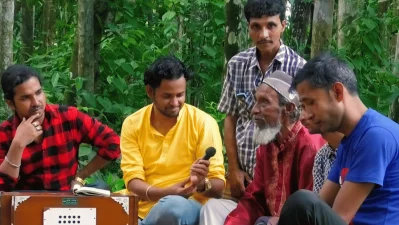
Since his early teens, Khuaj developed a fascination for musical instruments like the flute and the Dotara (a two-stringed homegrown musical instrument), and he used to make his own Dotaras. In 1962, when he finally approached legendary folk maestro Durbin Shah for mentorship, Durbin inquired whether he had any poetic talent. He answered in the negative but said he had a thirst for music. Eventually, Khuaj would write hundreds of lyrics, many of them blending Sufi mysticism and devotion to the Creator as guiding themes.
In the 1960s, when both Durbin Shah and another maestro, Shah Abdul Karim, were on an epic musical journey to the United Kingdom amidst widespread receptions, Khuaj was busy honing his own musical pedigree while staying at the home of his ustad, Durbin Shah. During that time, Khuaj started lending his voice to maljora (a musical debate competition between two performers, a popular format in the Sylhet-Mymensingh belt) and earned a name for him as a maljora performer.
As the son of a Maulvi (religious scholar), Khuaj was discouraged by many village guardians from indulging in music. Throughout his journey, however, he successfully and consciously managed not to give up his passion for music, while also not abandoning his religious obligations. He maintained a fine balance and consequently remained lovable to everyone in his extended neighborhood. Even before urban elites became acquainted with his creations, his musical numbers used to feature exclusively in village folk fests in greater Sylhet region. His compositions heavily featured themes of humanity, spiritual devotion, and self-realization, and his lyrics are known for the simple phrasing.
For example, in Lagaiya Piriter Duri, Alga Thaki Tanere, Amar Bondhu Moha Jadu Jane, the full lyrics roughly translate into English as follows:
“Tying the string of love, he draws me close from afar,
My friend possesses great magic, Oh, he knows magic, he knows magic,
My friend knows great magic.
Looking up at the golden moon, whomever he casts his eyes upon,
He works his magic without a spell, using the arrows of his two eyes.
The moon-like glow of beauty is on my beloved's face,
Whoever sees it wants to lose their senses and be with him.
With a flute in hand, a crown on his head, and anklets on both feet,
Khuaj Mia becomes mad at the melody of the Kala’s flute,
Oh, my friend knows great magic.”
In his lyrics, Baul Khuaj Mia uses the metaphor of human romance to express divine love and spiritual devotion. Here, the ‘friend’ or “Kala” (literally ‘the dark-skinned one’) represents the divine Creator or a spiritual guide, often personified as Krishna in folklore. The "string of love" represents the invisible, magnetic pull of spirituality that draws a human soul toward the divine. Unlike worldly magic that requires complex rituals or spells; divine beauty and love capture the human heart effortlessly through a single glance or a beautiful melody.
The references to “going mad,” the ‘crown,’ or the ‘flute’ all symbolize spiritual awakening. Hearing the divine call (the flute) makes the seeker forget the material world entirely. The lyricist names himself—Khuaj Mia—at the end to show his own complete surrender, acknowledging that he had willingly lost his mind to this divine love.
Such messages of spirituality, love, and empathy can be found in many other creations of Khuaj Mia. In another popular lyric—Amar Bari Ayre Bondhu Amar Bari Aye—he applied the traditional Radha-Krishna style spiritual folk genre, where the devotee (symbolized as Radha spreading her saree) eagerly awaits the arrival of the divine beloved (Krishna), completely untroubled by the hardships (‘mud and rain’) of the worldly path. A translation of this piece looks like the following:
“Come to my home, oh friend, come to my home,
Your world-enchanting beauty soothes my soul when I look at you.
On the path to my house, my friend, there is mud and rain,
Knowing you will come, I have spread the veil of my saree on the road.
I have laid out a bed of flowers, it is all for your sake,
I will rest you on the couch and fan your weary body.
Your world-enchanting beauty soothes my soul when I look at you,
Come to my home, oh friend, come to my home.”
