Char Nangulia is a riverine island in the mouth of the Meghna river in coastal Bangladesh. Just 20km away from Noakhali town, it is home to a thriving community of more than 60,000 people.
During a visit to the Uttar Mohammadpur village on the lush green island during an autumn morning, several women were found sitting in a circle, engaged in an animated discussion in the front yard of a tin-roofed house.
Speaking to the Dhaka Tribune, the women shared some interesting insights into the social hierarchy of the island, revealing that most families in Char Nangulia are led by matriarchs.
In a study published by the World Economic Forum, Bangladesh yet again topped South Asia in terms of gender equality. However, the advancement of women is still quite slow due to the patriarchal social structure of Bangladeshi society.
However, the female villagers of Char Nangulia are respected as much as their male counterparts in the island, and are confidently leading their households in many cases, a sign of female empowerment and economic emancipation.
Nurjahan Begum, 40, initially faced a lot of challenges when she relocated to Char Nangulia. The island was infested with river pirates that extorted money from settlers, and attacked those who could not pay the ransom.
Many young men left the island, but the women living there persisted against all odds.
“There were pirates that attacked us for money, and even coerced the men to join their ranks. Under the circumstances, many fled the island, including my husband. But, we [the women] stayed here and struggled to establish ourselves,” said Nurjahan.
Nurjahan and many other women such as Saleha Begum, Rozina Akter and Jarina Khatun banded together and fought for survival on the remote island.
“Our persistence paid off in the long run. Local law enforcement and several non-government organisations (NGOs) took notice of the situation and came forward to offer their support,” she added.
The rise of Char Nangulia
Char Nangulia first emerged from the Meghna River nearly two decades ago. Many people arrived on the island to settle with their families, the majority of whom were people who had recently lost their homestead in river erosion in different parts of Hatiya Upazila under Noakhali district.
The island was initially at the mercy of natural disasters, and was frequently flooded by saline water. After the intervention of NGOs, the people of the char took up forestation to protect the area from climate complexities, with the women playing a leading role.
In 1994, the government launched an initiative titled “Char development and Settlement project (CDSP)” to develop coastal islands, aiming to reduce poverty and create employment.
Char Nangulia was brought under the CDSP-4 project in 2011.
The CDSP project in Nangulia is being co-financed by the Bangladesh government, the government of Netherlands and the International Fund for Agriculture Development (IFAD).
The total cost of the project is Tk687 crore, and IFAD is contributing around Tk364 crore, which is 53% of the total cost.
The CDSP-4 project is being implemented jointly by the six public departments of the Bangladesh government, with the support of four local NGOs-- Brac, Society for Development Initiatives SDI, Dwip Unnayan Sangtha (DUS) and Sagarika Samaj Unnayan Sangtha.
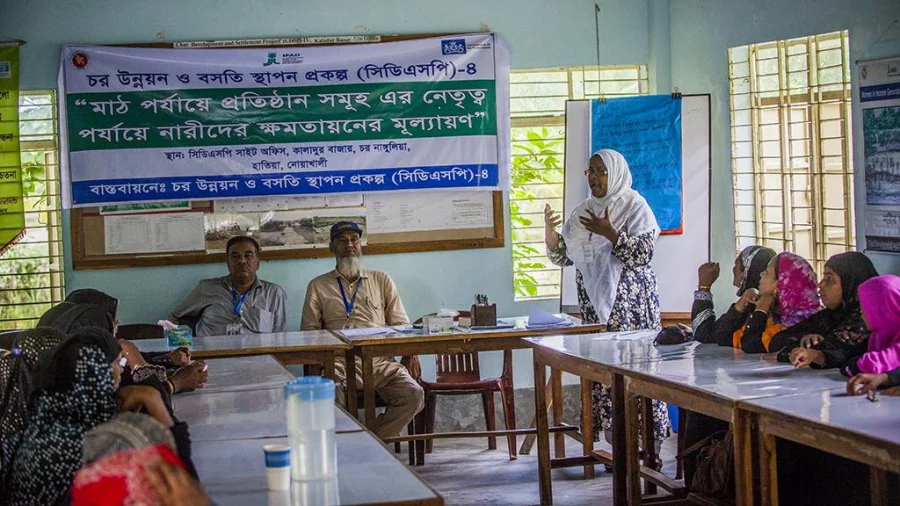
The site of gender development training at the CDSP IV office in Kaladur Bazar, Char Nangulia, Hatiya. As part of the Gender Action Plan, the goal of this training is to make stakeholders more gender sensitive and to ensure sufficient women participation in the field level institutions established by the project, such as the farmers forum, water management group, social forestry group, etc
The island is becoming a lush green settlement through innovative cultivation and farming carried out mostly by the women, with support from the NGOs.
Aside from the agricultural sector, the women of the village are also helping with the construction of roads, culverts and other infrastructures. Some of the women have also launched small businesses on the island.
Saleha Begum, another villager in Char Nangulia, told the Dhaka Tribune of her struggles and successes on this island.
When she relocated to Char Nangulia with five members of her family, her husband couldn’t accompany her because he had been targeted by the pirates who held sway in the area. She built her life on the island by joining forces with other women here.
Saleha’s eldest son is now a higher secondary level student studying at Chittagong Mohsin College, while another son is studying at a madrasa. She also married off her two daughters with her income alone.
But what is the secret behind her success?
Saleha said she took out a loan from an NGO, and established a poultry firm. She now earns around Tk10,000 per month.
“Many families of the Nangulia village have received micro credit, which made a positive impact on their livelihood. The NGOs formed a group to offer financial support to villagers for raising livestock, establishing poultry farms, small businesses, shops and for agriculture,” Jannatul Nayem, NGO sector specialist of the CDSP-4 told the Dhaka Tribune.
“The NGOs also offered training to the villagers, and loan recovery rate is 100% in the village.”
Equal rights, equal pay
Char Development and Settlement Project (CDSP) has a Gender Action Plan, aimed at ensuring empowerment and economic progress of women. There are regular gender development trainings to make stakeholders more gender sensitive and to ensure sufficient participation of women in the field level institutions established by the project, such as the farmers forum, water management group, social forestry group, etc.
CDSP officials have launched labour contracting societies (LCS) in Nangulia. Under the LCS, landless and extremely poor groups are getting work in development projects such as road construction and re-excavation of canals. Both men and women can choose to work in these projects under a fair and equal wage policy.
The CDSP authority has also introduced regulations aimed at strengthening women’s rights regarding land ownership.
It is now mandatory for a man to register his wife’s name in legal documents, making women the 50% owner of any land owned by their husbands.
“We handed over land to settlers, following an extensive plot-to-plot survey for identifying land plots and their current occupants,” Land settlement adviser Rezaul Karim told the Dhaka Tribune.
He added: “Then we organised public hearings to hand over the land to the actual landless household. To encourage women empowerment, we made it mandatory to register the names of both wife and husband in legal documents and in the digital land record management system.”
“When we introduced equal rights to the land, the divorce rate dropped and we hope it will be close to zero within a few years,” said Kiron Sankar Sarker, Monitoring Evaluation and acknowledgement adviser of CDSP.




