It was just another day at the North House of Dhaka University’s Jagannath Hall. Most students were either in classes or taking afternoon naps.
A scream for help pierced the silence. It came from the stairway of the second floor.
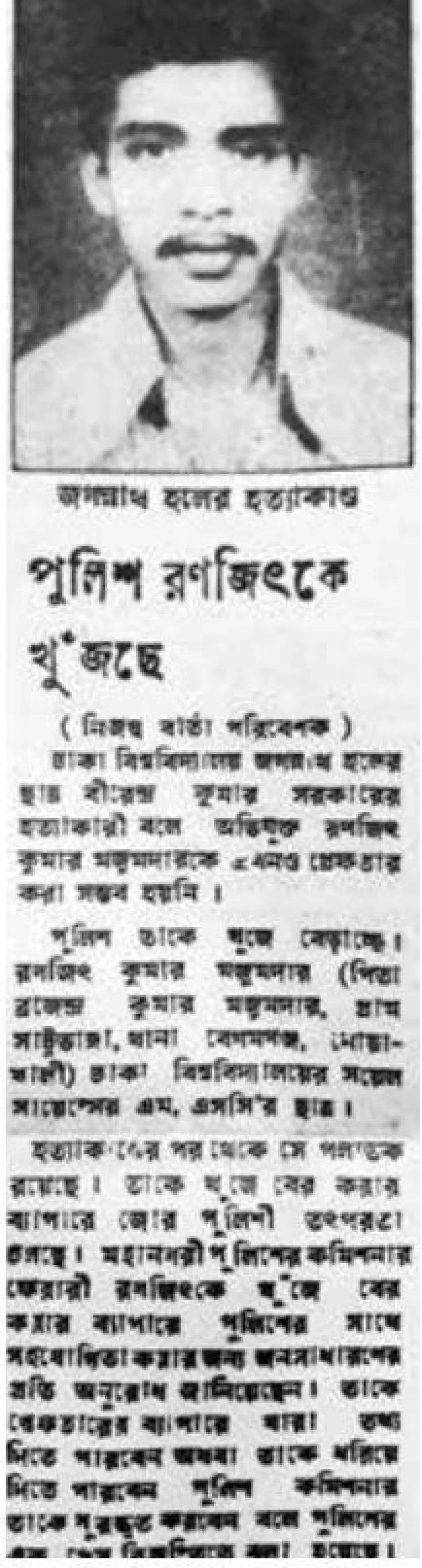
Students who rushed there found geology department MA student Birendra Kumar Sarker lying in a pool of blood. Before Birendra succumbed to his injuries at the Dhaka Medical College Hospital, he said that he was stabbed by his friend Ranjit Kumar Majumder, an MA student of soil science.
The incident on the afternoon of September 27, 1977, triggered a massive protest on the Dhaka University campus. Chhatra League and Chhatra Union held demonstrations as Geology department mourned Birendra’s death.
A case was filed with Ramna police but Ranjit had fled the country. Police announced a bounty on his head.
During their investigation, police learned that Birendra was killed in a feud over a love triangle.
The murder case has been pending at a Dhaka court since 1988, making it one of the oldest unresolved criminal cases in the country’s judicial system.
Non-appearance of witnesses and the plaintiff has stalled the trial since February 22, 1988. The latest date of hearing was on November 26, 2017
Rakhal Das, a ward boy of the North House in 1977, has vague recollections of the incident.
“Nobody saw the murder take place. We were on duty but went back to our quarters for lunch. Someone informed us that there had been a murder on the second floor. When I arrived at the hall, I saw the students taking Birendra to the hospital,” he told the Dhaka Tribune recently.
Rakhal, now in his 80s, recalled that Birendra lived in room number 157 on the second floor.
“The room was sealed off after the murder,” he said. “Japabrata Chowdhury (a house tutor of the hall and acting chairman of statistics department) filed a case over the incident.”
The love triangle
Ranjit had an affair with Dhaka University student Shikha Rani.
But Shikha got involved with Birendra, a close friend of Ranjit’s. Police described Birendra as a meritorious student and a handsome young fellow.
Ranjit was irked and planned to kill his friend. He called out Birendra and stabbed him indiscriminately on September 27, 1977.
While there were no witnesses to the actual stabbing, Birendra named Ranjit as the attacker before his death.
Police have interrogated Shikha but did not make her a witness in the case.
New twist as trial starts after 11 years
It took nearly 11 years for the trial to finally start.
A Dhaka Court framed charges against lone accused Ranjit in the murder case on February 22, 1988.
But non-appearance of witnesses and the plaintiff has stalled the trial since then. The latest date of hearing was on November 26, 2017.
Md Khorshed Alam, the investigation officer of the case, who is now retired, appeared before the court to testify three years ago. But due to an unexpected setback, the public prosecutor could not present the case dockets before the court.
The court, however, fixed a date to produce the dockets. But later the Deputy Commissioner (prosecution) Mohammad Anisur Rahman of Chief Metropolitan Magistrate Court wrote the court that they had “failed to find the old docket” in record room.
“In all these years, places for preserving case dockets have been shifted several times. This one might never be found,” Rafique Uddin Bacchu, the special public prosecutor of Special Judge Court 3, told the Dhaka Tribune.
He said that the trial would not end if the dockets were lost.
The court issued a show-cause notice to the prosecution team for their failure to find out the dockets.
The plaintiff’s gone, so are the witnesses
Japabrata Chowdhury, the case’s plaintiff, left the country in 1989, a year after the trial started. Police went to his village home in Chittagong in 2014 at the court’s behest.
In June that year, the court warned that it would dispose of the case without recording the deposition of remaining witnesses if the prosecution failed to produce the plaintiff.
The prosecution and the concerned parties will be responsible for whatever the outcome of the case is, the court had said.
Shahbagh police in August 2014 informed the court that Japabrata had gone to the US on education leave and joined Johns Hopkins University Baltimore, Maryland. He had settled there permanently with his family.
The court had recorded depositions of two prosecution witnesses in August 2009, three decades after the murder.
Witness seemed unwilling to testify even though the court had issued non-bailable warrants against the seven witnesses.
Of them, Sajal Kanti Mandal, who was a professor of Kustia Government College, and Ashish Kumar Paul, a government official, had testified before the court in 2009. They were Birendra’s friends.
The trial continues
On September 22 last year, Judge Abu Sayed Diljar Hussain of Special Judge Court 3 deferred the trial date to January 21, 2018.
An analysis of the case dockets revealed that the court has continued with the case proceedings for 230 days so far. The prosecution filed time petitions on every hearing date as they failed to produce witnesses.
Over the years, at least 22 judges conducted the case’s trial while the number of public prosecutors dealing with it was also 22.
Ranjit, the lone accused is the son of Dr Brajendranath Majumder, hailing from Setubhanga village of Noakhali’s Begumganj Upazila.
He reportedly fled to India after the murder. All the members of his family joined him in India in 1987, a year before the trial had started.
Meanwhile, the family members of victim Birenda, son of Bajendra Kumar Sarker of Kartikpur village under Dhaka’s Doha thana, have been untraceable.




