




Bangladesh’s prominent Bengali and English daily newspapers are currently struggling with a staggering backlog of unpaid advertising bills totaling more than Tk209 crore.
These outstanding payments, owed by both government agencies and private organizations, are raising urgent concerns about the financial sustainability of newsrooms and the preservation of editorial independence across the country.
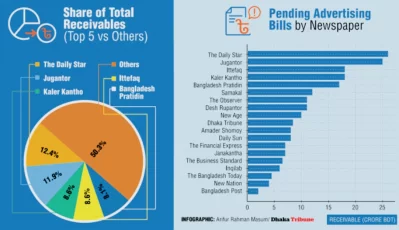
Industry data compiled from 19 leading broadsheet dailies shows that Tk122 crore remains unpaid to Bengali newspapers (excluding Prothom Alo, which did not disclose figures), while English dailies face arrears of approximately Tk87.4 crore.
Among individual newspapers, The Daily Star leads with Tk26 crore in dues, followed closely by Jugantor at Tk25 crore, while both Kaler Kantho and Ittefaq each have pending bills worth Tk18 crore.
Other dailies such as Bangladesh Pratidin (Tk17 crore), Samakal (Tk12 crore), Desh Rupantor and The Observer (Tk11 crore each), New Age (Tk. 10 crore), Dhaka Tribune (Tk8.4 crore), Daily Sun and Amader Shomoy (Tk8 crore each), Janakantha and Financial Express (Tk7 crore each), and Inqilab (Tk6 crore) are also burdened with significant arrears.
Advertising revenue remains the lifeblood of newspapers in Bangladesh, with major contributions coming from government ministries, state-owned enterprises, banks, telecom firms, and real estate developers.
Prolonged delays in clearing these bills, often tied up in bureaucratic red tape or stalled by corporate payment processes, are severely straining media houses’ cash flow.
Industry insiders warn that sustained payment delays are forcing newspapers to implement cost-cutting measures, postpone staff salaries, and reduce investment in investigative journalism and field reporting.
Challenges in meeting operational expenses such as printing, distribution, and staff payments threaten the overall quality and independence of journalistic work.
As unpaid advertising dues continue to mount, stakeholders are urging government bodies and private advertisers to take prompt action to ensure the financial health and editorial freedom of Bangladesh’s newspapers.
When asked, an editor of a leading Bengali newspaper told Dhaka Tribune on Friday that pending advertisement bills keep newspapers under constant financial pressure, which affects their overall operations.
That editor, requesting anonymity, also suggested that the government strengthen its regulatory authorities to scrutinize the advertisement disbursement process, ensuring that newspapers with little or no real circulation do not receive disproportionate advertising compared to those with large readerships.
“It is a big challenge to determine which newspaper should receive government advertisements and which should not,” the editor said.
Speaking to Dhaka Tribune, Shamsul Huq Zahid, editor of The Financial Express and member of the Media Reform Commission, said: “We have made recommendations to address this issue in our media commission report and have raised it several times while talking with two Information Advisers of the Interim Government.”
Zahid, who is also a member of the Editors’ Council, further said: “Newspapers have never been in such financial distress before. Most of them are now struggling with a financial crisis because government advertising has decreased by 30 to 40 percent, along with private advertising.”
In its report submitted to the Prof Yunus-led transitional government, the media reform commission also drew attention to the fact that the advertisement bill rates remained low and had never been revised or revisited in the last 10 years.
The report also recommended reconsidering advertisement rates separately for English and Bangla language papers as circulations of different language papers aren’t comparable in a newspaper market where news consumers’ natural preference in reading vernacular dailies is predominant.
Reason behind the backlog
According to media insiders, government agencies are responsible for most of the pending bills due to their lethargic payment system, which can take years to clear.
The Department of Films and Publications (DFP), the central body providing government advertisements to newspapers, currently has around Tk36 crore in pending bills. Most of this debt relates to supplement advertisements from 2011 to 2022.
“DFP had due bills of more than Tk70 crore. Recently, in June 2025, they cleared almost half of the pending advertisement bills owed to newspapers,” said an official of the Ministry of Information, requesting anonymity.
“The problem is that there is no central database for pending government advertisement bills, except for DFP and a few organisations. Almost every government office—from upazila to district level—issues advertising work orders. Only that particular office knows how many pending bills they have, and there is no record at the parent ministry. When yearly budgets are released, some dues are cleared but new ones pile up. This is the common practice in government advertisement payments in Bangladesh,” said the CFO of a newspaper.
A senior marketing manager of a daily newspaper said that due to fabricated circulation figures, they often have to compete with many listed newspapers for government advertisements, even though many of these outlets are not in regular operation.
“A listed newspaper without regular circulation and only sample publications often receives nearly equal treatment as a mainstream newspaper with regular readership. This is a big challenge for us,” the manager said.
Speaking to Dhaka Tribune, Golam Rahman, one of the senior-most retired professors of the Mass Communication and Journalism Department at the University of Dhaka, said most newspapers in Bangladesh rely on government advertisements, as private-sector advertising is insufficient.
He pointed out a major problem with the DFP’s media list, saying that many listed newspapers are not in regular publication, yet mainstream outlets must compete with them for government ads.
“This is not easy to fix under the existing system, so almost every newspaper suffers. The government should allocate advertisements based on actual circulation numbers,” he said.
Golam Rahman, who also served as editor of a mainstream Bengali daily, added: “Due to the pending advertisement bills, the backbone of newspapers has collapsed, and some can no longer publish properly.”
He suggested that the government regularize advertisement payments based on category, circulation, and quality of newspapers to give the industry much-needed relief.
