



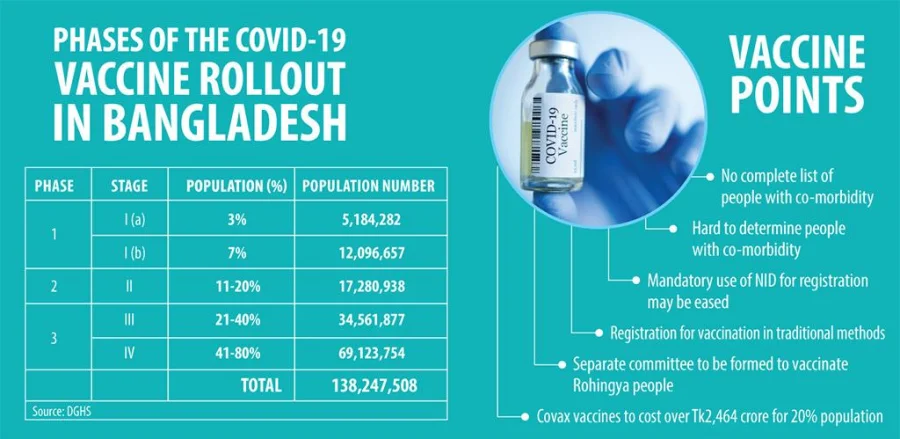
The government has decided to vaccinate people according to their age, prioritizing it over co-morbidity, even though most of the patients who died of Covid-19 in Bangladesh had co-morbid conditions.
The decision was announced at a virtual panel discussion organized by Bangladesh Health Watch (BHW) on Monday.
During the discussion, IEDCR adviser Dr Mushtuq Husain said: "Selecting people with co-morbidity is a difficult and complex procedure. That is why, as per the latest decision, we [the authorities] are going to vaccinate using age criteria."
However, in the draft of the National Vaccine Deployment Plan, vaccinating people with co-morbidity had been prioritized.
Co-morbid conditions include cardiac problems, high blood pressure, kidney disease, cancer and diabetes, according to the Institute of Epidemiology, Disease Control and Research (IEDCR), under the Directorate General of Health Services (DGHS).
A study, published in October last year by the National Institute of Preventive and Social Medicine (NIPSOM), said around 80% of the patients in the country, who died of Covid-19, had diabetes, lung diseases and hypertension – the top three factors for the fatalities.
Meanwhile, the DGHS daily press release said around 58% patients aged above 60, died of the deadly disease.
Dr Mushtuq Husain, who is former principal scientific officer (PSO) of IEDCR, said although the authorities had made it mandatory to use NID information for online vaccine registration process, it would be eased during the procedure as it could cause technical hazards.
"The registration procedure will follow previous vaccination registration methods," he added.
He also said a person would be vaccinated once he/she gave consent for it.
An individual has to stay at the vaccination camp under observation for at least 30 minutes to determine if he/she has any adverse impact, the former PSO said.
He said the government had built a framework mechanism to monitor the condition of the vaccinated people.
In his presentation, Dr Mushtuq mentioned that the government had to pay $2 (Tk170 approximately) for each shot of the vaccine from the Covax program, an initiative co-led by The Vaccine Alliance, Gavi, the World Health Organization (WHO), and the Coalition for Epidemic Preparedness Innovations (CEPI).
The operational cost of the vaccine would be another $2, he said.
The Covax program would provide vaccines for 20% of the total populations (estimated over 34 million people).
For receiving further vaccines, depending on availability, the Bangladesh government would need to pay $5 (Tk425 approximately) for each dose, he added.
According to the IEDCR adviser, the government has to spend $290.3 million, or more than Tk2,464 crore, to vaccinate the 20% of the population.
Dr Mushtuq also stated that a separate committee would be formed to vaccinate the forcibly displaced Rohingya people from Myanmar.
Ensuring equity in the vaccination program urged
In the program, speakers also voiced for ensuring equity in the vaccination program.
Unicef Consultant Engineer Md Hamidul Islam said ensuring an organized, effective distribution of Covid-19 vaccine could prevent huge wastage.
In the discussion, Action Aid Bangladesh Country Director Farah Kabir urged the authorities to address discriminatory practices in a dispensation of the vaccine.
Corruption related to vaccines must be checked, she added.
Barrister Rashna Imam, managing partner of Akhtar Imam and Associates and also a member of Advisory Group of BHW, Dr Shafiun Shimul, associate professor of the Institute of Health Economics, Dhaka University, and Dr Rubaiul Murshed, founder of Shomman, were the panellists among others.
