



Dhaka wakes each morning under a pale layer of dust and haze. In winter, the Air Quality Index often climbs above 200, well beyond the threshold of 100 that is considered unhealthy, and the city’s readings frequently violate World Health Organization (WHO) air quality guidelines. The skyline shimmers under rising heat. Dhaka is widely described as a classic urban heat island, where temperatures in the city’s core can vary by several degrees Celsius compared to its outskirts. These rising temperatures contribute to more frequent and intense heat waves, posing significant health risks, particularly for vulnerable populations such as children and the elderly. The United Nations Environment Programme suggests that an ideal city should have at least 25 percent green space, yet studies indicate that central Dhaka holds only around 2 percent forest cover and roughly 7 to 8 percent general greenery. In a place where balconies replace backyards and rooftops substitute for parks, the absence of green feels both visible and intimate.
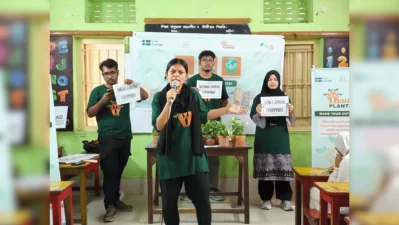
It was within this landscape that two undergraduates, Shahana Alam, pursuing a Bachelor of Architecture (B.Arch) at Bangladesh University of Engineering and Technology (BUET), and Tazrian Rahman, studying Geography and Environment at Jagannath University, began to imagine something different. As Fellows of ICCCAD 2025 and winners of the Youth Innovation Fund supported by ICCCAD and the Embassy of Sweden, they chose not to respond to Dhaka’s environmental reality with grand speeches or dramatic campaigns. Instead, they asked a simple question: what if climate action could begin inside homes and classrooms? Their answer took shape as Dhaka Planters, a youth-led initiative designed to make urban tree plantation practical, informed, and accessible for ordinary residents, especially in the dense neighborhoods of Old Dhaka, where open space is scarce and concrete dominates the skyline.
The project unfolded gently but deliberately between May and December 2025, mostly across Old Dhaka. Before speaking to students, Shahana and Tazrian visited local nurseries to understand which plants were actually available in the city’s markets. They discovered abundance but also confusion. Many people wanted to grow plants yet lacked clear guidance about species suitability, sunlight needs, or maintenance in small urban spaces. So they built a digital platform featuring detailed information on 82 plant species suited to Dhaka’s environment, offering residents a simple, science-based guide to indoor and outdoor gardening, one that quietly links tree plantation with carbon footprint reduction and improved indoor air quality. Alongside this, they entered classrooms at institutions such as Silverdale Preparatory & Girls’ High School in Wari, Dhaka Govt. Muslim High School in Laxmibazar, The Manchester School on Larmini Street, Progose Laboratory School and College on Chittaranjan Avenue, and Dr. Mahbubur Rahman Mollah College in Demra. They spoke with students about air pollution, rising temperatures, and the quiet power of trees. They did not present climate change as a distant global crisis, but as something visible in the air they breathe and the heat they feel.
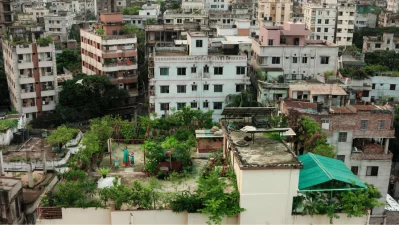
By the end of their school campaigns, 367 students had been directly engaged, often exceeding their initial target of 50 participants per school. Their website drew 1,424 users seeking practical advice, while a social media community of more than 9,700 people followed and shared the message. Yet the true measure of Dhaka Planters cannot be captured by numbers alone. It lives in small shifts: a student convincing their family to place a plant on their balcony, a classroom calculating its carbon footprint with new curiosity, a rooftop slowly turning green. Shahana and Tazrian never claimed to transform the city. They simply planted knowledge where they could. In a dense, overheated capital with limited green cover, that quiet persistence feels like its own kind of climate action, rooted, patient, and growing.
