



The phrase “Just Transition” has traveled a long way. What once belonged to activist spaces and labor movements now sits at the center of global climate negotiations. But beyond the jargon, the idea is straightforward. As economies move toward low-carbon and climate-resilient systems, the shift must be fair. Workers must be protected. Inequality must shrink, not widen. No community should pay the price for progress.
Still, the meaning of Just Transition changes depending on where you stand.
In many parts of the world, the focus is on phasing out coal plants or protecting industrial workers. In Bangladesh, the conversation feels more urgent and more personal. Here, transition is not just about decarbonization. It is about survival. It is about rising seas, saltwater creeping into farmland, unbearable heat, and families forced to move because their land can no longer sustain them.
In Bangladesh, Just Transition touches agriculture, fisheries, informal labor, renewable energy expansion, and urban migration all at once. It affects rural women managing climate-stressed crops, coastal families adjusting to salinity, and young people trying to find a place in emerging green sectors. If Just Transition is going to mean something here, it must reflect these layered realities.
And yet, one of the country’s most powerful climate solutions remains underinvested and underrecognized.
It's women.
At COP30 last year. I attended a panel as a panelist, titled Youth-led Pathways for a Just Transition: Skills, Jobs, Gender and Social Inclusion in Bangladesh, at the Just Transition Pavilion. Which organized by the International Labour Organization. The discussion revolved around skills, employment, and how Bangladesh can prepare its workforce for a green future without deepening inequality.
From a skills and technology implementation perspective, I kept returning to one point: if we do not deliberately invest in women, the transition will simply reproduce the same inequalities under a greener label.
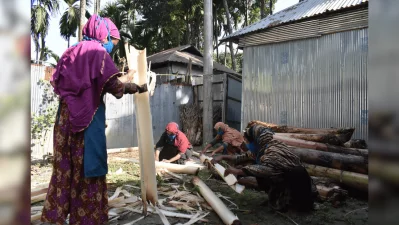
Women in Bangladesh are not spectators in the economy. They manage household energy use. They decide how cooking fuel is sourced. They ration water during shortages. They stabilize food systems. They hold informal markets together. During climate shocks, they absorb the first and longest impacts.
If Just Transition is truly about not leaving anyone behind, then women cannot be framed as vulnerable beneficiaries waiting for inclusion. They must be recognized as economic drivers of change.
The renewable energy sector offers a powerful starting point. As solar home systems, mini-grids, and clean cooking technologies expand, so does the opportunity for women to step in as entrepreneurs, technicians, and distributors. Women-led renewable businesses can reach communities where centralized systems never fully arrive.
But opportunity alone is not enough. Without structured training and access to technical education, green jobs will remain out of reach. At COP30, the word “skills” surfaced again and again. A green transition demands a reskilled workforce. If women are excluded from training in climate-smart agriculture or green manufacturing, they will be locked out of the industries shaping the future.
Targeted training changes that equation. When women gain technical skills and earn income through green enterprises, the impact multiplies, income flows back into children’s education, family health, and community stability. The benefits extend far beyond individual households.
Also, in climate-vulnerable regions, women already act as informal adaptation planners. They understand seasonal shifts. They know which water sources survive dry months. They adjust planting cycles based on experience, not spreadsheets. Integrating this lived expertise into local planning processes would dramatically improve adaptation outcomes.
Just imagine a community adaptation committee led by women who have navigated floods, salinity, and livelihood disruption firsthand. Policies would feel less abstract and more grounded in reality.
Then there are green supply chains. From climate-resilient farming to fisheries and circular economy initiatives, women are already embedded in value chains. With better access to markets, digital tools, and finance, they can move from low-value labor roles to leadership positions.
A woman engaged in climate-resilient farming should not remain invisible in the supply chain. She can lead cooperatives, manage distribution networks, and access higher-value markets. A woman working in fish processing can expand into branding, packaging, and sustainable certification. These shifts are not symbolic. They are structural.
But we have to keep in mind that potential does not unlock itself. Structural barriers remain real. Access to finance is limited. Technical training opportunities are uneven. Land ownership constraints persist. Market networks often exclude women from scale.
And microcredit alone will not solve this. Women climate entrepreneurs need growth capital, mentorship, and risk-sharing mechanisms. National climate strategies must intentionally integrate gender-responsive economic frameworks. Inclusion cannot be assumed. It must be designed.
The economic logic is clear. When women participate fully in green industries, productivity increases. Innovation improves. Communities become more resilient.
Picture a Bangladesh where women run solar cooperatives in rural districts. Where climate-resilient agricultural enterprises are led by female entrepreneurs. Where local adaptation plans are drafted with women at the decision-making table. Where girls studying STEM step confidently into clean technology industries.
We have to remember that the capacity already exists. What remains is the willingness to invest deliberately.
A transition cannot be just if half the population remains underfunded and undervalued. But if women are positioned as entrepreneurs, planners, innovators, and leaders, Bangladesh’s green transformation can move faster and stand stronger.
Unlocking the power of women is not an optional add-on to climate policy. It is the foundation of a transition that is truly fair. And the women of Bangladesh are not waiting to be included.
