



We have grown up watching our mothers and grandmothers plant vegetables and fruit trees around the house. They used cow dung, compost, and leftover kitchen scraps as natural fertilizers. Long before “organic farming” became a development buzzword, rural women were already practicing it. I have seen my own mother working in open fields, growing vegetables on barren land, and turning it into something alive. These everyday practices, often dismissed as domestic labour, quietly sustain biodiversity, food security, and ecological balance.
Women’s relationship with nature is not merely symbolic; it is lived and embodied. Their daily interaction with soil, water, crops, and seasonal cycles places them at the frontline of environmental change. Women’s biological rhythms, including menstruation, are influenced by environmental conditions. When climate patterns shift, women feel it first, through water scarcity, declining harvests, food insecurity, and even disruptions in their own biological cycles. Climate change enters their kitchens, their fields, and even their bodies. It is not gender-neutral, and neither is adaptation.
In rural Bangladesh, climate resilience does not begin in conference halls or policy frameworks. It begins in the courtyards of our houses.

During fellowship with the International Centre for Climate Change and Development (ICCCAD), I visited the Kuakata coastal region for fieldwork. Our first Focus Group Discussion was with local women. They spoke about the struggles of living with iron-contaminated and salty water. Many workers in agriculture stand for hours in water that is harsh on their skin and health.
They told us something that stayed with me. Because of working in salty water and facing poor nutrition, many were experiencing irregular menstruation, early menopause, skin diseases, constant tiredness, and weakness. Some felt embarrassed to even speak about it. Yet they continue working under the same conditions every day. Their families depend on that income.
This is what climate adaptation looks like in reality: women in coastal regions adapting through their own bodies. It is not always about new machines or infrastructure projects. Sometimes it is women silently pushing their bodies beyond their limits so their households can survive.
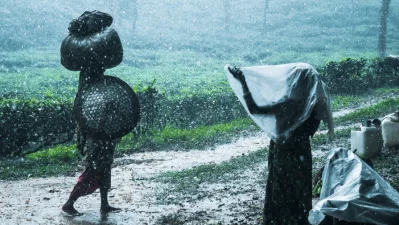
Statistics reinforce this reality. In developing countries like Bangladesh, women make up around 43 percent of the agricultural workforce. In rural communities, they grow food, save seeds, raise poultry, produce compost, and manage home gardens. Many women are involved in mushroom cultivation, rooftop gardening, and small-scale farming. These small acts help families earn money while strengthening local resilience.
Bangladesh offers powerful examples of women leading eco-friendly innovation.
In 2023, in Bandarban, the country’s first saree made from banana fiber yarn — Kolaboti Cotton Saree was created. Manipuri craftswoman Radhavati Devi transformed banana fiber into sustainable
fabric under the initiative of District Commissioner Yasmin Parveen Tibriji. It was not just about a saree. It was about reducing waste, merging climate-conscious innovation, while creating income opportunities for women.
Similarly, in Rangamati, Naiyu Pru Marma Mary from the Marma Indigenous community launched the production of “Prokriti,” an eco-friendly and reusable sanitary napkin made from processed banana fiber. For the first time in Bangladesh, banana plant fiber is being used to produce sanitary products. Its reusability reduces both environmental waste and menstrual vulnerability among women.
Beyond these examples, many women are engaged in producing handicrafts, such as bags, baskets, flower vases, pen holders, and household items, using bamboo, wood, and clay. These biodegradable products reduce waste, minimize carbon footprints, and strengthen community resilience.
These initiatives are not isolated stories of empowerment. They are structural responses to climate vulnerability, designed and led by women who understand local realities deeply. However, despite these contributions, women’s participation in climate governance remains structurally marginalized. Often, women are invited to panels but excluded from policy drafting. They are counted in attendance sheets but absent from budget allocations.
Policies concerning women’s health, land rights, livelihoods, and climate adaptation are frequently designed without consulting the very women who are most affected. Representation without decision-making power is not inclusion. This reflects a representational gap between participation and power.
If climate policy in Bangladesh and globally is to be effective, it must recognize women not as vulnerable beneficiaries, but as knowledge holders, innovators, and decision-makers. Climate governance must move beyond tokenism toward structural inclusion. Women need seats not just at the table, but in the rooms where final decisions are made.
The climate crisis is not only an environmental issue; it is a justice issue. And justice demands that those who bear disproportionate costs must also hold proportional power. Bangladesh’s courtyards, coastal fields, and hill tracts are already demonstrating what women-led climate adaptation looks like. The question is whether policy institutions are ready to catch up.
Women are not merely victims of climate change.
They are its first responders, and they deserve to shape the future they are fighting to protect.
