



Around this time of year, the mighty Padma still flows quietly past the Bhagyakul point in Munshiganj. After quenching my thirst with a glass of the region’s famous whey at Govind Sweetmeat in Bhagyakul Bazaar, I spent a few solemn moments by the riverbank. Under the shadow of ancient trees, cooling off from the scorching late-Chaitra heat, I reflected on the sprawling palatial houses of Zamindar Jadunath Roy I had just visited.
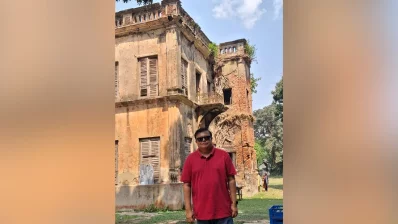
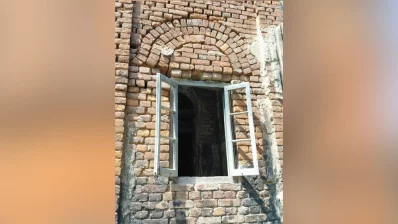
Jadunath Roy, a British-era landlord on whom the Raj conferred the title of ‘Raja’ for his contributions to the colonial economy and public service, built a magnificent estate at Balasur around 1900. The site features several Greco-style buildings, temples, and a vast dighi (pond).
To this day, he is remembered for his commercial success and the architectural legacy he left behind; the Bhagyakul Zamindars were, after all, among the wealthiest families in Bengal. A successful merchant, Roy traded betel nuts, salt, and sarees from Barisal to Murshidabad, and in 1907, his family entered the shipping business with the East Bengal River Steamer Company.
As I toured the estate last week, locals told me that since Raja Jadunath’s descendants left following the 1965 Indo-Pak war, the area has fallen victim to decadence and land-grabbing. Fortunately, a private initiative by the Agrasar Bikrampur Foundation in 2010 led the government to lease out the estate and its buildings to develop the Bikrampur Museum.
The Foundation deserves immense credit. Today, visitors can admire a wealth of historic and archaeologically valuable artifacts under the roof of one of the estate's converted buildings. However, the Foundation can no longer sustain the upkeep and routine maintenance of the entire legacy alone. The time has come for the relevant government authorities to step in.
At the estate’s entrance, a signboard from the Department of Archaeology is prominently displayed. Yet, upon my return, I spoke with museum curator Nasiruddin Jewel, who clarified the reality of the situation. “You must have seen the sign,” he told me. “Unfortunately, despite our repeated pleas, the department hasn’t actually taken charge. We are finding it increasingly difficult to manage the daily expenditures of the museum and the estate.”
Since 2012, numerous letters have been sent to successive governments seeking to cancel the lease and hand the museum over to the Department of Archaeology, but they have gone unheeded. It would be a great injustice if the government fails to protect this heritage—a site Dr. Humayun Azad once likened to ‘A Paris’ in the midst of Arial Beel.
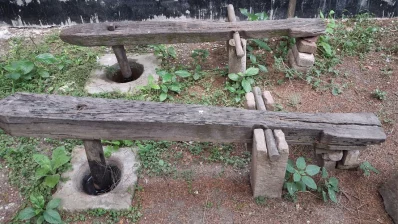
The distress is visible on the ground. The two caretakers who ushered me in bore looks of quiet exhaustion. Though they were eager to show me the collection, a deep sorrow sat behind their eyes. When asked, they revealed they hadn’t been paid properly for some time; the authorities had already been forced to let several colleagues go.
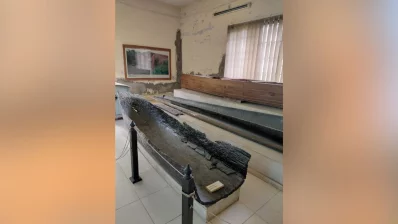
Inside the three-story museum, I was greeted by a traditional rice husker (dheki) and two large earthen pots (motka). Seven galleries showcase the region's history: the ground floor’s Jadunath Roy Gallery houses ancient maps of Bikrampur, terracotta toys, and relics, while the Sir Jagadish Chandra Bose Gallery displays basalt stone bowls and artifacts from nearby excavations.
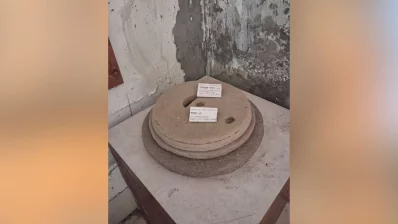
The first floor features a Liberation War Gallery alongside a section dedicated to famous personalities born in Bikrampur. It even holds the rare Bhurja Patra (birch bark) used for writing in ancient times.
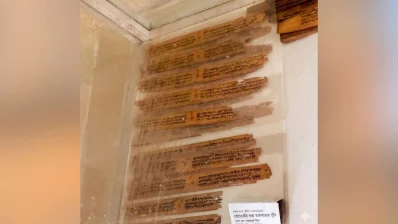
The top floor is a treasure trove of palm-leaf manuscripts, antique furniture, old currency, and charkas (spinning wheels).
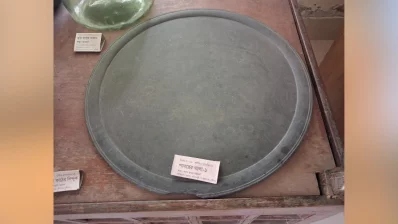
The Agrasar Bikrampur Foundation has done tremendous work in preserving these artifacts despite limited resources. But as I sat by the Padma before heading home, a worrying thought lingered: if the government does not take charge soon, this heritage site may perish through collective negligence.
With the soil of Munshiganj literally impregnated with the remnants of the thousand-year-old Bikrampur civilization, we must protect facilities like this so future generations can admire their rich inheritance.
