
 Meanwhile, others are worried about practical changes such as changing the spelling on their passports, NIDs etc., such as Tanvir Anik from Chittagong.
“We do not know if we need to change our National Identification Card and our passports. Chittagong is shown as my hometown in my secondary and higher secondary school certificates. I do not know whether I will be allowed to apply to foreign universities with my current documents.”
Chittagong University Vice Chancellor Prof Dr Iftekhar Uddin Chowdhury said the university will run according to the Chittagong University Act 1973 and that only after consulting with a legal advisor will they approach the subject of changing the name of the university.
However, the district administration sources said that there would not be any issues as a result of the spelling changes, as all kinds of government letters and documents are written in Bangla.
Meanwhile speaking about future academic certificates and passports, the Bogura Deputy Commissioner Nure Alam Siddique said: “I do not think people would need to change certificates and passports. When the spelling of the capital was changed from Dacca to Dhaka, people did not really have to suffer too much.”
When the Dhaka Tribune inquired about the cost of changing the names on documents, the DC said they have not received the legal notification from the government as yet and therefore could not give an estimate. The final implementation and cost will come from the ministries.
On April 2, the country woke up to the news that the names of five districts had been changed overnight.
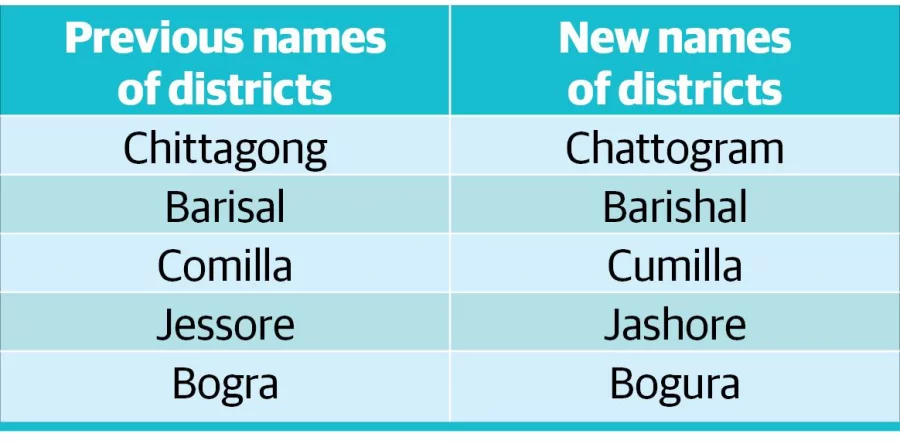
There was no prior indication that this was in the pipeline until only a few days prior to that, and suddenly Chittagong became Chattogram, Comilla became Cumilla, Barisal was changed to Barishal, Jessore became Jashore and Bogra was changed to Bogura.
A single decision of the government has made things potentially difficult for millions of people in these five districts, with inhabitants of these areas claiming it was done without any public demand for it whatsoever. The change will affect the people concerned in numerous ways, including in relation to schools, names of public institutions, addresses etc.
Dhaka University’s Professor Emeritus Serajul Islam said that there was no need to change the names of these districts and it was a big waste of money.
“Without any public demand, the decision taken by the government seems to me like a luxury for a country like Bangladesh. Besides, it would require a set of complicated steps to implement this decision,” he said.
A businessman from Comilla, Enamul Haque said he would have liked to have been asked before the names were changed through at least an opinion poll.
The government has said the names are a vestige from the colonial times and did not reflect the proper phonetic pronunciation of their names, to which Enamul argues: “There are a number of districts like Sylhet, Brahmanbaria, Lakshmipur and Mymensingh that are still spelled how the British spelled them. Had the government wanted to change the colonial names then they would have changed those too.”
But NM Ziaul Alam, the secretary of co-ordination and reforms at the Cabinet Division at a press briefing on Monday said that if the government deems necessary, then the remaining names of districts will also be changed gradually.
The University of Texas’s Bangla Lecturer Ahmed Shamim criticized the move in a Facebook post.
Citing Professor Glen Coulthard of First Nations Studies and Political Science at the University of British Columbia, Shamim wrote that decolonization without bringing changes in material condition was a liberal politics that actually served the colonizers.
“I consider such change by spending public money positively only when there are such public demand, otherwise it seems to be just an eye-wash,” he said in the post. Meanwhile, others are worried about practical changes such as changing the spelling on their passports, NIDs etc., such as Tanvir Anik from Chittagong.
“We do not know if we need to change our National Identification Card and our passports. Chittagong is shown as my hometown in my secondary and higher secondary school certificates. I do not know whether I will be allowed to apply to foreign universities with my current documents.”
Chittagong University Vice Chancellor Prof Dr Iftekhar Uddin Chowdhury said the university will run according to the Chittagong University Act 1973 and that only after consulting with a legal advisor will they approach the subject of changing the name of the university.
However, the district administration sources said that there would not be any issues as a result of the spelling changes, as all kinds of government letters and documents are written in Bangla.
Meanwhile speaking about future academic certificates and passports, the Bogura Deputy Commissioner Nure Alam Siddique said: “I do not think people would need to change certificates and passports. When the spelling of the capital was changed from Dacca to Dhaka, people did not really have to suffer too much.”
When the Dhaka Tribune inquired about the cost of changing the names on documents, the DC said they have not received the legal notification from the government as yet and therefore could not give an estimate. The final implementation and cost will come from the ministries.
Meanwhile, others are worried about practical changes such as changing the spelling on their passports, NIDs etc., such as Tanvir Anik from Chittagong.
“We do not know if we need to change our National Identification Card and our passports. Chittagong is shown as my hometown in my secondary and higher secondary school certificates. I do not know whether I will be allowed to apply to foreign universities with my current documents.”
Chittagong University Vice Chancellor Prof Dr Iftekhar Uddin Chowdhury said the university will run according to the Chittagong University Act 1973 and that only after consulting with a legal advisor will they approach the subject of changing the name of the university.
However, the district administration sources said that there would not be any issues as a result of the spelling changes, as all kinds of government letters and documents are written in Bangla.
Meanwhile speaking about future academic certificates and passports, the Bogura Deputy Commissioner Nure Alam Siddique said: “I do not think people would need to change certificates and passports. When the spelling of the capital was changed from Dacca to Dhaka, people did not really have to suffer too much.”
When the Dhaka Tribune inquired about the cost of changing the names on documents, the DC said they have not received the legal notification from the government as yet and therefore could not give an estimate. The final implementation and cost will come from the ministries.