




The Amar Ekushey Book Fair 2026 is ending on Sunday, and it is drawing to a close under a cloud of frustration and financial loss — the result of a delayed decision on timing, the holy month of Ramadan, and a last-minute rainstorm that dealt one final blow to publishers and participants.
Bangla Academy pushed the fair into existence this year almost by sheer force of will, navigating obstacle after obstacle.
Because a national election and referendum was scheduled for February 12, the interim government chose not to open the fair on its usual date, opting instead for an unusual window. Bangla Academy, facing pushback from publishers, initially announced February 20 as the opening date.
Publishers, however, were firmly opposed. Their position was clear: the fair should be held after Eid. Bangla Academy refused to budge — until a meeting with the Ministry of Cultural Affairs on the evening of February 18 changed things. A new decision emerged from that meeting: the fair would begin on February 25.
The meeting also brought one significant concession — stall rental fees would be waived entirely for all participating publishers. Those who had not yet secured a stall allocation for the 2026 fair were given until 3pm on February 19 to apply, with allocations to be announced the same evening at 6pm.
Shortly after, a bloc of around 350 publishers issued a collective ultimatum: they would boycott the fair unless pavilions held by previously favoured publishers were removed. Bangla Academy relented, ordering the pavilions dismantled and promising refunds to those who had paid but been unable to set up stalls.
That was the turbulent backdrop against which this year's fair finally opened.
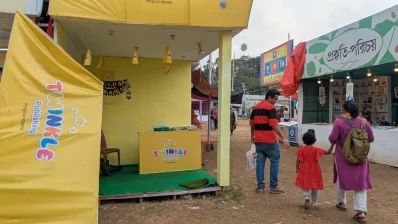
On Saturday (March 14), the fair's penultimate day, the scene on the grounds told a quiet story of disappointment. Book sales had picked up marginally, but foot traffic remained thin. Publishers noted that the number of new titles released this year was proportionally lower than any previous edition. Shyamal Pal, the owner of Puthiniloy Publications, put it bluntly: "Sales this year have been worse than any fair I can remember. We've sold maybe a tenth of what we sold last year. We won't even cover the wages of the stall staff, let alone our own expenses. Every publisher here has taken a beating — not a single one will break even."
Bangla Academy's own figures underscore the point. The 2025 fair saw 3,299 new books submitted. This year, only 1,337 were received — a dramatic drop. Fewer stalls, fewer books, fewer readers.
At a press conference held Saturday, the "Prokashok Oikya" laid out the scale of the damage. Sales in 2025 had already fallen roughly 60% compared to 2024, they said, due to political and economic instability. This year's fair has seen a further 80% decline compared to 2025. Overall, book sales are down approximately 70% against a normal year. The situation, the group said, is worse than the Covid-hit fair of 2021. Around 90% of participating publishers failed to recoup even their basic stall setup costs, and nearly 30% sold fewer than Tk5,000 worth of books.
And then, just as the fair was entering its final stretch — when a flurry of last-minute buying usually brings the grounds to life — the weather turned.
A sudden evening storm on Friday, with heavy rain and strong winds, swept through the fairgrounds and left chaos in its wake. By Saturday morning, the mood had shifted entirely. Where there should have been festivity, there was only anxiety and weariness on the faces of publishers. By Saturday, 157 new books had been logged at the information centre — a modest number for what is meant to be the country's largest literary celebration.
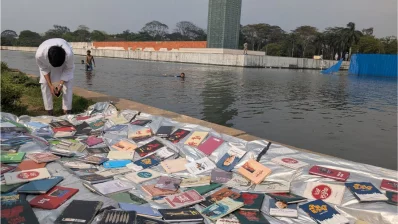
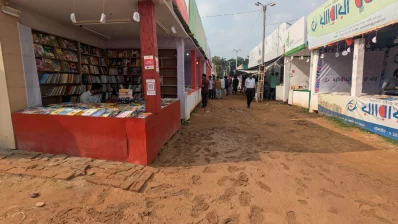
Walking through Suhrawardy Udyan on Saturday morning, the 17th day of the fair, visitors encountered a disheartening sight: mud and standing water in front of many stalls, and rows of rain-soaked books spread out on plastic sheets and tarpaulins to dry in the sun. The stalls along the lakeside were hit particularly hard.
A sales representative at the Chaman Prakash stall was laying out wet books beside the lake when he described his helplessness. "The rain last night was completely unexpected. I was the only one at the stall, so by the time I managed to move the books on my own, a lot of them had already gotten soaked. I can't give an exact number yet, but many are completely ruined — beyond saving."
Larger publishers managed to weather the situation with some difficulty, but for small and mid-sized publishers it was devastating. SM Jasim Bhuiyan of Priyo Bangla told this reporter with visible despair that at least 100 to 120 books at his stall had been completely destroyed. "The worst-soaked ones we're sending back to the press — there's no recovering those. Another 50 or 60 got partially wet; we've laid those out to dry. They might dry out, but the quality won't be the same."
Mahabub Rahman of Adarsha Prakashan, speaking on behalf of Prokashok Oikya, was pointed in his criticism: "It would be hard to say that everything possible was done in managing this fair. Even now, there's still standing water across the grounds."
Bangla Academy Director General Professor Mohammad Azam pushed back on that characterization. "There is no area between the main grounds and the lake where the water is actually blocking movement," he said, adding that mechanical pumping had continued through the night until 4:00 AM. "When I walked the grounds at 11 in the morning, there were a few spots that were difficult to walk through. But by 5 in the evening, the only place I found standing water was in front of Bidya Prakashan's stall — and I immediately had bricks laid down there."
