




While travelling through the Dhaka University campus, if one crosses the Bangla Academy premises and moves on towards Doyel Chattar, then one will arrive at the renovated Mir Jumla Gate or Dhaka Gate. Named after Subedar Mir Jumla of Bengal, this gate was built for the security of Dhaka 400 years ago. This beautiful architecture of the Mughal period was lost in the memory of time. Dhaka South City Corporation (DSCC) has brought back that establishment in a new form. Mir Jumla's cannon has also been installed to make the gate more beautiful.
During the reign of Islam Khan (real name: Sheikh Alauddin Chishti, 1570-1613 AD), there was a Mughal garden called Bagh-e-Badshahi in the Ramna area of Dhaka. There were two pillars at the entrance of Bagh-e-Badshahi. Later, the gate was rebuilt and named Dhaka Gate. During the Mughal period, this archway was the entrance to Dhaka through the Buriganga River. Later, people called it by various names, such as Mymensingh Gate, Dhaka Gate, and sometimes Ramana Gate.
Due to years of neglect, the gate gradually lost its beauty. The last traces of it started to disappear. Recently, the DSCC has taken various initiatives to make the nation’s capital a tourist-friendly city. As part of this initiative, renovation work started last year to bring back the historical Dhaka Gate to its beauty. Archaeology expert and faculty member of the University of Asia Pacific, Dr Abu Sayeed and his team, gave this new look to the gate. At a cost of Tk82 lakh, the renovation work was done under the leadership of Dr Sayeed.
Speaking to Dhaka Tribune, he said: “We have evidence that this gate was built during the time of Magistrate D'Oyly during the British period. Three parts of this gate can be seen now, but it was not like that in the beginning. Initially, the road was single-lane, so the gate had two parts. A part of the road was demolished when the road was widened into two lanes in the 1960s, during the Pakistan era. Part of the shrine of the three leaders was rebuilt. The pillar between the two roads is one of those broken parts.”
He said: “We have renovated it with the same materials as the original lime-plaster. Part of the original D’Oyly architecture and a portion from the 1960s have also been placed here. Mir Jumla's cannon from Osmani Udyan has also been re-installed."
While touring through the gate on Wednesday morning, it was seen that the gate has been returned to its original form in parts, and there is a beautifully designed square as well. There are also seating arrangements for visitors. However, it is not yet fully open to everyone. Several visitors were seen standing on the main road looking at the renovation work. They were photographing the architectural magnificence while looking around it. Especially Mir Jumla's cannon attracted more interest among the visitors.
Rabiul Islam, who is in charge of the security of the architecture, said: "Even though it was supposed to be officially opened on Wednesday, pedestrians and visitors have been coming here for the past few days. Although not allowed to come inside, many visitors come regularly to take pictures of this beautiful place. "
Historian Muntassir Mamoon also spoke to Dhaka Tribune regarding the gate. He said: "We have been agitating for the preservation of Dhaka's heritage for 50 years. These architectures are the life of Dhaka. But most of the structures are slowly disappearing. The current mayor has taken on a big project to protect the history and heritage of Dhaka. The work on Dhaka Gate has been completed. Northbrook Gate conservation work is currently ongoing. Hopefully, the city corporation will take more initiatives.”
History of Dhaka Gate and Mir Jumla’s cannon
There is debate among historians and archaeologists as to when and why the gate was built. But archaeologists believe that it was built during the Mughal period. According to “Dhaka Kosh” published by the Asiatic Society, Mir Jumla built the Dhaka Gate between the years 1660 and 1663 to mark the boundaries of Dhaka and protect it from enemy attacks by land. Mir Jumla was the Subedar (administrator in charge of various provinces of the Mughal empire) of Bengal during the reign of Mughal emperor Aurangzeb. Over the centuries, this gate has been transformed. After rebuilding it in 1825, British Magistrate Charles Dawes named it Ramna Gate. The gate was damaged during British rule as well as military rule in East Pakistan.
On the other hand, the real name of Mir Jumla’s cannon is Bibi Mariam cannon. But it is popularly known as Mir Jumla's cannon. The cannon weighing 64,815 pounds was installed in the Sowari Ghat area in front of Bara Katra in the capital after the Assam Campaign in the middle of the 17th century.
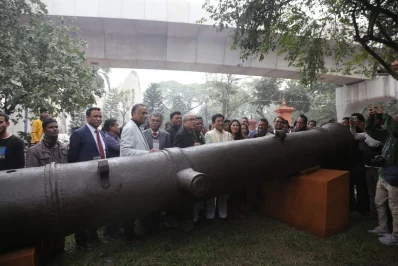
Once the cannon got half-buried under the sand in 1840, Magistrate Walters placed it in the Chawkbazar area. After that, its location changed several times. The cannon was installed at Sadarghat in 1925 with the patronage of Nalini Kanta Bhattasali, the then director of the museum in Dhaka. In 1957, GA Madani, chairman of the then Dhaka Improvement Trust (DIT), shifted the cannon to Gulistan, which was known as DIT Avenue at the time. After staying there for three years, it was shifted to Osmani Udyan in 1983. Lastly, the cannon has been installed next to the newly renovated Dhaka Gate. As such, this cannon has not been a mere war tool; it has witnessed the historical turning points of Dhaka.
