




University of Liberal Arts Bangladesh (ULAB) and UNHCR, the UN Refugee Agency, have recently celebrated the closing of the seventh annual mobile filmmaking workshop — the learning component of the Dhaka International Mobile Film Festival (DIMFF).
The workshop, a unique initiative in Bangladesh, empowers emerging filmmakers to share compelling narratives using mobile devices. The 2024 edition, spanning from October 13 to November 11, focused on the theme "Forced to Flee," sponsored by UNHCR.
Two fictions (Unsent Letters and The Unbreakable Wall) and one docu-fiction (Slang) reflected both on the experiences of refugees — people forced to flee their homelands due to violence, persecution, conflict or human rights violations — and the experiences of communities hosting them.

“This is the only mobile filmmaking workshop in Bangladesh,” said ULAB instructor Zahid Gogon, who has led the workshop for the last five years. He explained that the progression of mobile phone technology – particularly the leaps in phone camera quality — have enabled new, unheard voices to enter the world of filmmaking in ways that were previously unimaginable.
“Filmmaking used to be very complex, requiring a lot of resources,” he said. “Now even a small child can make a film – it’s a new tool for a new generation.”
Over the five-week workshop, participants from universities across Dhaka learned the ropes of filmmaking – from ‘film grammar’ (i.e. camera shots and angles) to prepping budgets and prop lists, from scripting, sound design and editing to the pavement-pounding art of scouting locations and casting actors.
To make films with heft and heart, first the young auteurs had to immerse themselves in the feelings, stories and even legal frameworks defining refugee lives.
“Before, all I knew about refugees was from the news,” said Jubayer Ahmed, a journalism student at Green University, who conceived Slang to examine the evolution of the word Rohingya in local slang. Through course materials and presentations by UNHCR, his eyes were opened to a different, more human reality than glimpsed in the media.
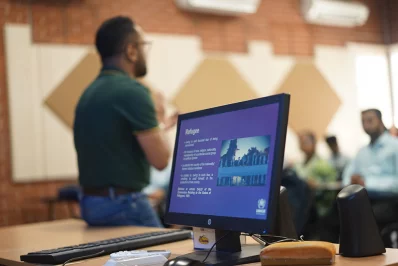
Participants, who were selected through a competitive application process, received on their first day a quick introduction to the 1951 Refugee Convention, legal protection, durable solutions, and UNHCR’s mandate as the UN Refugee agency. This included untangling the definitions of ‘refugee’ and ‘migrant.’
“I learned that not everyone who is displaced is a refugee,” said Jubayer. “That hadn’t been clear to me before.”
Saleh Mohammad Shafi, UNHCR Protection Officer, discussed with the students the theoretical example of a person who has fled his rural home for an urban centre of his own country — such as farmer forced to find a means of living in his nation’s capital after rising waters drown his ancestral land. Students learned that such a person is not a refugee but rather a migrant or an internally displaced person. In contrast, the Rohingya in Bangladesh or Ukrainians fleeing war to neighboring countries are defined as refugees as they have been forced to seek safe refuge away from their homeland. However, someone voluntarily departing their homeland for economic opportunities or to study is a migrant as they are not fleeing violence or persecution.
Over the course of the workshop, participants also viewed and discussed a series of short films about the experiences and perceptions of refugees, and chatted with a Rohingya refugee born and raised in the Cox’s Bazar camps. Inspired and engaged, students then began developing their own story ideas. Out of 15 original concepts, they chose four achievable within limited budget and time. Without access to the Cox’s Bazar camps in Cox’s Bazar, the filmmakers were challenged to conjure a refugee’s world through imagination and sleight of hand.
Their ideas emerged from various sources: the inspiration for Unsent Letters, a narrative short about a refugee’s loss of belonging, ‘struck’ Rafsan Jony Rahat, the writer/director, during a phone call with his father.
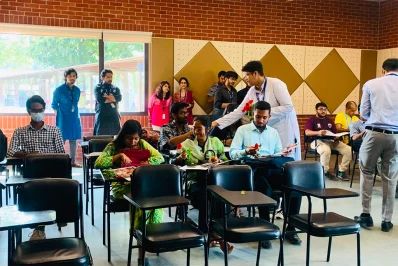
“I realized the privilege of being able to communicate with my family at any time,” said Rafsan, a third-year anthropology student at Dhaka University. “This led me to consider that, if I were a refugee living in another country without my family, such communication would be impossible. I developed the story from there.”
Similarly, the short The Unbreakable Wall considers the often stark differences between the life of a refugee child and that of a ‘normal’ child living in comfort and security in their own homeland. It explores the psyche of a refugee boy stuck in a “silent shadowed room of refugee existence.”
The film’s writer/director Nowrin Islam Rio, a second-year computer science and engineering student at BRAC University, described how moved she was by a short film screened earlier in the workshop, depicting a year in the life of a young girl whose childhood is shattered when conflict erupts in her homeland, and she is forced to flee.
“Older people may have the tools to handle themselves, but a child is innocent and doesn’t know what to do. I wanted to work on this perspective,” she said.
For sound design, Rio’s team applied an audio track – a reading of the poem What They Took With Them — from a different short they had seen, which they mixed with the Bangla song They Have No Country to create another layer of tension.
Rio feels that her film has the power to shift public perceptions.
“People have many wrong ideas about refugees,” she said. “That they are criminals, for example. In reality, they are living with uncertainty, without proper rights, food, education. I think my film can help people be more conscious.”
ULAB instructor Zahid Gogon says he’s proud that the filmmakers were able to express authentic and personal emotional truths through the process of filmmaking. “Film is about the expression of feelings, and they were able to realize those feelings through the language of film. They also bonded with each other, grew their skills and confidence.”
Next, he hopes the workshop could take place in Cox’s Bazar so that local Bangladeshi and Rohingya youth can engage in storytelling together: “I would love to do a combined workshop of Rohingya and Bangladeshi students.”
Meanwhile, the students say the workshop was a transformative experience: “It has changed my views, ideas, and perspective regarding refugees,” said Rahat. “I never felt as much empathy towards refugees as I do now.”
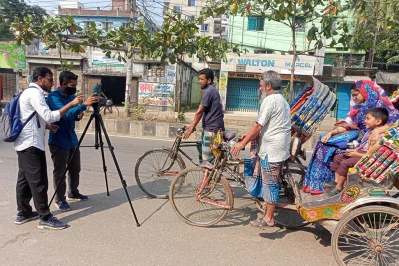
Jubayer, whose team heroically conducted over 30 man-on-the-street interviews in different Dhaka neighbourhoods, for Slang, added: “Whatever I do in the future and in my career as a journalist, I will remember what I learned about refugees in this workshop.”
