





Students and teachers of Dhaka University’s Fine Arts Faculty (Charukola) are working to complete all preparations for the Mangal Shobhajatra parade, which will take place on Sunday morning to welcome Bengali New Year 1431.
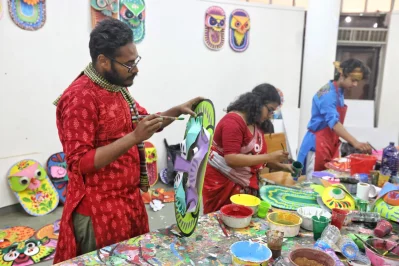
For the last few weeks, the volunteers have been working day and night inside the faculty building and the premises to make large and small motifs, masks, and other decorative items to be carried by the participants in the parade.
On November 30, 2016, Unesco recognized the Mangal Shobhajatra as an intangible cultural heritage due to its uniqueness.
During a visit to the Fine Arts Faculty on Saturday, the volunteers were seen giving finishing touches to large motifs of Asian white elephants and the traditional Tepa Putul (hand-pressed dolls made of clay) on the ground floor.
Some were making masks with paper, while others were busy painting the structures again. They aim to make the procession more interesting and beautiful than other times.
Visitors of different ages also thronged the premises to look over the preparations. A piece of graffiti caught the attention of two foreigners who were seen taking pictures in front of the wall.
In addition to DU students and teachers, attendees at the Mangal Shobhajatra will include members of various cultural organizations and people from all walks of life.
Every year, participants carry the motifs during the procession as a symbolic protest against contemporary social and national issues.
How it started
In 1989, the DU fine arts students began to arrange the procession on a large scale every year. It was officially named “Mangal Shobhajatra” in 1996.
However, the beginning of Mangal Shobhajatra dates back to 1985 in Jessore, where some former students of DU fine arts, including Mahbub Jamal Shamim and Hironmoy Chadra, formed a cultural organization named Charupith.
They brought out the first procession to welcome the new year in 1985.

The following year, Charupith initiated a larger platform with all cultural organizations in the district and brought out the procession on the first day of Boishakh.
Soon, cultural organizations in different districts started observing the day with a colourful procession.
In 1994, Mangal Shobhajatra processions were taken out in Bangaon and Santiniketan in West Bengal, India.
