



The bullish trend in the US dollar that began earlier this year has reached its highest peak in the history of Bangladesh's kerb market, or open market.
Bangladesh Bank is monitoring the open market, along with banks, to curb the spike of the dollar rate, along with punishing errant bankers and forex merchants. But that seems to have backfired, at least for now.

To resolve the ongoing crisis in the first 40 days of the current fiscal year 2022-23, the central bank sold more than $1.60 billion from the reserve.
However, the crisis has not subsided, but rather intensified.
Dhanmondi’s Zobair Shihab arrived at money exchanges in Paltan on Wednesday morning, looking to buy $500 for a business trip to Singapore, after he failed to find any in his area.
“No one in Dhanmondi, or even Mirpur was able to give it (US dollars) to me. So, I came to Paltan. But these people can sell only $200 now and the rest later in the afternoon. Even if I agree to it, the prices in the afternoon will be different from what it is now,” he said.
The money changers asked for Tk120 per dollar from Shihab – an increase of Tk 10 from August 7.
Although the kerb market rate reached Tk119.90 on the day, Bangladesh Bank's interbank rate was set to Tk95, the difference between the two markets standing at a whopping Tk25.
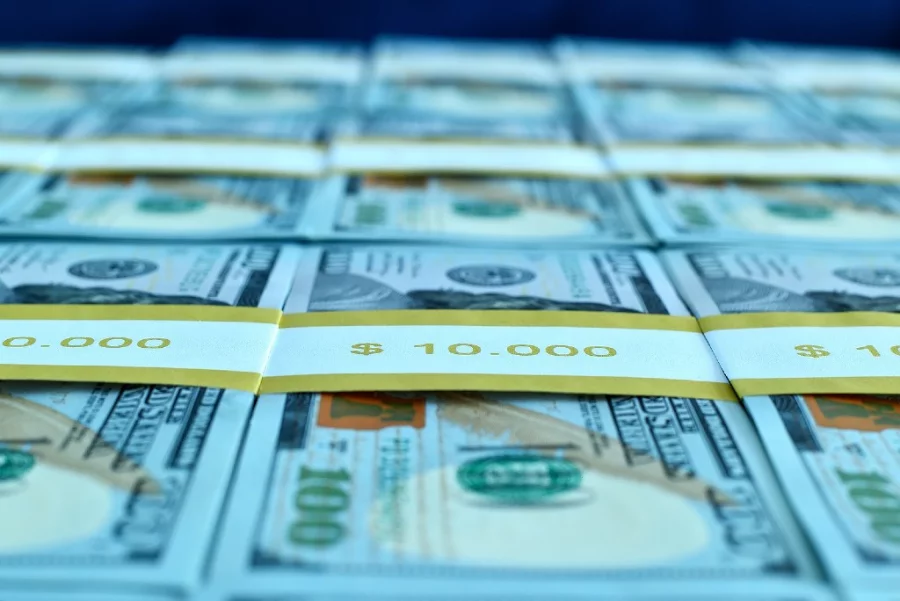 Representational Photo Bigstock
Zahid Hussain, former lead economist of the World Bank's Dhaka office, told Dhaka Tribune: “The kerb market has moved in tandem, provoking increased policing. Amid the central bank's increased raids, the number of dollar sellers has declined despite plenty of customers willing to transact at the higher rate. Fear gripped the market, making many money changers refrain from trading.”
On August 4, central bank governor Abdur Rouf Talukder called a spade a spade about intervening to set the exchange rate.
The Taka will float as the market becomes stable, the governor assured.
"So, it seems to me that Bangladesh Bank is counting on a significant easing of international commodity prices, declining import volume due to the policy measures, remittances edging up, and exports averting major impact from expenditure slowdown in advanced economies as early as the next few months,” he added.
Other variables
Although export earnings fell in July compared to June, remittances were the highest in 14 months and, on the other hand, the ratio of LC (letters of credit) opening fell. It was expected that the exchange rate of the dollar may weaken slightly.
According to the latest data from Bangladesh Bank, the opening of letters of credit (LC), generally known as import orders, was $6.58 billion in July, down from $7.53 billion in the previous month of June.
LC settlements fell by 9.23% during the one-month period, according to the data.
Besides, banks opened LCs worth $5.55 billion in July, a decrease from the $7.96 billion registered in June. As a result, LC opening decreased by 30.20% in July.
And it is not only low LC opening. In July–the first month of FY23, $2.09 billion in remittances came through the banking channel, the highest in the last 14 months and up 14% from a month ago.
Remittance flow to Bangladesh rose 11.76% year-on-year, as migrant workers sent home $1.87 billion in July last year.
In July, $330 million in remittance was channeled to Bangladesh through state-run commercial banks, $32.42 million through state-run specialized banks, $1.78 billion through private banks, and $6.64 million through foreign banks, data from BB showed.
How high will the dollar go?
Now the million dollar question is how high the dollar can go.
According to traders, foreign buyers of readymade garments (RMG) are not placing purchase orders as much as before.
But due to the abnormal increase in fuel oil prices and electricity load-shedding, the production cost of the product is increasing.
On one hand, orders are decreasing and foreign buyers are not raising prices, while on the other hand, production costs are increasing.
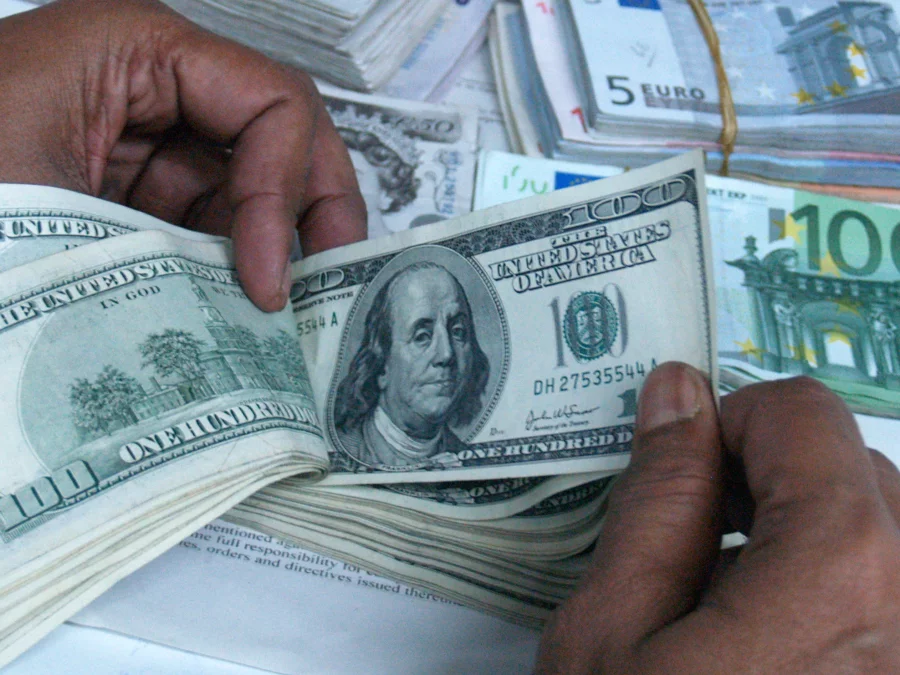 File Photo of Dollar Note Syed Zakir Hossain/Dhaka Tribune
There is a question about the continuation of the growth of export income.
Similarly, the supply of goods other than essential commodities will decrease even if imports are reduced, putting pressure on the country's import-dependent economy, which may lead to a crisis in the market.
As a result, the pressure on forex will not decrease, but rather may increase.
In this situation, if the supply does not increase, stakeholders are skeptical about how high the value of the dollar will go.
Asked how the exchange rate can be stabilized, Zahid Hussain said that free trade between banks in the interbank market is strained by Bangladesh Bank's interbank rate, which is the lowest of all rates.
Except for BB, no one is willing to sell at this rate, he explained.
The differing bank and market rates seen of late cannot persist. Something, including reserves, has to give, the economist opined.
Market forces can set exchange rates. Had this been given a chance, which it was not, the market would have found a set of rates where supply and demand could be cleared after catching up with pent-up depreciation. A sustainable foreign exchange intermediation requires the selling rate to exceed the buying rate, he further explained.
Economic theory
Hussain went on to elaborate: "Arbitrage ensures convergence of rates at which the authorized dealers (banks) buy dollars from the exporters, individual remitters, and exchange houses. Call it X. There would be a similar convergence of rates at which banks sell dollars to importers, travellers, and outward remittance. Call it Z. Sustainable foreign exchange intermediation requires the selling rate to exceed the buying rate (Z>X)."
The interbank rate at which banks trade with each other for a very short period is somewhere in between, call it Y.
Rates in the informal market, call it W, tend to have a positive risk premium over the formal market selling rates.
 Representational Photo Bigstock
In equilibrium, the relation X<Y<Z<W must prevail. It can be violated on any given day but not day after day in the absence of frictions such as imperfect contestability and market policing by the regulators, the former World Bank lead economist surmised.
The BB's recent strategies contrast rather starkly with other central banks which could afford large scale interventions but chose not to, he said.
Japan had $1.3 trillion reserves in June 2022, yet it allowed 21.8% depreciation of the Yen in the last 12 months. Over the same period, South Korea allowed 12.7% deprecation despite having $438 billion in reserves.
The Indian rupee has depreciated more than 7% in 2022 with the RBI still holding $572 billion.
Taiwan's reserves in 2022 have been about 280% of their GDP while the Taiwanese dollar depreciated more than 7.5%.
All stayed away from rate repression. They used the exchange rate as a shock absorber while protecting reserve buffers. The BB is seeking similar results using its own unique model, he added.
