




Asmani
Translated by: Hasna Jasimuddin Moudud If you want to see Asmani Go to Rahimuddin’s small house in Rasulpur. It is not a house, a bird’s nest made with ‘venna’ leaves The slightest rain pours water inside. The slightest wind, rocks the house Under its roof Asmanis’ live all year long. She doesn’t have a full stomach The ribs in her cage are witness to her starving days. The bright smile has gone from her sweet face wiped out by cruel poverty. She wears one hundred stiches on a hundred holes in her dress Making a mockery of her golden skin. The bee black eyes do not have twinkle of laughter Only tears pour down in deluge. Her flute like voice is wasted by crying out She never had a chance to sing to tune of music. Near Asmani’s home lies the lotus pond Where tadpoles and moss cover the water. Mosquitos breed poisonous seeds of malaria germs In its water the Asmanis carry on cooking and drinking. Her stomach swells with worms, fever accompanies daily They have no money to call for a doctor. Khosmani and Asmanis live in two lands Tell me my jadu who will you accept with greater love. The last two lines of Asmani talk about what we now think of as climate justice. The poet wonders: Who deserves our love and compassion, other than the destitute and the dispossessed Asmanis of Bangladesh? Another of his poems, O Bajaan, Chol Jai Chol, describes destitute farmers who struggle through draught and floods to raise crops for the country but go to bed with empty stomachs. The inhumanity – and farmer suicide – brought on by old agricultural practices and natural disasters, is a form of realist visualisation that is a hallmark of climate consciousness.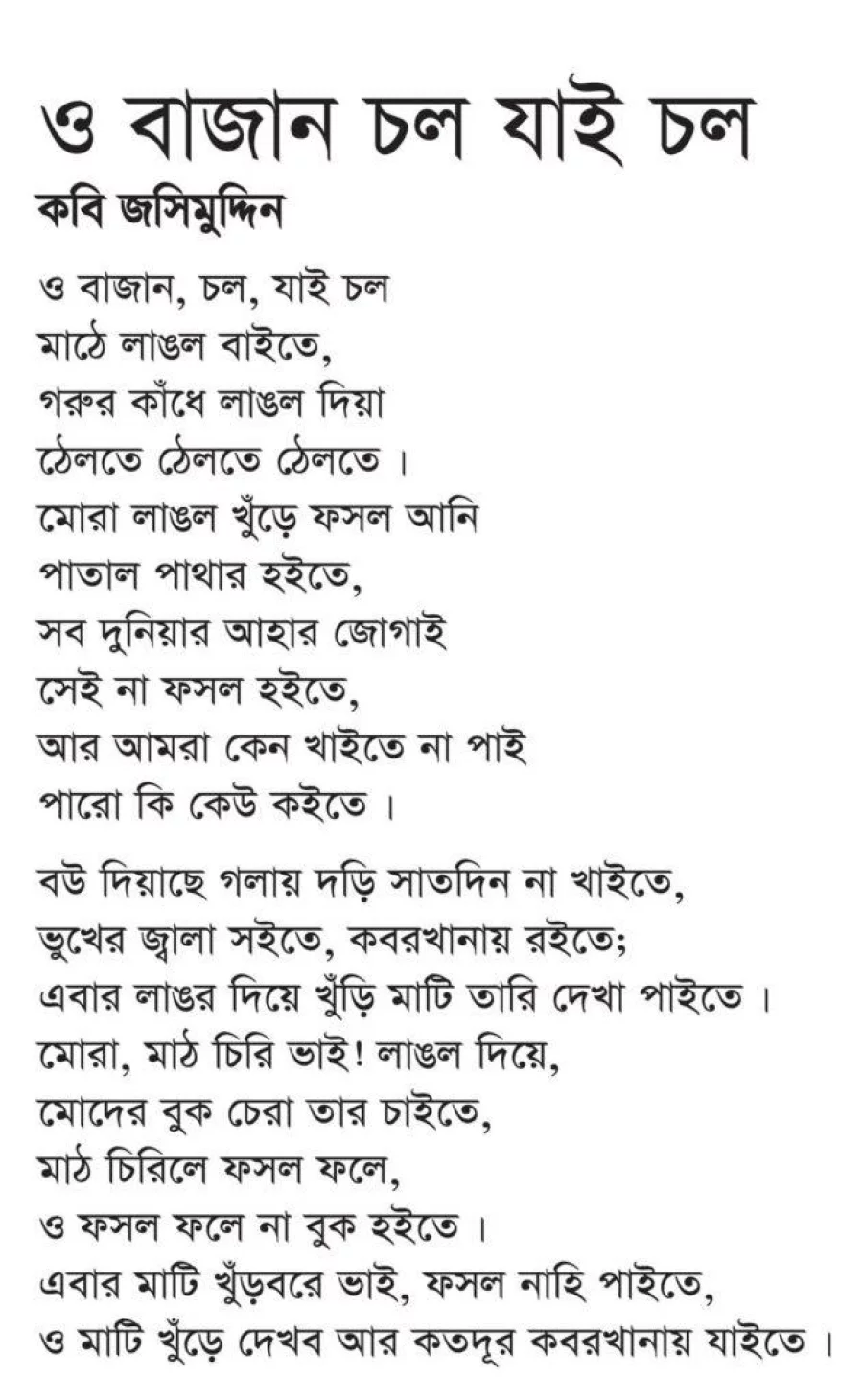 O Father Come Let Us Plough
Translated by: Hasna Jasimuddin Moudud
O father come let us go
To the field to plough
Place the ploughs on oxen shoulders and
Push, push, push.
We who bring out food
From the depth of the earth
We who provide food for the whole world
Why can’t we eat can any one tell us?
My wife has hanged herself
She could no longer bear hunger,
Now I plough deep into soil
In the hope of seeing her again.
We plough the fields
Our bosom is always flayed
But from the fields we get harvest
None from the scarred bosom.
We shall plough no more for rice
But to see how far it is to graves.
 The famous ‘Famine’ Sketch by Zainul Abedin WikimediaI must return to Zainul Abedin and the Bengal Famine of 1943. He visited Kolkata and saw for himself the kind of horror it takes to claim four million lives. The emotion of watching destitute mothers holding babies on the verge of dying is something that transcends dry famine data. His Bengal famine sketches aim to not just visualise the human aftermath of agricultural failure, land politics, the Raj’s aid denial, cyclones, storm surges and flood damage, but also to bear testimony through cultural production. It was Abedin the artist, expressing himself as the activist.
Perhaps the greatest masterpiece of Bangladeshi climate art is Zainul Abedin’s Monpura (1970). Following the Bhola cyclone, Abedin painted the masterpiece of cultural testimony to climate disaster. He became known as the artist for the downtrodden. The scroll now hangs in its majesty at the National Museum in Shahbagh, stunning visitors to silence.
Sanjukta Sunderason, in Shadow Lines (2017), says about Monpura: “When a huge coastal storm on the island of Monpura killed thousands of people in November 1970, Abedin rushed to the affected areas. The artist’s wife, Jahanara Abedin’s recollection of his disquiet in an interview is telling: “Upon his return from Monpura, he just sat there with his head in his hands. Seeing such loss and desperation shook him from within. He didn’t paint immediately. He sat contemplating for a long while, feeling the need to do something practical to help those people. Much later, he painted scenes of what he saw in Monpura, working tirelessly ...”
So how should we think about climate change now? And where? Who will get to record it? Who will tell our story as survivors of climate damage? We need a space for thinking about our collective uncertain futures. Having this space for reflexive and reflective interaction with the “hard sciences” of climate change might lead to a more energetic and inclusive understanding of what climate change and climate action mean. This space must be collaborative between scientists, artists and the common people – with their contested agencies, disagreements and dissent. The hard facts of climate change have its own value and space (albeit with its own controversies and contentions), and it needs to be complimented with cultural interpretations and documentation, beyond “soft communications” with expert driven narratives that follow international climate conferences. It is a challenge to the imagination of the creative community and carries with it some urgency as the world is changing with every season.
We must think of climate art as our art – it is a product of our collective struggle. We create art, depicting our struggles, processing our memories and understandings of climate trauma through fresh experimentations. Songs of suffering, change, beauty and joy will evolve through our collective recording and retellings. We must think of climate art as a means of giving meaning and value to our past, present, and future. Art has always been an important means of processing trauma - Guernica being an icon in that sphere - be it cyclone damage, hunger or displacement. An artist’s creative empathy and consciousness are the most important elements that will form cultural memory and imagination. It is our cultural conscience that we must bring to climate discourse.
The famous ‘Famine’ Sketch by Zainul Abedin WikimediaI must return to Zainul Abedin and the Bengal Famine of 1943. He visited Kolkata and saw for himself the kind of horror it takes to claim four million lives. The emotion of watching destitute mothers holding babies on the verge of dying is something that transcends dry famine data. His Bengal famine sketches aim to not just visualise the human aftermath of agricultural failure, land politics, the Raj’s aid denial, cyclones, storm surges and flood damage, but also to bear testimony through cultural production. It was Abedin the artist, expressing himself as the activist.
Perhaps the greatest masterpiece of Bangladeshi climate art is Zainul Abedin’s Monpura (1970). Following the Bhola cyclone, Abedin painted the masterpiece of cultural testimony to climate disaster. He became known as the artist for the downtrodden. The scroll now hangs in its majesty at the National Museum in Shahbagh, stunning visitors to silence.
Sanjukta Sunderason, in Shadow Lines (2017), says about Monpura: “When a huge coastal storm on the island of Monpura killed thousands of people in November 1970, Abedin rushed to the affected areas. The artist’s wife, Jahanara Abedin’s recollection of his disquiet in an interview is telling: “Upon his return from Monpura, he just sat there with his head in his hands. Seeing such loss and desperation shook him from within. He didn’t paint immediately. He sat contemplating for a long while, feeling the need to do something practical to help those people. Much later, he painted scenes of what he saw in Monpura, working tirelessly ...”
So how should we think about climate change now? And where? Who will get to record it? Who will tell our story as survivors of climate damage? We need a space for thinking about our collective uncertain futures. Having this space for reflexive and reflective interaction with the “hard sciences” of climate change might lead to a more energetic and inclusive understanding of what climate change and climate action mean. This space must be collaborative between scientists, artists and the common people – with their contested agencies, disagreements and dissent. The hard facts of climate change have its own value and space (albeit with its own controversies and contentions), and it needs to be complimented with cultural interpretations and documentation, beyond “soft communications” with expert driven narratives that follow international climate conferences. It is a challenge to the imagination of the creative community and carries with it some urgency as the world is changing with every season.
We must think of climate art as our art – it is a product of our collective struggle. We create art, depicting our struggles, processing our memories and understandings of climate trauma through fresh experimentations. Songs of suffering, change, beauty and joy will evolve through our collective recording and retellings. We must think of climate art as a means of giving meaning and value to our past, present, and future. Art has always been an important means of processing trauma - Guernica being an icon in that sphere - be it cyclone damage, hunger or displacement. An artist’s creative empathy and consciousness are the most important elements that will form cultural memory and imagination. It is our cultural conscience that we must bring to climate discourse.Dr Shahpar Selim is a visiting researcher at the International Centre for Climate Change and Development (ICCCAD) at IUB.
