




In the last two weeks, Bangladesh has witnessed a continuous decline in the Covid-19 test numbers. Several reasons are put forth for this decline. The imposition of the testing fee is one of them.
Even though there is no study on how much that testing number decline is due to the imposition fees, various case studies and newspaper reports suggest that a 30-50% reduction of tests can be attributed to the newly imposed fees and the remaining for other problems -- flood, scarcity of testing kits, and lack of motivation from the patient side to participate in testing.
Whatever the reason, it is very alarming, given that testing early can increase the chances of survival of the infected and can also significantly reduce the chance of infecting others. Pathogen’s ability to transmit from one person to another is often expressed with the basic reproduction number -- infectiousness of the disease, Ro. The estimated Ro for Bangladesh is 1.47 (as of July 10).
If we assume that 30% of the reduction of the tests are due to higher fees (given that poverty has increased drastically due to income shocks, it can even go up to 50%), then there would be about 210 underestimations of cases daily only due to higher fees, which will result in more than 6,000 cases per month (on an average). If we multiply this number with the infectiousness, then these people would infect more than 9,000 additional people in just one month.
Even if we consider the effective reproduction number -- infection at a point in time -- which is around 1, then 6,000 more people will be infected just due to an increase in fees. With the basic reproduction rates and more than 9,000 additional avertible infections, 118 lives can be saved in only one month.
Now, if we multiply these numbers with Value Statistical Life -- a statistical or economic way of valuing life based on implied behaviour of the labour -- then the additional benefit of saving those lives would be around Tk485 crore.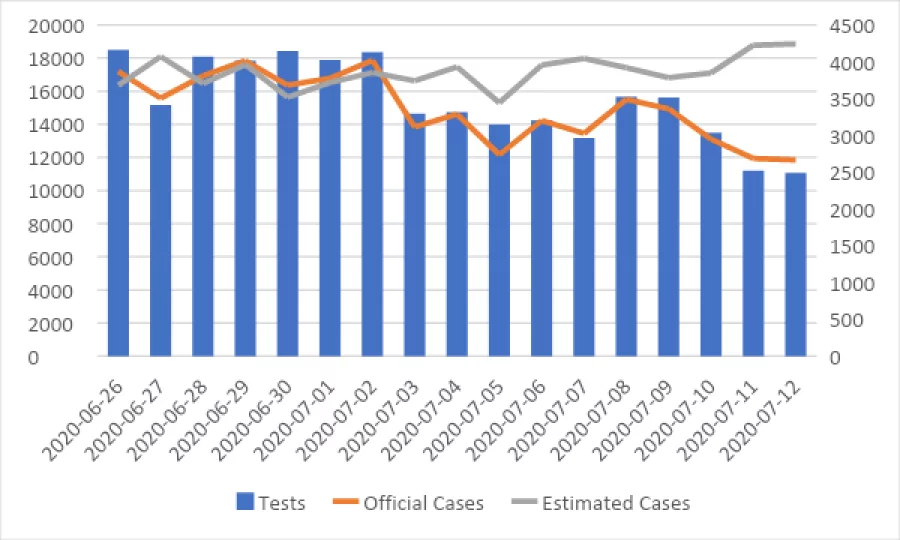
Figure 1: Test Adjusted Cases
Conducting an additional 31,000 (5 times than the 6000+ cases) tests in one month, the government would have to spend only Tk11cr more in a month. Therefore, the benefit of that additional testing far outweighs the costs; in fact, the benefit-cost ratio -- benefit for per taka investment -- is greater than 44, which is most likely to be significantly higher than the BCR of many of our mega-projects.
In a very narrow economic sense, if we consider only the lives of people under age 60 to be valuable, then the BCR becomes 27, which is also substantial. All lives are invaluable; however, even if someone is obsessed with an economic benefit, this number strikingly suggests that imposing fees on the tests that discourage poor people to go for testing does not make economic sense.
If we use the effective reproduction number to estimate potential additional infections, then the BCR ratio declines; however, then the BCR becomes 18 (if productive people’s life is regarded valuable) and 30 (if all people’s lives are valued equally).
Another estimation economists often use to understand the project's value is how much income will be potentially missed if a project is not adopted. Here, productivity plays a significant role. For instance, saving a child’s or working-age individual’s life is more valuable than the lives of older people. Simply put, it gives an idea of whether a project has any economic sense for a country (ie, whether it is worthwhile).
Using this method, I find that BCR is 4.10 if death averted number is estimated from the Ro, and 2.80 if that is estimated from the Rt (effective reproduction number). Both methods posit that even if policy-makers think it is a business project, still, they should allow free testing for the poor segment of the population.
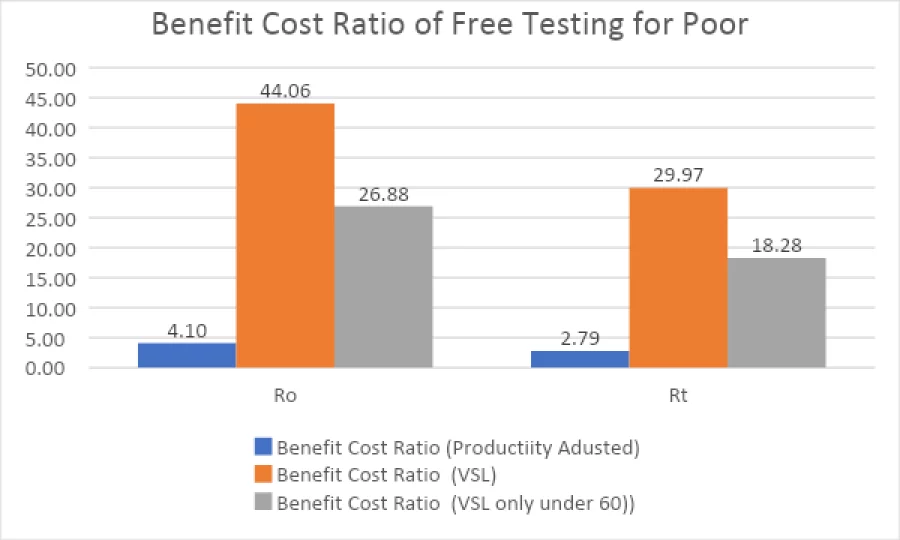
Figure 2: Benefit cost ratio of giving free testing for poor people
Death of family members to a family is not just a loss in income potential, but also an invaluable loss in terms of the social and mental infliction to that family. Those losses are invaluable, and so the actual benefit of saving people’s lives definitely is much more than just the economic benefits mentioned here. If those numbers are considered, then the actual benefit would be hundreds or thousands of times higher.
It is worth mentioning that all these estimations require some assumptions to be made -- the countries' growth potential, how we value future benefits, etc. In estimating figures mentioned here, standard assumptions are made. Even with some sensitivity analysis -- re-estimating BCR with various changes in assumptions -- the results remain robust.
Therefore, the imposition of a fee on Covid-19 testing, especially those who are poor, is inhumane and unjustifiable in terms of economic benefit.
Dr Shafiun Nahin Shimul is an Associate Professor, Institute of Health Economics, University of Dhaka.
