




At dawn in Kata Khal, as the first light touches the riverbank, Pushpa Rani Ray often begins her day by staring at something she never imagined she would see: a thick, suffocating sheet of sand covering the land her family has tended for generations.
Three years ago, she woke one morning to find that during the night, company workers dumping dredged sand on the neighbouring plot had silently buried hers as well. Villagers had warned the company, pleading with them to be careful. “We woke up and saw sand everywhere,” Pushpa recalls. “We tried to stop them. They stopped for a few days, then started again.”
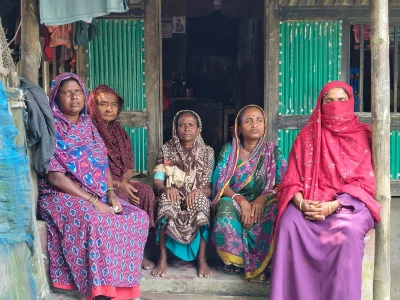
Kata Khal in Joymonir Ghol was once a landscape of rice paddies, shrimp enclosures, canals, and quiet stability. Families lived on land their ancestors had farmed for four generations, surviving on fishing and rice cultivation. But large-scale dredging for Mongla Port — and earlier for the Rampal Power Plant — has transformed the area into an uneven desert of sand piles, some rising as high as 30 feet. The dredging itself takes place far away in the Pashur River, but the sand ends up here.
More than 700 acres in Chila Union have been covered. For families like Pushpa’s, who refused to sell their land or lease it to the company, the consequences have been devastating. Sand dumped on neighbouring plots that were sold has naturally slid downhill, burying the land of those who chose to stay.
The villagers protested. They formed human chains, went to the police, and appealed to the local chairman. At one point, the company promised compensation. But three years have passed and no money has arrived. No sand has been removed. The dredging pipes are gone, but the damage remains.
The story repeats itself from house to house.
Tapas Ray remembers how sand slowly filled his land over several months. “We are ten to twelve families,” he says. “We haven’t received any compensation. They dumped the sand at night without informing anyone.” The local chairman disappeared, leaving residents with no recourse.

With fields buried and fish habitats destroyed, many of the village’s men have been forced to migrate for work. What was once a community bound together by land and water has become a scattering of broken households.
In Pushpa’s neighbourhood alone, almost every family has a man working far away.
Meera Ray stands by the riverbank where she once fished every day. She no longer casts her nets — there are hardly any fish now — and her husband has left in search of work. “Our households are not running,” she says. “Sand has covered our land. My husband cannot find work in the village. He has gone far away. I am left alone.”
Shilpi Rani’s husband now works in Chittagong as a mason, returning home every six or seven months. For the rest of the year, Shilpi relies on her own resourcefulness. “We used to fish in canals and rivers,” she says. “There was plenty of fish. We sold them in the market. How will we survive now? Because of the sand, there are hardly any fish left.”
Gayatri Rani Ray, once able to support her family by catching shrimp fry, now earns less than a quarter of her former income. Her husband, son, and brother-in-law have all migrated in search of livelihoods.
Across Kata Khal, women are bearing the burden of abandoned homes, lost incomes, and the growing emotional toll of isolation.
Every household in Joymonir Ghol knows the month of Falgun all too well. Winds blow from the south, lifting loose sand into the air and driving grains into homes, bedding, cooking pots, and lungs. “Sand gets into my rice and vegetables,” says 60-year-old Amena Begum. “When we complain, the company owners say: ‘We dumped sand on the land we bought.’”
Her family now lives beside a towering sand dyke. Children suffer from constant itching. Elderly villagers struggle to breathe. Pregnant women face complications, and babies are born with respiratory problems.
Health workers confirm what residents experience daily. At the Joymoni Community Clinic, Nasrin Akter sees chronic eye and respiratory illnesses every day. Rabeya Khanam, a Family Welfare Assistant, adds that rising salinity has worsened uterine conditions among local women.
A generation of mothers is quietly enduring illnesses their daughters are now beginning to face. “I know what problems I have,” says Monsura Begum. “But my daughter does not. She is still young. I don’t want her to become a victim like me.”
Fariha Jesmin, programme manager at Badabon Sangha, has observed these impacts for years. “In places like Mongla, embankments are promoted as climate solutions,” she explains, “but for women fisherfolk they often create new risks instead of safety. When embankments block tidal rivers, women lose both income and access to fish for household nutrition. Displacement and livelihood loss push many women into unsafe work conditions, increasing their exposure to health problems, food insecurity, and gender-based violence. Climate adaptation in Bangladesh cannot be considered successful if it protects land but leaves women’s bodies, livelihoods, and dignity unprotected.”
Residents allege that sand should have been dumped to a height of 5.5 metres, but piles now reach 30 feet or more. A former dyke supervisor, speaking off the record, confirms that the rules are routinely ignored.
The Mongla Port Authority says it enforces guidelines and instructs companies to remove excess sand, claiming some of it is sold. Compensation, officials say, is provided according to regulations: Tk200,000 per acre for land under requisition.
But villagers say they have received nothing. And even if compensation arrives one day, it will not restore soil fertility, revive the canals, or bring back lost livelihoods.
Every evening, as the wind lifts dust and sand settles again on abandoned fields, the women of Kata Khal stand at the edge of their buried plots, wondering how much longer they can endure this alone.
The men have left to earn. The authorities offer promises. And the land that once sustained generations lies silent beneath mountains of sand.
In Joymonir Ghol, development has arrived — but at a cost borne almost entirely by women, every single day.
Ruhina Ferdous is a journalist. This story was published with the support of Earth Journalism Network
