



Economists aren’t known for their imagination, the lack of which among the practitioners of the dismal science is evidenced by the prevalence of the adjective “great” to describe economic events. Thus, the worldwide slump of the 1930s became the Great Depression, and the 2008-09 financial crisis led to the Great Recession.
Enter into this dubious pantheon of greats the Great Lockdown -- the moniker given by the IMF to the shutdown of economic activities around the world in the wake of the Covid-19 pandemic.
The World Economic Outlook -- the IMF’s flagship publication -- is released twice a year, in April and October, at meetings in Washington DC that are attended by the finance ministers, central bank governors, and other econocrats from around the world.
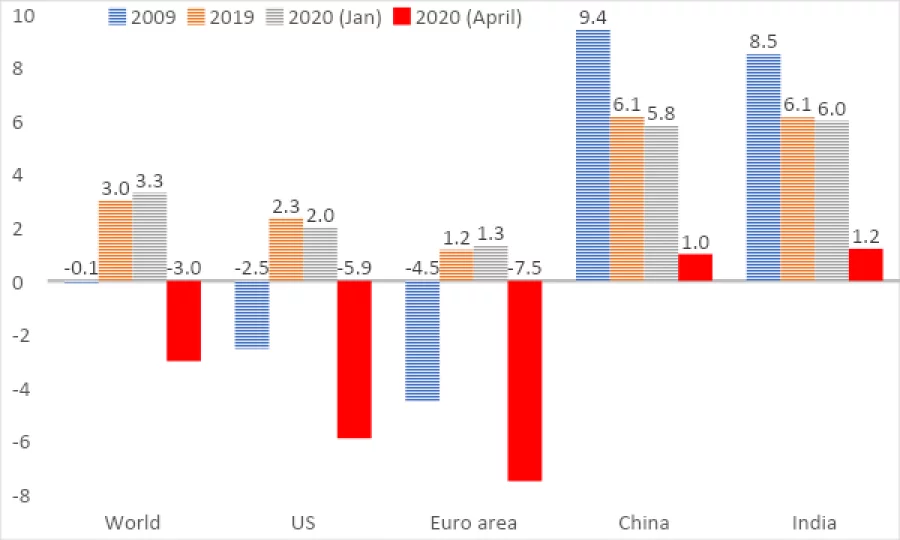
There was no DC gathering this April, and the first chapter of the Outlook was released last week. The Fund projects the world economy to shrink by 3% in 2020. Not only is this a sharp downgrade from January projections, but if realized, this will be a worse performance than what happened in 2009 across the world (Chart 1).
Chart 1: GDP growth
Source: IMF.
If the real world was a textbook economic model, the Great Lockdown would have been followed by the Gala Reopening -- the consumers would have spent on the pent-up demand, and the firms would be busy filling the shelves.
Unfortunately, the real world is not so simple. The scary thing about the Fund’s forecasts is that they are based on assumptions that may well be too optimistic.
The IMF assumes that the pandemic will fade in the second half of the year, allowing for a gradual lifting of containment measures around the world. These are strong assumptions.
Medical and life scientists’ understanding of the virus is evolving by the hours, but as things stand, we simply don’t know enough about the virus to say whether the pandemic will fade in a few months, or whether there might be a second wave of outbreak. Overlaying this is the thorny politics of lockdown and re-opening around the world.
The uncertainty around the economic impact of the pandemic is illustrated by how the financial markets view 2020 growth prospects for China -- the origin of the pandemic and one with the most data points about the economic impacts of the lockdown.
As of April 6, the average among the blue chip forecasting firms’ projection for China was 2% growth for 2020, compared with 5.2% forecast a month earlier. Underneath this average forecast was, however, a remarkable spread, with some forecasters still expecting China to grow by 5% or more this year, while others expecting a contraction of up to 3%.
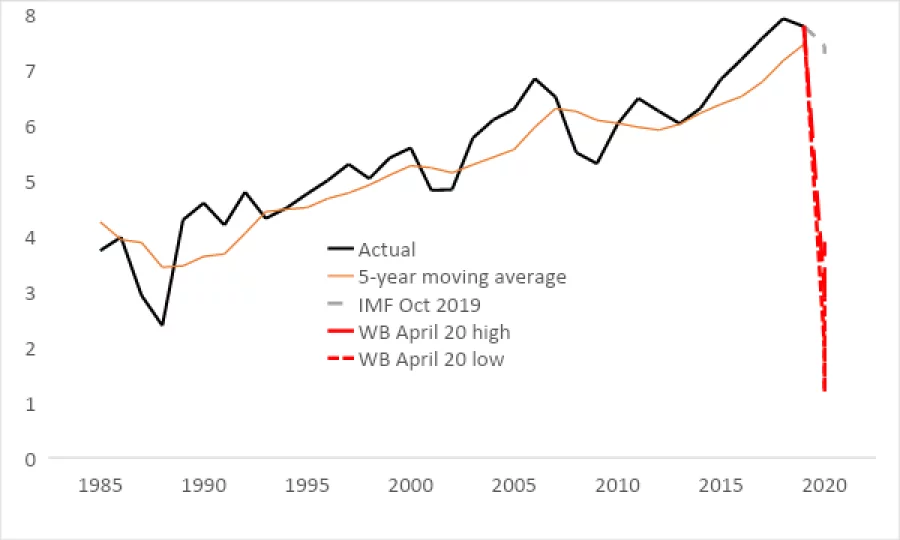
The IMF’s forecast for Bangladesh will be included in the complete World Economic Outlook, which is scheduled for May. The World Bank, however, has released a detailed analysis of the economic impact of the pandemic on South Asia. The Bank forecasts the Bangladesh economy to grow by 2-3% in the fiscal year 2019-20 and 2.2-2.9% in the fiscal year 2020-21.
To put these numbers in context, in the five years to 2019, average annual growth rate was 7.5%, while as of October 2019, the IMF was expecting the economy to grow by 7.3-7.4% a year into 2024, and the last time the country experienced a growth rate below 3% was when HM Ershad was still president (Chart 2).
Chart 2: Economic growth in Bangladesh (%)
Source: IMF, World Bank.World Bank forecasts are for fiscal years.
Considering the huge uncertainty around the assumptions that underpin these forecasts -- both the IMF’s global ones as well as those by the World Bank for South Asia -- it might be more useful to focus on the detailed mechanisms behind the headline numbers. And such, a detailed examination would highlight the complex policy challenges of this multi-layered crisis.
As best as one can guess, with a determined effort and a bit of luck, Bangladesh may be able to avert a humanitarian or financial crisis in the near term. But the pandemic will likely leave the country much weaker in the medium term, derailing the hard earned development trajectory of the past decades.
In the near term, like the rest of the world, Bangladesh is also facing what the Economist calls the grim calculus (the London magazine is better in the profession when it comes to coining phrases). But the trade-off between lives and livelihood is particularly acute in Bangladesh, which is potentially at risk of a humanitarian crisis -- what Asif Saleh of Brac calls the pandemic of hunger.
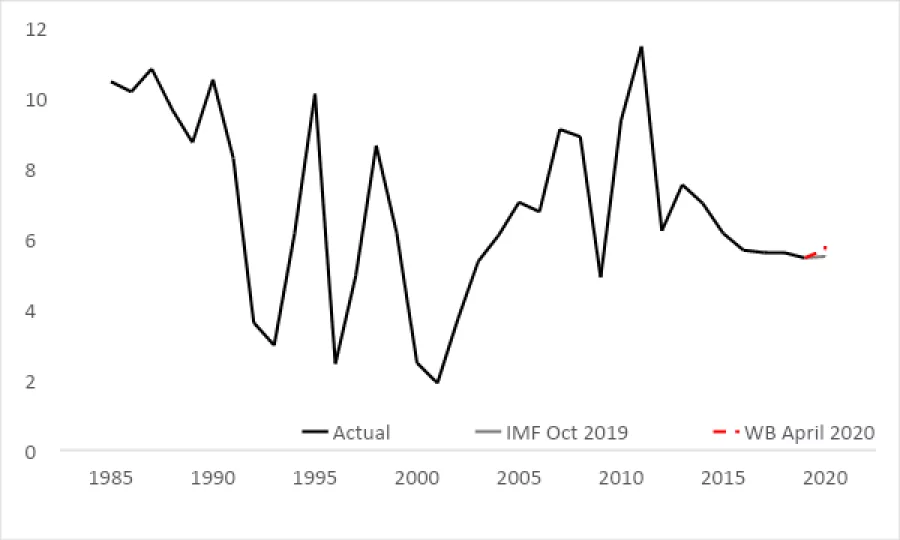
Largely reflecting the collapse in global oil prices, the World Bank expects inflation to remain moderate (Chart 3). But it does acknowledge the risk of food price spikes. If countries ban food (particularly rice) exports and transport routes are disrupted, risks to food security and social disruption will heighten.
Chart 3: CPI inflation (%)
Source: IMF, World Bank.World Bank forecasts are for fiscal years.
Of course, an important threat to food security is from various social distance measures. However, it is not at all clear that social distancing as practised in the advanced economies is appropriate for Bangladesh. Ahmed Mushfiq Mobarak, a Yale economist, puts it succinctly:
“If you’re a day-wage labourer in a rural area of a developing country, and you don’t have much of a buffer of savings, you may be reliant on your wage earnings in a given day or a given week in order to feed your family.
“Now, in a country where there’s social insurance and you can target social protection to people who are in that situation, maybe you can tide them over for this period of need. But in a country where it’s not easy for us to identify people who need that social protection and provide aid to them directly, it’s going to be very difficult for us to ensure that they abide by those guidelines.
“If their family is going hungry that week, they’re not going to follow all of your guidelines.”
Mobarak is repurposing his existing research to explore public health measures that are more fit for purpose for our conditions. We can also learn from two other densely populated, manufacturing and remittance dependent monsoon lands that have done well to tackle the pandemic.
Tightened border controls, agile health departments, tech platforms, and a hand-washing song that went viral helped in Vietnam. Aggressive testing, contact tracing, cooked meals helped in Kerala. In both cases, public awareness played a crucial role.
Is Bangladesh behind the curve when it comes to flattening the curve through public awareness? Even as the world was shutting down, Dhaka saw a huge concert on March 7 and large public gatherings on March 17, to say nothing of the RMG worker return to Dhaka fiasco in the first week of April and the massive janaza in Brahmanbaria as recently as April 17.
Well, if we are late then it’s all the more urgent to put the effort into a 360 degree campaign to raise public awareness.
Few regimes in the world have a friendlier media and civil society. Crisis is the time for all that chumminess to turn to concerted action-oriented camaraderie.
What else can be done?
The government has announced cash handouts. A variation of the “universal basic income” concept that is popular among progressive activists and wonks in the West, this is being tried in a number of countries (the Pakistan example would appear to have caught the fancy of Bangla social media).
The idea here is that government programs are complex and inefficient, people know what they need, so give them cash and trust their judgment. Forrest Cookson, a Dhaka-based American economist, suggests using the voter list and puts a price tag of 2% of GDP. His approach may well be feasible, and is worth pursuing. But it may not be enough on its own.
Exactly how will a cash handout help by itself if there is no rice in the market? If there is a food shortage, and prices are rising, cash handouts will risk fuelling that inflation even higher. If we are worried about the poor going hungry, we need to give them food, not just cash. And if there is any country that knows how to distribute relief efficiently and forestall famine, it is Bangladesh.
As Asif Saleh puts it: “Covid-19 is new and different in important ways, but we are home to premiere public health experts and institutions. We have one of the world’s best networks of community health workers, a rich history of public-private partnerships in emergencies, and communities with incredible levels of resilience. We have weathered cyclones, floods, and so much more.”
Of course, the pandemic is different from cyclones and floods. The contagion element has to be addressed in the relief operation. For example, the World Bank report shows that Bangladesh performs the worst in the region when it comes to access to soap for hand washing.
Shruti Rajagopalan and Alex Tabarrok of George Mason University recommend trucking in water and soap for hand washing. Something similar should be feasible in Bangladesh. The authors also recommend: Using cell phones to survey, inform, and pre-screen for symptoms, and subsidizing phone accounts alive; and requisitioning and repurposing government buildings as quarantine facilities. Both may well be feasible in Bangladesh.
Even without any food crisis, the pandemic is already wrecking lives and livelihoods. Depending on the measure, over three-quarters of Bangladeshis work in informal sectors. The Great Lockdown is hitting them particularly hard.
Using cell phone data, the World Bank report notes that 10 million people may have left Dhaka as their incomes dried up. Unsurprisingly, the Bank forecasts a sharp slowdown in service sector and household consumption growth. As a result, the World Bank estimates 15 million people will fall below the poverty line -- that is, people earning less than US$1.90 in 2011 prices -- by 2021-22
In the short term, that is over the next weeks and months, as the global economy remains frozen, orders, production, profits, and jobs are taking hits. The chaos and despair in the garments belt north of Dhaka is visible to all.
Reflecting the global slump, the World Bank forecasts a nearly 20% fall in exports in 2019-20. Meanwhile, factories in Bangladesh’s major competitors are partly (Indonesia, Cambodia) or fully open (China, Vietnam). If the rest of the world recovers as the IMF optimistically assumes, it’s important that Bangladesh doesn’t miss out on the winter production schedule, orders for which typically would come in during May-June.
China and Vietnam are in much better shape than us when it comes to the pandemic. That may well be the case when it comes to production of the country’s major export.
Even more worryingly, exports are not expected to rebound until 2021-22. Reflecting the global uncertainty, investments are also expected to remain tepid into 2021-22. Clearly, the longer the global recession continues, the more pressure businesses and firms will be under.
Bangladeshi businesses are, by and large, not cash-rich, high-margin firms. Many RMG factories will not survive if the global slump continues beyond 2020. If the country’s industrial capacity is damaged because of the pandemic, longer term development prospects will dim. Contrary to the populist reactions, therefore, there is much logic to the government’s support (not stimulus -- that’s a misnomer!) package.
The global slump is also exacting its toll on the other driver of growth -- remittances. Remittances continued in the aftermath of the 2008-09 crisis as the gulf economies recovered and migrant workers with precarious lives sent money back to the only safe haven they know -- Bangladesh.
This time may be different. The service sector jobs whence much of our remittances come are also the ones that are affected by the social distancing policies around the world. Most of the Bangladeshi workers around the world don’t have a savings buffer. As their incomes stop, presumably so will remittance.
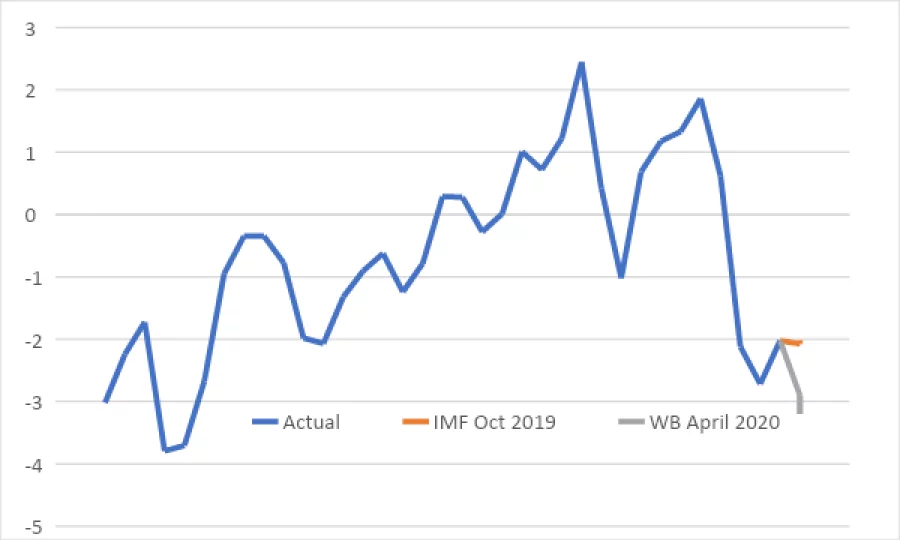
In addition to dampening household income and consumption as remittances dry up, the country’s external balances will be hit. The World Bank projects a widening of the current account deficit (Chart 4).
How concerning is that?
Chart 4: Current account deficit (% of GDP)
Source: IMF, World Bank.World Bank forecasts are for fiscal years.
The currency crisis
As the pandemic went global in February and March, financial markets around the world recoiled. Most emerging markets experienced unprecedented capital flight -- $90 billion dollars in the first quarter of 2020, far higher than was experienced during the 2008-09 global financial crisis.
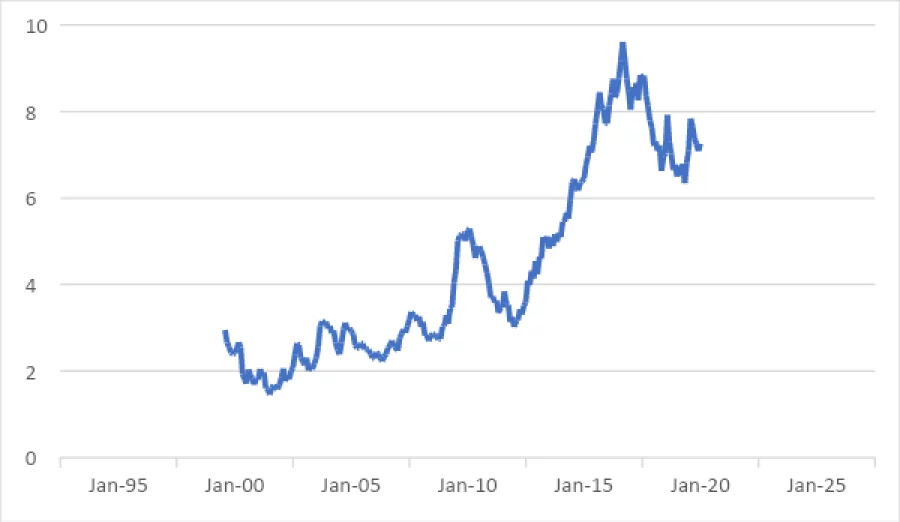
Investors did not differentiate between countries -- money simply flew to the safety of the dollar. Exchange rates tumbled -- both Indian and Pakistani rupees have fallen by over 7% since the beginning of the year. So far, the taka has avoided the carnage, and foreign exchange reserves remain ample (Chart 5).
Chart 5: Reserves in terms of months of imports
Source: CEIC Asia.
The best way to forestall a currency crisis is to avail an IMF lifeline, which is exactly what’s being done. The Fund is essentially giving free money to the developing world to cushion finances from the economic freeze. And Bangladesh has had strong macroeconomic fundamentals over the last three decades.
That is, with luck, a currency crisis should be avoided. Nonetheless, moving into the longer term, the Great Lockdown will still leave a fiscal scar. Even without any significant new policies, the World Bank expects the budget deficit to nearly double to about 10% of GDP in 2020-21. Public debt is projected to rise from 33.8% of GDP in 2018-19 to over 50% of GDP in 2021-22.
Of course, the pandemic will leave a huge fiscal imprint around the world. But as is the case for individuals, so it is for countries that the poor can afford debt the least. Ultimately, how the fiscal burden is shared between different sections of society reflects the underlying socio-political settlements. And there is no getting away from the fact that our polity was in extremely rude health well before the pandemic.
For the last four decades or so, there has been an elite consensus in Dhaka to do whatever it takes to avoid a repeat of the macabre dance of deluge and death that hit us in the early 1970s. That consensus underpinned the exports and remittance-driven growth of the last four decades and the accompanying social development.
When an economy grows at 7% a year, incomes double roughly a decade. At 3% growth rate, it takes a quarter century. A new growth and development model will be needed to revert to the faster pace of growth after the pandemic is over.
But that’s in the longer term. Before that, we will need to survive the Great Lockdown.
Jyoti Rahman is an applied macroeconomist (www.jrahman.wordpress.com).
