



Roads 5, 6 and 7 in Dhanmondi have been under excavation for around seven to eight months. In Mirpur, at least 15 roads around Paris Road remain in various stages of incomplete construction.
Different neighbourhoods, same story: unplanned development work, poor coordination among utility agencies and delays in project implementation are leaving Dhaka’s roads dug up for months, causing year-round hardship for residents.
Repeated excavation disrupts daily movement, undermines road durability, damages drainage infrastructure and increases the risk of accidents, raising questions about the effectiveness of urban development planning.
Mirpur: 15 roads left incomplete
In Mirpur’s Paris Road area, near Benaroshi Palli, excavation work began on several roads early this year.
A visit to the area on Thursday found at least 15 roads around Paris Road in various stages of incomplete construction, with several sections left unfinished.
On some roads, the Dhaka South City Corporation (DSCC) has installed drainage pipes but left the surfaces unrepaired for months.
Elsewhere, the Dhaka Water Supply and Sewerage Authority (Wasa) is installing water supply lines, while additional roads have been excavated for electricity and internet connections.
Dhanmondi: Seven to eight months of disruption
A similar situation prevails in parts of Dhanmondi, where residents have been facing prolonged disruption due to overlapping development projects.
Roads 5, 6 and 7 in Dhanmondi have remained under excavation for around seven to eight months.
According to local sources, the Dhaka Power Distribution Company (DPDC) first began work to upgrade electricity lines. Wasa subsequently undertook water supply-related work, followed by a DSCC road and drainage development project.
The DSCC project, titled “Development of Roads including Street Lights, Walkways and Drainage from Kolabagan Bus Stand to Dhanmondi Road 10, Baitul Aman Mosque, Magician Street and Dhanmondi Road 05 under Ward no 15 of zone 01 of Dhaka South City Corporation”, has been allocated Tk29 crore.
The project covers 1,350 metres of roads and 2,700 metres of drains and footpaths. Work began on July 6, 2026, and is scheduled for completion on March 13, 2027.
However, the city corporation's work came after other agencies had already been operating in the area. Residents said Wasa and other agencies had been working on the same roads for at least six to seven months before the DSCC project began.
This means residents could face at least a year of disruption due to the prolonged roadwork.
Despite more than four months having passed, little visible progress has been made beyond excavation, residents said.
DSCC Zone 1 Executive Engineer Saiful Islam Joy told Dhaka Tribune that 35% of the project work had been completed, with the remaining work underway.
Shahriar Zaman, a resident of Road 7, said several roads had been excavated simultaneously, while construction was progressing at a slow pace.
“We can no longer walk on the footpaths because they have been broken up. Traffic congestion has also become a regular problem on the roads,” he said.
Shonir Akhra: Newly repaired roads cut open again
The consequences of uncoordinated development work are also evident in Shonir Akhra, where residents have been experiencing recurring road excavation and repair work since 2024.
Rafi Kabir, a resident of the DSCC area, told Dhaka Tribune that poor coordination between the city corporation and Wasa had resulted in newly repaired roads being excavated repeatedly.
He said the problem began when Wasa first dug up a road to install water supply pipelines. However, the contractor suddenly suspended the work before completing it.
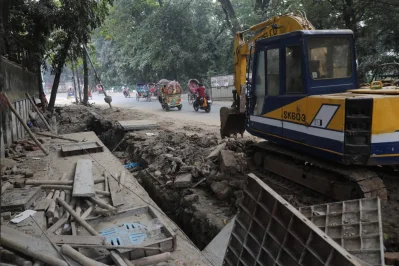
As Eid-ul-Azha approached, the excavated section was temporarily covered with soil without proper restoration. Nearly two months after the Eid holidays, workers returned and resumed excavation, this time digging through the middle of the road.
Risks to safety and drainage
Residents said repeated excavation had left several roads in poor and potentially hazardous condition.
They also complained that roads were often not restored to their original condition after utility work. Uneven surfaces, raised sections and incomplete repairs obstruct vehicle movement, increase the risk of accidents and raise questions about the durability of newly constructed roads.
The disruption also extends to drainage infrastructure. Residents fear that excavation work damages existing drains, while soil and construction debris obstruct water flow.
Without proper restoration and maintenance, reduced drainage capacity could worsen waterlogging, particularly during the monsoon.
Bridge work adds to Shonir Akhra woes
Residents of Shonir Akhra have also faced prolonged hardship over the construction of a bridge on the route to Shonir Akhra Bazar.
According to locals, the previous structure had repeatedly collapsed, making it dangerous to cross. Several accidents had occurred in the past, with people and vehicles falling into the canal and leaving many injured.
Although reconstruction was undertaken in response to longstanding public demands, residents alleged that completing the work took around six to seven months. They believe it could have been completed within a month with proper planning and timely implementation.
The timing of the work also drew criticism. Residents said the bridge should have been constructed before the road was raised and water pipelines installed. Instead, Wasa's pipeline installation and road-raising work were followed by further disruption for bridge construction.
The road has recently been reopened to traffic after months of hardship. However, residents remain apprehensive that another agency may soon begin fresh excavation.
Coordination efforts fall short
Several officials from DSCC, Dhaka North City Corporation (DNCC) and Wasa told Dhaka Tribune that they were trying to coordinate road development, drainage, footpath construction, water supply pipelines and sewerage works.
They acknowledged that carrying out water supply and sewerage installations separately often results in repeated excavation, increasing public inconvenience and reducing road durability.
DSCC Chief Engineer Nur Azizur Rahman told Dhaka Tribune that the corporation regularly held coordination meetings with agencies involved in urban utility services to ensure development work was completed within stipulated deadlines.
“However, these efforts are not always effective. Wasa often fails to complete its work within the scheduled time. As a result, even when we are ready, we cannot begin our work until they finish theirs,” he said.
He explained that although the agencies wanted to complete interconnected projects within a short period, the sequence of work often prevented them from doing so.
He also pointed to jurisdictional complications, as several ministries, including the Local Government Division and the Ministry of Energy and Mineral Resources, oversee different utility agencies.
“Sometimes contractors also delay the work, citing various problems and excuses,” he added.
DNCC Chief Engineer Brig Gen Syed Rakibul Hasan, PSC, said road development projects faced multiple challenges, including poor coordination, road-related complications, deliberate delays by contractors and funding constraints.
He said different agencies had separate responsibilities and funding sources, making it difficult to complete road and sewerage projects within a short period.
He also pointed to shortcomings in Dhaka's sewerage infrastructure, saying many residential buildings lacked separate septic tanks and relied on city corporation sewerage networks.
“These systems are not suitable for handling everything. As a result, they often become dysfunctional after three to four years, forcing city corporations to excavate roads again to carry out repairs,” he told Dhaka Tribune.
He added that city corporations tried to complete projects within their scheduled timelines.
Annual work plans needed
Urban planning expert and Professor Adil Mohammad Khan said coordination and timely implementation were essential to reducing public suffering.
He said city corporations had long been asking different utility agencies to submit their development plans for the coming years so that work could be scheduled according to location and priority.
However, he alleged that agencies often withheld information about their future projects due to institutional interests, weak oversight and a reluctance to share authority and accountability with other organisations.
He stressed that all agencies involved in urban development should submit at least annual work plans to the respective city corporations before undertaking excavation.
“Based on these plans, the Local Government Division can determine when and where each project should be implemented and which work should precede another,” he said.
Adil Mohammad Khan said such advance planning would allow road construction, water supply, drainage and sewerage installations to be completed in a coordinated sequence, significantly reducing repeated excavation and public inconvenience.
He urged the government to introduce a mechanism to ensure accountability and coordination among all relevant agencies.
Without integrated planning, timely implementation and proper restoration of excavated roads, Dhaka residents are likely to continue paying the price of development work through prolonged disruption to their everyday lives.
