In the face of repeated bashing on the legislative and executive branches by the chief justice, stating that the judiciary was a hundred times better any other branches of the state, the attorney general had a strong rejoinder on Wednesday: The Supreme Court could hold a public hearing to assess if justice seekers had faith in the courts.
During the sixth-day hearing before a seven-member Appellate Division bench headed by Chief Justice Surendra Kumar Sinha for an appeal filed by the government against a High Court verdict which scrapped the 16th amendment to the constitution, yet another argument broke out between the chief justice and the attorney general.
A showdown between the chief justice and the chief judicial officer of the state has almost become a everyday matter since the beginning of the hearing of this crucial but sensitive constitutional issue.
‘Even Chowki Adalat is better than other branches of state’
At one point during the hearing, Justice Sinha said: “I went to a Chowki Adalat in Banshkhali [Chittagong]. Many justice seekers were seen coming to the Adalat instead of the deputy commissioner’s office. So, the judiciary is hundred times better that any institutions.”
The Chowki Adalat is a type of special court set up during the British era in rural areas to settle civil and criminal cases. In some rural areas of Bangladesh, such courts are still in operation, which provide judicial services to justice seekers.
To that, Mahbubey replied: “I am absolutely not happy [with the current status of the judiciary].”
“You know and everyone knows what you want,” the Chief Justice told him.
Though Sinha did not elaborate on the jab, it was apparent that he was referring to the long-standing tug-of-war between the executive and judicial bodies regarding the full implementation of the December 1999 verdict of State v Masdar Hossain which required the official separation of the judiciary from executive control.
The Supreme Court issued a 12-point directive for the lower court judges including the formulation of separate disciplinary rules. The Ministry of Law submitted the draft of the code of conduct to the Supreme Court on May 7, 2015. The court sent the draft back to the ministry with some modifications and asked the government to finalise the code and issue a gazette notification.
On December 12 last year, the court asked the authorities concerned to issue the gazette by January 15 this year. Since then, the government has been repeatedly asking for time extensions, having failed to meet all the deadlines set by the top court.
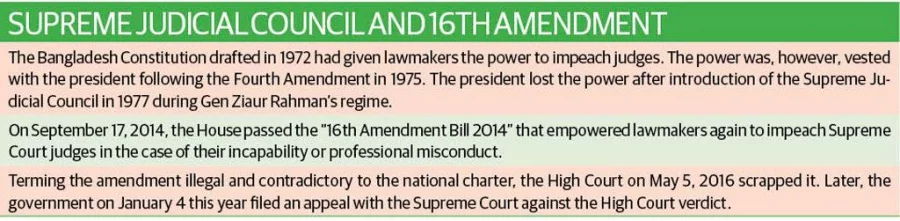 ‘Supreme Judicial Council, state religion shameful issues for Constitution’
Instead of lengthening the point, the attorney general moved the conversation back to the High Court verdict being appealed.
“The Supreme Judicial Council was brought through martial law, which is a shame for the Constitution,” said Mahbubey.
The Supreme Judicial Council, composed of the chief justice and two of the senior most Supreme Court judges, was empowered to impeach judges for their incapacity to carry out their duties and for professional misconduct.
The attorney general also mentioned the issue of a state religion during his argument, which he termed as “a shame for the Constitution as well.”
Rebuttal by the attorney general
The bench then asked him why the state religion has been kept in the Constitution but the council no longer exists.
Mahbubey, in his counter-argument, said the court has no jurisdiction to touch provisions of 1972 Constitution, which the bench strongly objected.
During the hearing, Chief Justice Sinha gave him a handout on the British judicial system. When the attorney general finished reading it out, he told him that the arguments they had earlier put forward lacked proper information and facts about the country’s judiciary.
The hearing was adjourned until Thursday.
Tuesday’s showdown
On Tuesday, during the fifth-day hearing, Justice Sinha observed that the state is trying to tighten its grip on the apex court after having taken control of the lower ones.
“As a result, we can’t appoint judges in many cases. Even in some cases, the Law Ministry is not taking proper steps although the Supreme Court asks for taking actions against lower court judges following allegations,” he said.
During the hearing, the bench also talked about Article 70 of the constitution, which allows the cancellation of membership of a lawmaker for voting against his or her party's decision in the House.
He asked: “Why has the government not removed the article yet?
“If the government cannot trust them [the lawmakers], then where is the assurance that this [impeachment] will not happen to the judges?
When Mahbubey Alam said “the president can remove a justice if he wants” as there is no law in this regard after the amendment was scrapped, the chief justice with a resentful look replied: “Will the president dismiss a judge without any law? How many thousand years do you want to take the country back? How do you think this?”




 ‘Supreme Judicial Council, state religion shameful issues for Constitution’Instead of lengthening the point, the attorney general moved the conversation back to the High Court verdict being appealed.
“The Supreme Judicial Council was brought through martial law, which is a shame for the Constitution,” said Mahbubey.
The Supreme Judicial Council, composed of the chief justice and two of the senior most Supreme Court judges, was empowered to impeach judges for their incapacity to carry out their duties and for professional misconduct.
The attorney general also mentioned the issue of a state religion during his argument, which he termed as “a shame for the Constitution as well.”
‘Supreme Judicial Council, state religion shameful issues for Constitution’Instead of lengthening the point, the attorney general moved the conversation back to the High Court verdict being appealed.
“The Supreme Judicial Council was brought through martial law, which is a shame for the Constitution,” said Mahbubey.
The Supreme Judicial Council, composed of the chief justice and two of the senior most Supreme Court judges, was empowered to impeach judges for their incapacity to carry out their duties and for professional misconduct.
The attorney general also mentioned the issue of a state religion during his argument, which he termed as “a shame for the Constitution as well.”