



 With the view that age should be one of the key considerations, the High Court also stated that the minimum age of a person intending to be selected for appointment as a Judge of the Supreme Court should be 45 years, since a person only achieves professional maturity after years of hard work in the professional arena.
The High Court also opined that the remuneration of judges of the Supreme Court should be made as attractive as possible so that brilliant lawyers would be enticed to apply.
“...We think that the existing system of appointment can be improved by the Chief Justice as he is the best and prime person to evaluate which lawyers and judicial officers working in the sub-ordinate judiciary are truly eligible to be elevated to the Bench―and we mean it,” read the verdict.
It charged the Chief Justice to, if necessary, consult with or share views with two senior judges of the Appellate Division and two of senior judges of the High Court Division when forming his “opinion”and to ensure that the recommendations given are appropriate, effective and transparent.
The court also said once the Chief Justice’s recommendations are made, there should be no room for the recommendations to be rejected or changed unless the person[s] recommended are found to have antecedents involved in anti-state or otherwise subversive activities.
With the view that age should be one of the key considerations, the High Court also stated that the minimum age of a person intending to be selected for appointment as a Judge of the Supreme Court should be 45 years, since a person only achieves professional maturity after years of hard work in the professional arena.
The High Court also opined that the remuneration of judges of the Supreme Court should be made as attractive as possible so that brilliant lawyers would be enticed to apply.
“...We think that the existing system of appointment can be improved by the Chief Justice as he is the best and prime person to evaluate which lawyers and judicial officers working in the sub-ordinate judiciary are truly eligible to be elevated to the Bench―and we mean it,” read the verdict.
It charged the Chief Justice to, if necessary, consult with or share views with two senior judges of the Appellate Division and two of senior judges of the High Court Division when forming his “opinion”and to ensure that the recommendations given are appropriate, effective and transparent.
The court also said once the Chief Justice’s recommendations are made, there should be no room for the recommendations to be rejected or changed unless the person[s] recommended are found to have antecedents involved in anti-state or otherwise subversive activities.An individual cannot be recommended for appointment as a judge of the High Court if his antecedents are not in line with the fundamental principles of state policy and the spirit of the Liberation War.
This observation was made in a verdict which lists seven criteria to be fulfilled in order for an individual to be recommended for a judge position in the High Court division.
The full 46-page verdict of the seven-year-old writ petition which sought guidelines for the appointment of HC judges was published on Monday, though the verdict itself was pronounced by Justice Obaidul Hassan and Justice Krishna Debnath on April 13 this year.
According to the verdict, for a person to be recommended to for a HC judge position, he must have a “brilliant academic profile, towering level of professional skill, legal acumen and integrity”.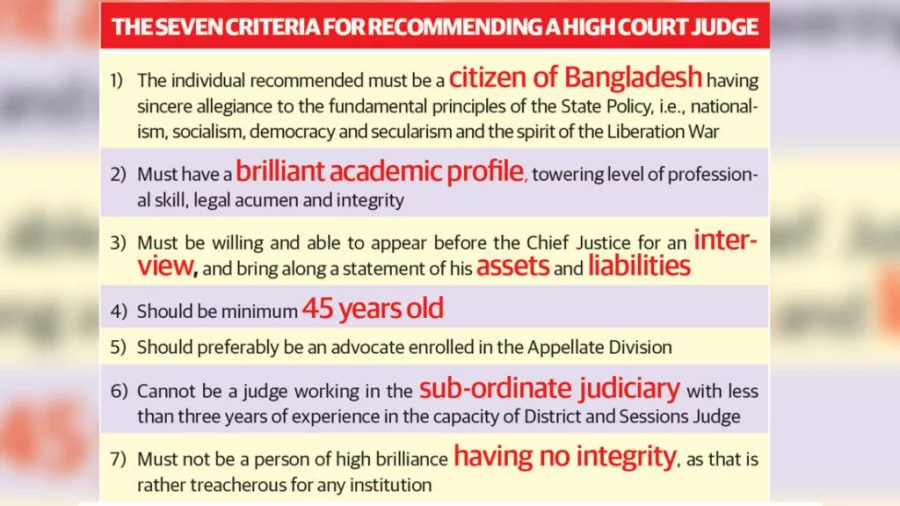 With the view that age should be one of the key considerations, the High Court also stated that the minimum age of a person intending to be selected for appointment as a Judge of the Supreme Court should be 45 years, since a person only achieves professional maturity after years of hard work in the professional arena.
The High Court also opined that the remuneration of judges of the Supreme Court should be made as attractive as possible so that brilliant lawyers would be enticed to apply.
“...We think that the existing system of appointment can be improved by the Chief Justice as he is the best and prime person to evaluate which lawyers and judicial officers working in the sub-ordinate judiciary are truly eligible to be elevated to the Bench―and we mean it,” read the verdict.
It charged the Chief Justice to, if necessary, consult with or share views with two senior judges of the Appellate Division and two of senior judges of the High Court Division when forming his “opinion”and to ensure that the recommendations given are appropriate, effective and transparent.
The court also said once the Chief Justice’s recommendations are made, there should be no room for the recommendations to be rejected or changed unless the person[s] recommended are found to have antecedents involved in anti-state or otherwise subversive activities.
With the view that age should be one of the key considerations, the High Court also stated that the minimum age of a person intending to be selected for appointment as a Judge of the Supreme Court should be 45 years, since a person only achieves professional maturity after years of hard work in the professional arena.
The High Court also opined that the remuneration of judges of the Supreme Court should be made as attractive as possible so that brilliant lawyers would be enticed to apply.
“...We think that the existing system of appointment can be improved by the Chief Justice as he is the best and prime person to evaluate which lawyers and judicial officers working in the sub-ordinate judiciary are truly eligible to be elevated to the Bench―and we mean it,” read the verdict.
It charged the Chief Justice to, if necessary, consult with or share views with two senior judges of the Appellate Division and two of senior judges of the High Court Division when forming his “opinion”and to ensure that the recommendations given are appropriate, effective and transparent.
The court also said once the Chief Justice’s recommendations are made, there should be no room for the recommendations to be rejected or changed unless the person[s] recommended are found to have antecedents involved in anti-state or otherwise subversive activities.
With the view that age should be one of the key considerations, the High Court also stated that the minimum age of a person intending to be selected for appointment as a Judge of the Supreme Court should be 45 years, since a person only achieves professional maturity after years of hard work in the professional arena.
The High Court also opined that the remuneration of judges of the Supreme Court should be made as attractive as possible so that brilliant lawyers would be enticed to apply.
“...We think that the existing system of appointment can be improved by the Chief Justice as he is the best and prime person to evaluate which lawyers and judicial officers working in the sub-ordinate judiciary are truly eligible to be elevated to the Bench―and we mean it,” read the verdict.
It charged the Chief Justice to, if necessary, consult with or share views with two senior judges of the Appellate Division and two of senior judges of the High Court Division when forming his “opinion”and to ensure that the recommendations given are appropriate, effective and transparent.
The court also said once the Chief Justice’s recommendations are made, there should be no room for the recommendations to be rejected or changed unless the person[s] recommended are found to have antecedents involved in anti-state or otherwise subversive activities.