



 According to Section 110 of the Banking Companies Act 1991, a manager or officer or any other functionary of a banking company shall be deemed to be a public servant under Section 21 of the Penal Code.
Though Tarique and Mominur were trustees of the private trust, they will be considered government employees as per the trust’s deed, the judgment says.
The lower court also took into account a previous decision of the Appellate Division, according to which a trustee shall be regarded as public servant.
Kamal was a public servant because he was the principal secretary to Khaleda during her first stint (1991-1996) as prime minister.
About Sharfuddin, the court said he could be tried under Section 409 as he was a businessman, that is, he was a merchant and involved in misappropriation of the funds.
According to Section 110 of the Banking Companies Act 1991, a manager or officer or any other functionary of a banking company shall be deemed to be a public servant under Section 21 of the Penal Code.
Though Tarique and Mominur were trustees of the private trust, they will be considered government employees as per the trust’s deed, the judgment says.
The lower court also took into account a previous decision of the Appellate Division, according to which a trustee shall be regarded as public servant.
Kamal was a public servant because he was the principal secretary to Khaleda during her first stint (1991-1996) as prime minister.
About Sharfuddin, the court said he could be tried under Section 409 as he was a businessman, that is, he was a merchant and involved in misappropriation of the funds.BNP Chairperson and former prime minister Khaleda Zia and five others, who have been convicted in the much-talked-about Zia Orphanage Trust graft case, were tried under Section 409 and 109 of the Penal Code, and 5(2) of the Prevention of Corruption Act 1947.
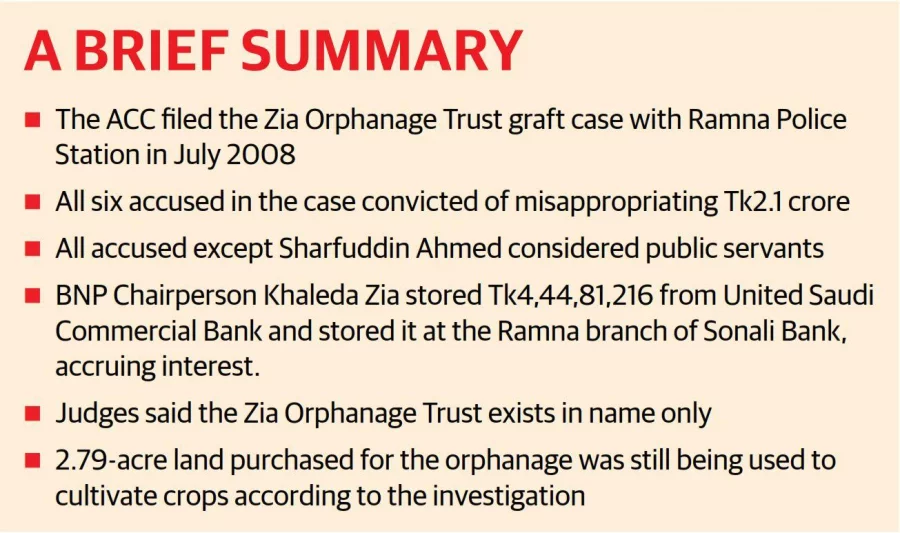
The other five convicts are Tarique Rahman, Khaleda’s elder son; Kazi Salimul Haque, a former BNP lawmaker from Magura; Sharfuddin Ahmed, a businessman; Mominur Rahman, a cousin of Tarique; and Kamal Uddin Siddique, principal secretary to then prime minister Khaleda Zia.
Punishment for a criminal breach of trust by a public servant, banker, merchant or agent is defined in Section 409 of the Penal Code.
Anti-Corruption Commission filed the case with Ramna Police Station in July 2008, accusing the six of misappropriating over Tk2.1 crore that had come from a foreign bank as grants for orphans.
The trial court, which sentenced Khaleda to five years’ rigorous imprisonment and the rest to 10 years with a fine of Tk2.10 crore each on February 8, said in its full verdict that a person has to be a government employee, a banker, a merchant or an agent to be tried under Section 409.
All the accused in the case, excluding Sharfuddin, were public servants, and they were involved in misappropriating the public money, it added.
Both Khaleda and Salimul were members of parliament. As per relevant laws, lawmakers are considered government employees, the verdict explains.
The court regarded Salimul as public servant also because he was the chairman and director of a bank (Prime Bank Ltd) then. According to Section 110 of the Banking Companies Act 1991, a manager or officer or any other functionary of a banking company shall be deemed to be a public servant under Section 21 of the Penal Code.
Though Tarique and Mominur were trustees of the private trust, they will be considered government employees as per the trust’s deed, the judgment says.
The lower court also took into account a previous decision of the Appellate Division, according to which a trustee shall be regarded as public servant.
Kamal was a public servant because he was the principal secretary to Khaleda during her first stint (1991-1996) as prime minister.
About Sharfuddin, the court said he could be tried under Section 409 as he was a businessman, that is, he was a merchant and involved in misappropriation of the funds.
According to Section 110 of the Banking Companies Act 1991, a manager or officer or any other functionary of a banking company shall be deemed to be a public servant under Section 21 of the Penal Code.
Though Tarique and Mominur were trustees of the private trust, they will be considered government employees as per the trust’s deed, the judgment says.
The lower court also took into account a previous decision of the Appellate Division, according to which a trustee shall be regarded as public servant.
Kamal was a public servant because he was the principal secretary to Khaleda during her first stint (1991-1996) as prime minister.
About Sharfuddin, the court said he could be tried under Section 409 as he was a businessman, that is, he was a merchant and involved in misappropriation of the funds.
According to Section 110 of the Banking Companies Act 1991, a manager or officer or any other functionary of a banking company shall be deemed to be a public servant under Section 21 of the Penal Code.
Though Tarique and Mominur were trustees of the private trust, they will be considered government employees as per the trust’s deed, the judgment says.
The lower court also took into account a previous decision of the Appellate Division, according to which a trustee shall be regarded as public servant.
Kamal was a public servant because he was the principal secretary to Khaleda during her first stint (1991-1996) as prime minister.
About Sharfuddin, the court said he could be tried under Section 409 as he was a businessman, that is, he was a merchant and involved in misappropriation of the funds.