




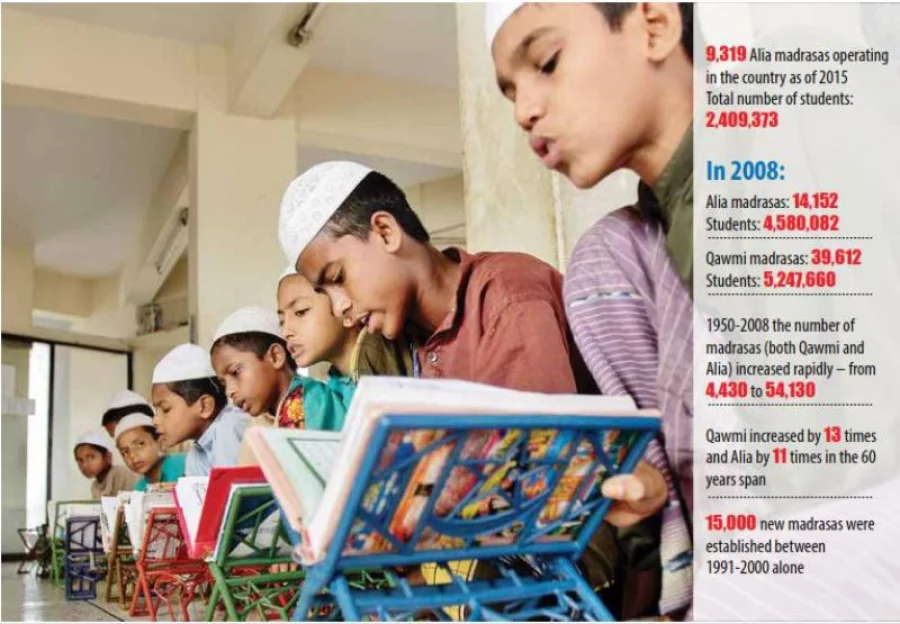
 Islamic school students sit in a classroom on the outskirts of Dhaka RAJIB DHARProf Abul Barkat’s research says, number of students in Alia mardasas until 2008 was 4,580,082. He said that the number of Qawmi madrasas was 39,612 that year where 5,247,660 students studied at different classes.
BANBEIS keeps no data of the students and number of madrasa of Qawmi stream.
Prof Barakat’s research indicates that between 1950-2008 the number of madrasas increased rapidly—from 4,430 to 54,130. This includes both Qawmi and Alia madrasas. The Qawmi ones increased 13 times and Alia 11 times in the 60 years span.
Between 1991-2000 the growth rate was highest when 15,000 new madrasas were added across the country.
Discussions with researchers, politicians and teachers points to religion being politicized and belief systems becoming entrenched, bolstering the grown rate of madrasa in Bangladesh.
The government’s negligence to introduce proper education guidelines has also had an impact.
Mawlana Rafiqul Alam, Principle of Monshipara Hafijiya Madrasa and Orphanage in Gazipur said to Dhaka Tribune: “The objectives of Qawmi madrasa education and general education system are totally different. People who want to pursue religious work opt for madrasa”.
Qawmi madrasas are operating under more than a dozen education boards. A handful of Qawmi madrasas are not under any board. Then there are Maktabs, which are often attached to a mosque. This primary type of institutions are being established to tutor children in reading, writing, grammar and Islamic studies such as Qira’at (Quranic recitation) at rural and town areas.
Befaqul Madarisil Arabia Bangladesh (Befaq) or Bangladesh Qawmi madrasa education board is the most popular regulatory board of Qawmi madrasas. Under Befaq there are approximately, 5,451 madrasa as per their website.
“A vast number of people in our society want to build madrasa because of their personal religious beliefs,” added Rafiqul.
Befaqul Madarisil Arabia Bangladesh (Befaq), aims to encourage dignitaries to form more madrasas in their communities. They aim to promote Islam and claims that as a result, almost all villages in the country have a madrasa.
Explaining why madrasas are popular, Rafiqul said: “Madrasa education is significantly cheaper than general education. In addition, they also offer residential facilities which otherwise are not available in normal schools at cheap cost,” he added.
The interesting fact of Qawmi madrasa is, they reject state funding and instead rely on donations from the public to run their activities.
Islamic school students sit in a classroom on the outskirts of Dhaka RAJIB DHARProf Abul Barkat’s research says, number of students in Alia mardasas until 2008 was 4,580,082. He said that the number of Qawmi madrasas was 39,612 that year where 5,247,660 students studied at different classes.
BANBEIS keeps no data of the students and number of madrasa of Qawmi stream.
Prof Barakat’s research indicates that between 1950-2008 the number of madrasas increased rapidly—from 4,430 to 54,130. This includes both Qawmi and Alia madrasas. The Qawmi ones increased 13 times and Alia 11 times in the 60 years span.
Between 1991-2000 the growth rate was highest when 15,000 new madrasas were added across the country.
Discussions with researchers, politicians and teachers points to religion being politicized and belief systems becoming entrenched, bolstering the grown rate of madrasa in Bangladesh.
The government’s negligence to introduce proper education guidelines has also had an impact.
Mawlana Rafiqul Alam, Principle of Monshipara Hafijiya Madrasa and Orphanage in Gazipur said to Dhaka Tribune: “The objectives of Qawmi madrasa education and general education system are totally different. People who want to pursue religious work opt for madrasa”.
Qawmi madrasas are operating under more than a dozen education boards. A handful of Qawmi madrasas are not under any board. Then there are Maktabs, which are often attached to a mosque. This primary type of institutions are being established to tutor children in reading, writing, grammar and Islamic studies such as Qira’at (Quranic recitation) at rural and town areas.
Befaqul Madarisil Arabia Bangladesh (Befaq) or Bangladesh Qawmi madrasa education board is the most popular regulatory board of Qawmi madrasas. Under Befaq there are approximately, 5,451 madrasa as per their website.
“A vast number of people in our society want to build madrasa because of their personal religious beliefs,” added Rafiqul.
Befaqul Madarisil Arabia Bangladesh (Befaq), aims to encourage dignitaries to form more madrasas in their communities. They aim to promote Islam and claims that as a result, almost all villages in the country have a madrasa.
Explaining why madrasas are popular, Rafiqul said: “Madrasa education is significantly cheaper than general education. In addition, they also offer residential facilities which otherwise are not available in normal schools at cheap cost,” he added.
The interesting fact of Qawmi madrasa is, they reject state funding and instead rely on donations from the public to run their activities.A total of 68 madrasas dot the eight kilometre stretch of highway going from Jatrabari to Kachpur.
There are 66 Qawmi madrasas, privately owned, while only 2 Alia madrasa exist that are government affiliated.
These privately owned Qawmi madrasas do not receive financial assistance from the government and are only able to operate with the aid of contributions and donations made by the locals or patrons.
There are however some exceptions such as madrasas that run an orphanage and are given financial aid strictly for the use of the orphanage. The madrasas that incorporate orphanages are sometimes given financial aid, following background checks and screening by government officials. It should be pointed out that
some institutions exploit this loophole.
Dhaka Tribune has found there are 47 schools and colleges that enjoy government support and are situated in the vicinity of the same eight kilometer highway.
Forming an Alia madrasa requires government permission. Until 1970, there were an estimated 2,721 Alia madrasas in the country, as per Prof Abul Barkat, author of Political Economy of Madrasa Education in Bangladesh published in 2011.
In 2008, the total number of Alia madrasas stood at 14,152.
Bangladesh Bureau of Educational Information and Statistics (BANBEIS), however, says that as of 2015 total of 9,319 Alia madrasas were operating in the country. Of them three are government and others are non-government. The number of total students are 2,409,373. Islamic school students sit in a classroom on the outskirts of Dhaka RAJIB DHARProf Abul Barkat’s research says, number of students in Alia mardasas until 2008 was 4,580,082. He said that the number of Qawmi madrasas was 39,612 that year where 5,247,660 students studied at different classes.
BANBEIS keeps no data of the students and number of madrasa of Qawmi stream.
Prof Barakat’s research indicates that between 1950-2008 the number of madrasas increased rapidly—from 4,430 to 54,130. This includes both Qawmi and Alia madrasas. The Qawmi ones increased 13 times and Alia 11 times in the 60 years span.
Between 1991-2000 the growth rate was highest when 15,000 new madrasas were added across the country.
Discussions with researchers, politicians and teachers points to religion being politicized and belief systems becoming entrenched, bolstering the grown rate of madrasa in Bangladesh.
The government’s negligence to introduce proper education guidelines has also had an impact.
Mawlana Rafiqul Alam, Principle of Monshipara Hafijiya Madrasa and Orphanage in Gazipur said to Dhaka Tribune: “The objectives of Qawmi madrasa education and general education system are totally different. People who want to pursue religious work opt for madrasa”.
Qawmi madrasas are operating under more than a dozen education boards. A handful of Qawmi madrasas are not under any board. Then there are Maktabs, which are often attached to a mosque. This primary type of institutions are being established to tutor children in reading, writing, grammar and Islamic studies such as Qira’at (Quranic recitation) at rural and town areas.
Befaqul Madarisil Arabia Bangladesh (Befaq) or Bangladesh Qawmi madrasa education board is the most popular regulatory board of Qawmi madrasas. Under Befaq there are approximately, 5,451 madrasa as per their website.
“A vast number of people in our society want to build madrasa because of their personal religious beliefs,” added Rafiqul.
Befaqul Madarisil Arabia Bangladesh (Befaq), aims to encourage dignitaries to form more madrasas in their communities. They aim to promote Islam and claims that as a result, almost all villages in the country have a madrasa.
Explaining why madrasas are popular, Rafiqul said: “Madrasa education is significantly cheaper than general education. In addition, they also offer residential facilities which otherwise are not available in normal schools at cheap cost,” he added.
The interesting fact of Qawmi madrasa is, they reject state funding and instead rely on donations from the public to run their activities.
Islamic school students sit in a classroom on the outskirts of Dhaka RAJIB DHARProf Abul Barkat’s research says, number of students in Alia mardasas until 2008 was 4,580,082. He said that the number of Qawmi madrasas was 39,612 that year where 5,247,660 students studied at different classes.
BANBEIS keeps no data of the students and number of madrasa of Qawmi stream.
Prof Barakat’s research indicates that between 1950-2008 the number of madrasas increased rapidly—from 4,430 to 54,130. This includes both Qawmi and Alia madrasas. The Qawmi ones increased 13 times and Alia 11 times in the 60 years span.
Between 1991-2000 the growth rate was highest when 15,000 new madrasas were added across the country.
Discussions with researchers, politicians and teachers points to religion being politicized and belief systems becoming entrenched, bolstering the grown rate of madrasa in Bangladesh.
The government’s negligence to introduce proper education guidelines has also had an impact.
Mawlana Rafiqul Alam, Principle of Monshipara Hafijiya Madrasa and Orphanage in Gazipur said to Dhaka Tribune: “The objectives of Qawmi madrasa education and general education system are totally different. People who want to pursue religious work opt for madrasa”.
Qawmi madrasas are operating under more than a dozen education boards. A handful of Qawmi madrasas are not under any board. Then there are Maktabs, which are often attached to a mosque. This primary type of institutions are being established to tutor children in reading, writing, grammar and Islamic studies such as Qira’at (Quranic recitation) at rural and town areas.
Befaqul Madarisil Arabia Bangladesh (Befaq) or Bangladesh Qawmi madrasa education board is the most popular regulatory board of Qawmi madrasas. Under Befaq there are approximately, 5,451 madrasa as per their website.
“A vast number of people in our society want to build madrasa because of their personal religious beliefs,” added Rafiqul.
Befaqul Madarisil Arabia Bangladesh (Befaq), aims to encourage dignitaries to form more madrasas in their communities. They aim to promote Islam and claims that as a result, almost all villages in the country have a madrasa.
Explaining why madrasas are popular, Rafiqul said: “Madrasa education is significantly cheaper than general education. In addition, they also offer residential facilities which otherwise are not available in normal schools at cheap cost,” he added.
The interesting fact of Qawmi madrasa is, they reject state funding and instead rely on donations from the public to run their activities.
Islamic school students sit in a classroom on the outskirts of Dhaka RAJIB DHARProf Abul Barkat’s research says, number of students in Alia mardasas until 2008 was 4,580,082. He said that the number of Qawmi madrasas was 39,612 that year where 5,247,660 students studied at different classes.
BANBEIS keeps no data of the students and number of madrasa of Qawmi stream.
Prof Barakat’s research indicates that between 1950-2008 the number of madrasas increased rapidly—from 4,430 to 54,130. This includes both Qawmi and Alia madrasas. The Qawmi ones increased 13 times and Alia 11 times in the 60 years span.
Between 1991-2000 the growth rate was highest when 15,000 new madrasas were added across the country.
Discussions with researchers, politicians and teachers points to religion being politicized and belief systems becoming entrenched, bolstering the grown rate of madrasa in Bangladesh.
The government’s negligence to introduce proper education guidelines has also had an impact.
Mawlana Rafiqul Alam, Principle of Monshipara Hafijiya Madrasa and Orphanage in Gazipur said to Dhaka Tribune: “The objectives of Qawmi madrasa education and general education system are totally different. People who want to pursue religious work opt for madrasa”.
Qawmi madrasas are operating under more than a dozen education boards. A handful of Qawmi madrasas are not under any board. Then there are Maktabs, which are often attached to a mosque. This primary type of institutions are being established to tutor children in reading, writing, grammar and Islamic studies such as Qira’at (Quranic recitation) at rural and town areas.
Befaqul Madarisil Arabia Bangladesh (Befaq) or Bangladesh Qawmi madrasa education board is the most popular regulatory board of Qawmi madrasas. Under Befaq there are approximately, 5,451 madrasa as per their website.
“A vast number of people in our society want to build madrasa because of their personal religious beliefs,” added Rafiqul.
Befaqul Madarisil Arabia Bangladesh (Befaq), aims to encourage dignitaries to form more madrasas in their communities. They aim to promote Islam and claims that as a result, almost all villages in the country have a madrasa.
Explaining why madrasas are popular, Rafiqul said: “Madrasa education is significantly cheaper than general education. In addition, they also offer residential facilities which otherwise are not available in normal schools at cheap cost,” he added.
The interesting fact of Qawmi madrasa is, they reject state funding and instead rely on donations from the public to run their activities.