



Minister for environment and climate change Saber Hossain Choudhury has said that he is working to create a platform where all development partners will come together and work for “Bangladesh projects” for better impacts.
“I think this is going to define how we work with our development partners in the coming years,” he said, adding that the private sector will also be incorporated in different working groups under the platform.
He, however, asked the private sector to change its mindset and see sustainability as an investment case, rather than the traditional approach of considering it as a cost.
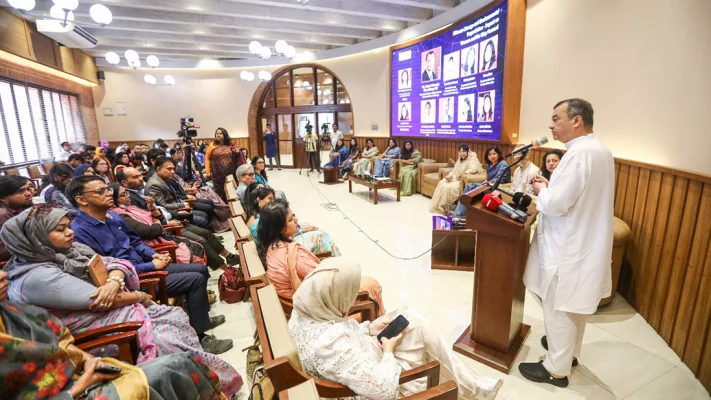
The minister was speaking at a seminar on "Climate Change and Environmental Degradation: Impact on Women and the Way Forward" at the Parliament Club on Saturday.
The Saarc Business Council – Bangladesh (SBCB) of the Women’s Indian Chamber of Commerce & Industry (WICCI) organized the seminar with the minister as the chief guest.
Dr Samiya Ahmed Selim, director of the Centre for Sustainable Development at the University of Liberal Arts Bangladesh, presented the keynote paper.
The seminar featured discussions on various aspects, including effective management of real estate development and construction to mitigate environmental impacts, and empowering women through clean energy.
Daniel Novac, first secretary (Program Specialist Health Sector) of the Embassy of Sweden in Dhaka, shed light on the impact of climate change on female health. Runa Khan, executive director of Friendship, discussed livelihood opportunities for marginal women affected by climate change.
Dilruba Haider, UN Women’s program specialist for climate change, shared insights into the agency’s efforts to alleviate the adverse effects of climate change on women in Bangladesh. Dr Farhina Ahmed, secretary for Environment and Forest, outlined government initiatives aimed at mitigating these impacts.
Srabani Datta, director of ABC Real Estates, addressed strategies for managing real estate development and construction to minimize environmental impact. Meanwhile, Azeeza Aziz Khan, director of the Summit Group, emphasized empowering women through clean energy and bridging gaps in energy access, supply chains, and logistics.
Dr Mantasha Ahmed, president of SBCB of WICCI, delivered the welcome remarks, while Nusrat Aman, SBCB member and CEO of Ayat Education, introduced the panel. Dr Maliha Mannan, founder of Organikare Limited and Public Health Communicator, concluded with a vote of thanks.
They explored women's roles in tackling climate change.
During her keynote presentation, Dr Samiya Ahmed emphasized the necessity of incorporating gender perspectives into climate action, highlighting the disproportionate impact on women. She recommended prioritizing investment in climate adaptation projects led by women.
The seminar was organized to raise awareness about the environmental hazards faced by women, particularly rural and marginalized women, a crucial but often overlooked aspect of climate change, President Dr Mantasha Ahmed said.
Bangladesh projects
Minister Saber Hossain Chowdhury invited the women entrepreneurs of the Saarc Business Council to join the upcoming platform of development partners and put forward the women's aspect, and the gender dimension of climate change.
“We have been working over the last six, seven months to try and put together a platform where we will have all of the development partners.
“So whether it is Swedish SIDA, Canadian CIDA, whoever, UNDP, everybody comes into one platform. And the reason we want to do that is because we feel there is fragmentation, there is duplication, there is overlapping of resources,” he said.
“If everyone comes into the one platform, and then these would be Bangladesh projects, I don't feel very dignified when I hear about a World Bank project being funded in Bangladesh. It should be a Bangladesh government project which is assisted by the World Bank,” the minister said.
“So we determine, just as women on the table determine what their priorities are, we, as a country, want to determine what our priorities are,” he told the women entrepreneurs.
There will be a few working groups and the private sector will be represented in each of those groups.
“So there will be a group, for instance, to look at what should be our priority. Then there will be a group to see how we will put that priority into action,” he explained.
He, however, lamented that the private sector still looks at sustainability as a cost, not as an investor.
“And unless we change that business as usual approach, we are not really going to go very far because we know sustainability makes commercial sense, it is good for the bottom line. So it is not either or. Am I going to be sustainable and compromise on my bottom line or is sustainability going to add to my bottom line?” he said, seeking support from the Saarc Business Council to get that change in mindset in the business sector.
He also acknowledged the disproportionate impacts of climate change on women's health and said if climate change and temperature rise continue the way they are, the impacts on women's health will be devastating.
