



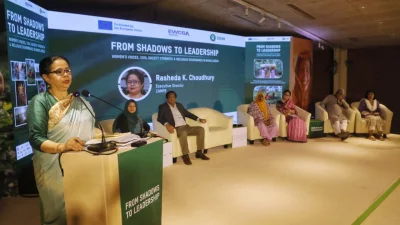
Bangladesh’s vast economy—where women make up most of the 85% working in informal and marginalized formal systems—took centre stage in the capital yesterday as women from domestic work, tea gardens, fisheries and home-based readymade garment work confronted government and relevant actors at the “From Shadows to Leadership” event, exposing inequalities while showcasing emerging changes.
The event, organized by Oxfam in Bangladesh with 33 civil society partners and co-funded by the EU under the Empowering Women Through Civil Society Actors in Bangladesh (EWCSA) project, highlighted the baseline findings: only 0.73% of women had formal contracts, 85% lacked rights awareness, and most had never engaged with a civil society organization (CSO)—evidence of deep policy gaps and long-standing invisibility. Yet in five years, EWCSA has shifted this trajectory, with women emerging as leaders, organizing collectively and engaging institutions that once overlooked them.
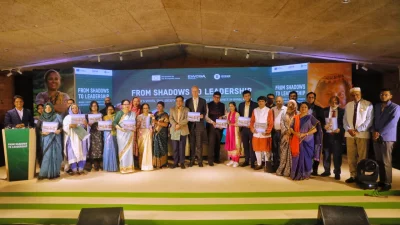
At the event, domestic worker Putul Akhter from Barisal said: “I never knew my own identity until this project showed me, I had one. Once humiliated and unseen, we now demand legal recognition, contracts, and the dignity every worker deserves.”
Tea worker from Sylhet Shila Kurmi said: “We demand a living wage, labour law implementation, safe healthcare, decent workplaces and education—not as favours but as rights. We have been heard; now we must be heeded as we continue our journey from isolation to advocacy.”
Speakers throughout the day underscored that structural change cannot happen without legal reform.
Syed Sultan Uddin Ahmed, executive director of BILS and former head of the Labour Reform Commission, shared: “Women workers in these four sectors have little legal protection. For this, we all need to work together. True change requires both organization and movement.”
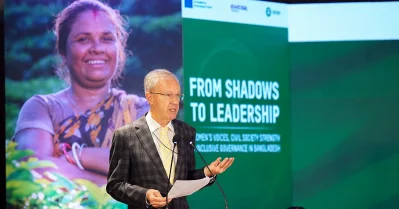
Farida Akter, Adviser at the Ministry of Fisheries and Livestock, in a video message, said: “Tea Garden workers, fisherfolk, domestic workers, and home-based RMG workers are marginalized. Their contributions must be formally calculated and recognized through identification and policy change. We must also shift the public mindset and expand media engagement, so rights move from paper to practice.”
Michal Krejza, head of development cooperation at the EU Delegation to Bangladesh, said: “Women from the EWCSA project are making an outstanding impact, and it has strengthened the systems that make rights real. Progress for workers is clear but unfinished. Lasting change demands stronger enforcement, wider social protection, sustained women’s leadership, and locally owned reforms to ensure every woman can stand in the light.”
Ashish Damle, country director of Oxfam in Bangladesh, said: “When people awaken, there is much to say and even more to do.”
“We are now in a phase of possibility—integrating technology and building on this awareness to empower communities with sustainable, independent futures. True sustainability means moving from support to self-reliance for workers.”
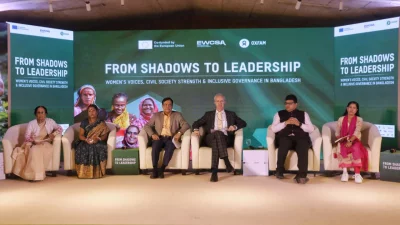
Rasheda K Choudhury, executive director of CAMPE, said: “Forums, partnerships and meaningful engagement with political actors are essential—especially now—to ensure women workers’ rights are clearly reflected in national manifestos.”
Mahmuda Sultana, program director of Oxfam in Bangladesh, gave a detailed presentation on the event. A photo storybook with 10 stories of women from four sectors was unveiled at the event.
Success stories
EWCSA shows how sustained support and collective organizing shift power: domestic workers win compensation, tea workers gain leadership roles, fisherwomen secure ID commitments, and home-based garment workers drive wage and safety reforms nationally.
Moderated by Md Sariful Islam from Oxfam, the call emerging from the event is that Bangladesh must enforce labour protections, strengthen local governance accountability, ensure identity and social protection coverage for excluded groups, and embed women’s associations in institutional frameworks so their leadership continues beyond the project’s lifespan.
Mahmuda Sultana further said: “Ensuring workers’ rights in an independent Bangladesh is not only a responsibility it is a moral obligation. Millions of women workers in fisheries, tea gardens, home-based production and garments form the backbone of our economy, yet their stories, struggles and contributions remain largely invisible.”
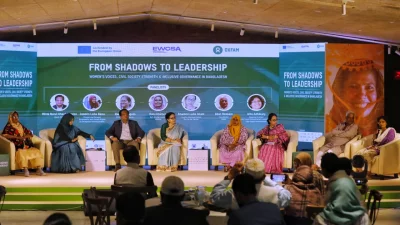
Roksana Sultana, executive director of Breaking the Silence (BTS), said: “Empowerment of women workers is impossible unless we understand their real, lived challenges. While working with tea garden women, we found that being a worker often means being exploited and if that worker is a woman, the exploitation runs deeper. When they learned to voice their own problems and seek solutions through better WASH facilities, safer work environments and minimum dignity that is where the journey of empowerment truly began.”
Mirza Nurul Ghani Shovon, chairman of Informal Sector Industry Skills Council (ISISC) said: “CSOs are playing a catalyst role bridging the gap between marginalized workers and state institutions to ensure rights awareness and accountability.”
Laila Jesmin Banu, program manager of EU delegation to Bangladesh, provided importance to strengthening capacity of CSO.
Shammi Laila Islam emphasized women workers access to information.
Shahajadi Begum, program coordinator at Oxfam in Bangladesh, stated that strong political commitment is essential to ensure women’s advancement and justice in Bangladesh’s economy
Putul Akhter of AVAS shared her experience, saying: “I never knew that even as a domestic worker, I had an identity and dignity. After joining the organization, I realized that we too are workers, and we too have rights. The fact that I am paid for my work and that it deserves respect has given me the greatest strength. In the future, we want domestic workers to have legal recognition so they don’t lose their jobs when they take leave due to illness or personal emergencies.”
Shila Kurmi from RWDO said: “I myself was a victim of child marriage. I have struggled immensely to stand where I am today. Through the CSA project, we realized that awareness of our rights creates the power for change.”
“Every day we work in the tea gardens under sun and rain. Even after picking 20 kilos of tea leaves, we earn only Tk176. With this income, it is impossible to cover school fees, healthcare or basic household expenses.”
Addressing the government and development partners, she said: “Our demands are simple -- raise wages, ensure better medical facilities, and declare tea garden schools as government schools. Only then can our daughters rise through education.”
Rabiul Hasan also contributed to this report
