




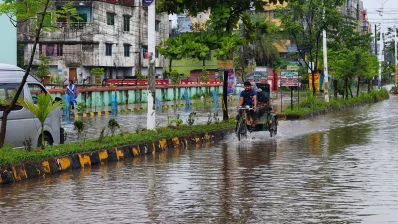
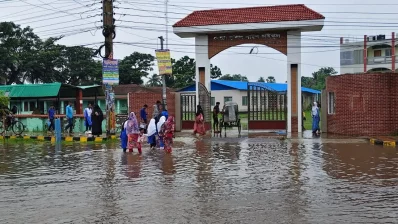
Heavy overnight rain left large parts of Khulna city under water early Thursday, exposing persistent drainage problems despite an ongoing Tk823 crore project aimed at eliminating waterlogging.
The Bangladesh Meteorological Department recorded 78mm of rainfall in the city in the 24 hours until 6am on Thursday.
Major roads and low-lying neighbourhoods were inundated, with residents facing severe disruption.
Water entered homes and businesses in several areas, while electric three-wheelers (easy bikes) broke down after being submerged. In some places, passengers had to get off and push rickshaws through flooded streets. Schoolchildren arrived at class in soaked uniforms, and office-goers struggled to reach their destinations.
Among the worst-affected areas were Khulna Specialized Hospital intersection, Ullas Park intersection, Ahsan Ahmed Road, Royal intersection, Khan Jahan Ali Road, Bastuhara, Baitipara, Chanmari, Labonchara, Tutpara, Mistripara and Rupsha New Market.
Mozammel Haque said rainwater from Daulatpur, Khalishpur, Boyra, Mujgunni and Kabir Bottola is supposed to drain into the Mayur River through the Karigarpara canal. However, years of neglect have restricted the canal's flow, preventing water from draining properly.
Rahim Mia, a resident of Tutpara, said high tide in the Rupsha River during rainfall causes river water to flow back into the city through drainage canals, flooding Rupsha Stand Road, Chanmari, the Khulna Metropolitan Police headquarters area and Dada Match Factory Road.
Mega project yet to deliver
Efforts to address Khulna's waterlogging date back to 2008, when a large urban development project was launched during the final phase of then mayor Talukder Abdul Khaleque's first term.
Eliminating waterlogging also featured prominently in his election campaigns in 2013, 2018 and 2023.
The government later approved an Tk823 crore drainage project. Over the past five and a half years, authorities have constructed more than 200 drains and excavated seven canals, including the Mayur River, spending around Tk750 crore so far.
Residents, however, say the infrastructure has failed to provide meaningful relief during heavy rain.
According to the Khulna City Corporation's Conservancy Department, the city has 1,165 kilometres of drainage canals. Most of the new drains built under the project are covered, but they still require manual cleaning because no automated maintenance system exists, making regular upkeep difficult.
Chief Engineer of the Khulna City Corporation Moshiuzzaman Khan said much of the project had been completed, but key components—including the construction of pump stations and the rehabilitation of sluice gates—remain unfinished.
He said the project's full benefits would only be realised once those works are completed.
Experts call for long-term planning
Sheikh Ashraf Uz Zaman, president of the Greater Khulna Development Action Coordination Committee, said successive elections over the past four decades had featured promises to solve the city's waterlogging problem, but no permanent solution had been achieved.
He said a comprehensive master plan and the full restoration of the city's 22 canals were essential to resolving the problem.
Khulna Nagorik Committee Member Secretary Advocate Babul Hawlader said waterlogging had worsened significantly over the past two decades.
He blamed the lack of regular dredging in the Bhairab and Rupsha rivers, which has reduced their capacity to carry away rainwater, while high tides now force river water back into the city. He also said low-lying wetlands on the western edge of Khulna had been filled for housing projects, destroying the area's natural water retention capacity.
Mahfuzur Rahman Mukul, Khulna divisional coordinator of the Bangladesh Environmental Lawyers Association (BELA), said authorities had identified 460 encroachers and 382 illegal structures on 26 canals, including the Mayur River, five years ago, but had taken no effective action to remove them.
He also said the Mayur River had been dredged without proper planning, allowing excavated soil left on the riverbanks to wash back into the river during rainfall. Opening the Alutala sluice gate and reconnecting the Mayur River with the Rupsha River would significantly improve drainage, he added.
Khulna City Corporation Administrator Nazrul Islam Manju said previous administrations had failed to address the root causes of the city's drainage crisis.
"We have identified the major problems over the past three and a half months, but even if work begins immediately, it will take another one to one-and-a-half years to complete," he said.
