



The birth centenary of a musical maestro of modern Bengali music passed by rather quietly. In Salil Chowdhury, music and a firm belief in Marxism came together to create an artist whose melodies have continued to move generations. His compositions are captivating not only for their musical brilliance but also for the depth of their messages and the richness of their lyrics—many of which he wrote himself. His collaborations with extraordinarily talented vocalists, who lent their gifted voices to his tunes, further enriched his work.
Take Salil’s partnership with the legendary Hemanta Mukhopadhyay as an example of how two of the finest musical minds of their time produced timeless music that continues to inspire millions of Bengali listeners long after their passing. In a 1989 write-up, Salil recalled: “I came to know of Hemanta Mukherjee in the mid-40s. We did have a few casual encounters, but I had never had the opportunity to know him closely. I met Hemanta Mukherjee for the first time at George-da’s (Debabrata Biswas’s) house. We exchanged common courtesies and that was just about it.”
Then came 1948. The Communist Party of India (CPI) was declared illegal, and because of Salil’s active association with the party since 1946, he spent most of his days underground. In Calcutta (now Kolkata), ‘Jashoda Bhavan’ near Golpark became one of his frequent hideouts and a hub for political meetings. During one such meeting, someone suggested that he ask Hemanta to sing his songs.
At the time, Salil was in his early twenties. He gathered the courage to visit the legendary singer at his South Calcutta residence sometime in 1948–49. Hemanta went through a few of Salil’s compositions but was initially unconvinced. As Salil walked halfway down the stairs, he suddenly remembered a new song he had just begun composing. He returned and requested Hemanta to listen to it. This time, it clicked—and the rest is history.
In August 1949, Hemanta lent his remarkable voice to a Salil masterpiece, Kono Ek Gayer Bodhu. The song became a smash hit upon release. From that August onwards, the Salil–Hemanta duo continued to enrich Bengali music with one hit after another.
Born on 19 November 1925 in undivided Bengal, Salil Chowdhury collaborated with numerous luminaries, including Mohammad Rafi, Manna Dey, Lata Mangeshkar, Mukesh, Kishore Kumar, Asha Bhosle, Sandhya Mukherjee and many others.
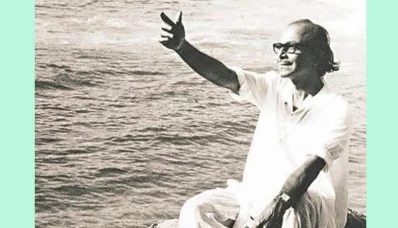
Salil, who passed away on 5 September 1995, was a music director, songwriter, scriptwriter and poet. Beyond Bengali, he composed music for films in 13 languages, including Hindi and Malayalam. His musical genius was widely recognised across the subcontinent’s film industry. A master composer and arranger, he was proficient in several instruments, including the flute, piano and esraj.
In the early 1950s, Salil left Calcutta for Bombay (now Mumbai) at the request of acclaimed filmmaker Bimal Roy, who wanted to make a film based on Salil’s story Do Bigha Zameen. The film became an instant classic and remains popular even after 70 years—still appearing on in-flight entertainment menus. Artists such as Manna Dey, Rafi and Lata Mangeshkar lent their voices to its songs.
Bangladesh’s own short-lived yet immensely gifted poet Sukanta Bhattacharya, who died before his 21st birthday, also inspired Salil. He set several of Sukanta’s poems to music, including Abak Prithivi and Runner. Beyond these, Salil wrote and composed many exceptional songs that significantly enriched patriotic music and ganashangeet (people’s music). His Marxist political consciousness undoubtedly shaped much of this work.
Salil spent much of his childhood in the tea gardens of Assam. As a boy, he absorbed everything he heard—from Western classical music to the folk tunes of tea labourers. This exposure likely laid the foundation for his creative brilliance. His musical repertoire spanned Indian nationalism, Soviet folk, North Indian classical music, Sri Lankan melodies, Western classical traditions and Communist Bengali songs. To this day, Salil Chowdhury mesmerises audiences of all ages with equal charm.
It is remarkable to imagine what gems lay hidden in his youthful mind when a juvenile Salil composed his first song—Bicharpoti Tumar Bichar Korbe Jara—in the early 1940s. From that first hit onward, he continued to enthral generations with one extraordinary composition after another.
During the 1971 Bangladesh Liberation War, Salil contributed to the programmes of Swadhin Bangla Betar Kendra in Kolkata. His 1971 album Bangla Amar Bangla was dedicated to the liberation struggle. He later visited Bangladesh to a warm reception in 1990.
