




Bangladesh is entering the era of electric vehicles (EV), but various complications regarding the charging stations have arisen at the outset.
Some companies have built charging stations but are not receiving enough vehicles, while others have not yet set their service charges.
Information gathered from discussions with Bangladesh Energy Regulatory Commission (BERC), Sustainable and Renewable Energy Development Authority (SREDA), charging station entrepreneurs, and vehicle owners revealed these issues.
According to related parties, the government is attempting to promote electric vehicles in the country. However, the lack of charging stations means that the general public are not very interested in buying electric cars.
Luxury brands like Mercedes-Benz and Audi have started selling electric cars in Bangladesh.
Recently, China's BYD Auto, in partnership with Bangladesh's Runner Motors, has also begun marketing cars. Besides these, well-known manufacturers like Toyota and Tata are selling electric vehicles alongside hybrid cars in the country.
In the developed world, especially Western countries, renowned brands like Tesla are gaining popularity over fossil fuel vehicles due to the lower per-kilometer operating cost of electric cars.
However, a major issue in Bangladesh is the lack of electric charging stations on the roads.
As a result, long-distance travel becomes difficult due to charging concerns. The Chinese brands BYD and Xiaomi have announced that their cars can travel up to 700 kilometers on a single charge.
There are generally two ways to charge an electric vehicle. A car can be charged in a home garage in 8 to 10 hours.
On the other hand, it takes 30 minutes to charge a car at a charging station with a fast-charging option.
Therefore, experts believe it is crucial to build charging stations along highways in a planned manner.
Sources at BERC indicate that such charging stations may not be very profitable initially and require government subsidies. Once the number of vehicles increases, private investment may be encouraged.
Overall situation
BERC has recently released a report on the overall aspects of electric vehicle charging stations. According to the report, 14 charging stations have received government approval so far.
The approved 14 charging stations are located at Audi Bangladesh in Tejgaon, Sumatra Filling Station in Cantonment, Goodluck Filling Station and East Zone Filling Station in Comilla, five stations under the name of Trust Electric Charging Station, REB Station in Narayanganj, two stations of Mahmud & Brothers in Rauzan and Rangunia, Chittagong, one station of Bryant Engineering Limited in Gazipur, and one of Imtiaz Auto LP Gas Limited in Sharsha, Jessore.
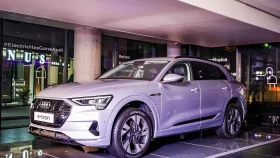 Audi Bangladesh officially launches its Battery Electric Vehicle
 Salman F Rahman emphasizes Bangladesh’s target to achieve 30% electric vehicle adoption by 2030
 Audi Bangladesh officially launches its Battery Electric Vehicle
 Salman F Rahman emphasizes Bangladesh’s target to achieve 30% electric vehicle adoption by 2030
Among these, the charging stations of Audi Bangladesh and Sumatra Filling Station in Dhaka, WZPDCL (West Zone Power Distribution Company) in Jessore, and Messrs Lata Filling Company in Rajshahi have completed construction and are awaiting approval from SREDA.
Additionally, the construction of a 180-kilowatt capacity charging station for Audi Bangladesh in Comilla is ongoing and is also awaiting SREDA’s approval. Audi started its charging operations at Tejgaon, Dhaka, in August 2023.
However, WZPDCL and Messrs Lata Filling Station have reported that they cannot start operations due to a lack of sufficient electric vehicles. Sumatra Filling Station in Dhaka Cantonment cannot begin operations as the service charges have not been determined.
Low number of EV
Engineer Md Shamsul Alam, executive director of WZPDCL, said: "We have built the charging station, but where are the cars? The number of electric cars in the country is very low. For now, we are charging auto-rickshaws at our station."
He added: "We hope the number of electric cars will increase in the future. These stations have been set up keeping the future in mind."
Price structure
The BERC report recommends setting the price of electricity per kilowatt at charging stations at the consumer level. According to the report, the consumer price, including all costs, is Tk16.24 per kilowatt (flat rate), Tk15.21 during off-peak hours, Tk14.22 during super off-peak hours, and Tk18.97 during peak hours.
Regarding the price of electricity and service charges, Abul Khair Md Aminur Rahman, member (electricity) of BERC, said that 14 charging stations are under construction in the country. Since the number of electric cars is still low, BERC has discussed adding a service charge to encourage entrepreneurs.
 Indian electric vehicle maker to set up plant in Bangladesh
He said: "We held a public hearing before Eid-ul-Adha. We gathered ideas from owners regarding the operating costs of the stations. We are considering adding a service charge to make it profitable for them. This decision is expected to be finalized within this week."
Ministry guidelines
The Ministry of Power, Energy, and Mineral Resources has guidelines regarding electric vehicle charging. These outline how such stations should operate.
Two types of charging infrastructure or stations can be built: private and general.
The first type is infrastructure set up by one or more electric vehicle owners or users for their specific group, not open to the public.
The second type is infrastructure set up by public or private initiatives for public use. Such infrastructure is usually open to the public for at least 12 hours daily or during business operating hours.
Charging electric vehicles at these stations will be considered a commercial activity. If a private charging station provides services to more than three electric vehicle owners, it will be considered a general charging station.
However, all electric vehicle charging stations must be inspected and tested by the electricity distribution licensee before connecting to the grid and periodically thereafter to ensure safety standards are maintained.
Charging infrastructure will be established in the centers of all divisional cities and along key highways where the rapid adoption of electric vehicles is likely.
Initially, priority will be given to setting up fast-charging infrastructure at CNG or petrol refueling stations with adequate space and power connections.
Additionally, initiatives will be taken to install charging stations on government premises to encourage the purchase of electric vehicles under government procurement programs.
Priority will be given to establishing charging stations with at least 50-kilowatt capacity every 100 kilometers along highways, accessible from both sides of the road.
