



A moderate earthquake jolted Dhaka and other parts of Bangladesh on Saturday morning, creating panic among the people who felt light to strong shakes.
With this, at least seven earthquakes were felt in Dhaka and elsewhere in the country this year. The epicentres of most of the tremors were near Dhaka.
No damage was reported at the time of filing this report due to the earthquake. However, people on social media said that the shaking was very remarkable.
The quake, measuring 5.6 magnitude on the Richter Scale, was felt at 9:35am. It lasted for a few seconds, according to the Bangladesh Meteorological Department (BMD).
The epicentre of the earthquake was located in Comilla district. The epicentre was 86km from the BMD Seismic Centre in Agargaon, Dhaka.
However, the United States Geological Survey (USGS) reported that the magnitude of the earthquake was 5.5. The quake originated at a depth of 10km with the epicentre about 8km east-northeast of Ramganj in Lakshmipur.
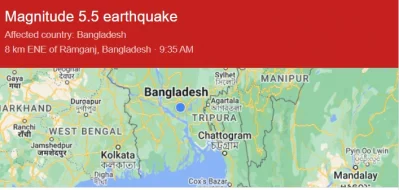
According to a notification from the Android Earthquake Alerts System, the earthquake was estimated at 5.2 magnitude.
The intensity of the quake was strong in Ramganj, moderate in areas within 25km and light in Dhaka, the USGS said.
Bangladesh felt the previous earthquake on October 2, when a 5.4-magnitude tremor rattled different parts of the country.
Before this, on September 17, an earthquake hit different parts of Bangladesh, including Dhaka. The epicentre of the quake, with a magnitude of 4.2, was in Tangail.
On September 9, another quake with a magnitude of 4.4 was felt.
At 8:51pm on August 14, various regions of the country, including Dhaka, felt an earthquake with a magnitude of 5.5 on the Richter scale.
Prior to that, on June 16, a mild earthquake of magnitude 4.5 occurred across the country, including the capital.
Another earthquake that took place on May 5 this year in Dhaka and its surrounding areas had a magnitude of 4.3 on the Richter scale.
According to experts, mild to moderate earthquakes are felt in the country due to the opposing movements of the Burmese Plate and the Indian Plate. They also say that there is a significant accumulation of energy at the junction of these two plates, which is seeking a way to be released, causing frequent earthquakes.
Experts highlight that Bangladesh is located in an earthquake-prone zone. The amount of energy accumulated beneath it suggests the potential for a major earthquake in the country.
