




Proficiency in Mathematics and English is a major qualification that opens the way to employment, business or higher education.
An assessment report prepared by the Monitoring and Evaluation Wing of the Directorate of Secondary and Higher Education (DSHE) shows that Bangladeshi students are very weak in these two subjects at their secondary level.
Educationists have identified the lack of qualified teachers for these subjects as a key reason behind this weakness.
In division-wise statistics, Sylhet division lags in terms of skill acquisition in almost all subjects. However, girls are ahead of boys in terms of academic achievement.
On the other hand, madrasa students are lagging behind general students in all measurements, while urban students are ahead in proficiency of rural students in every class.
The DSHE's Monitoring and Evaluation Wing developed the two reports, titled “National Assessment of Secondary Students (NASS)-2019” and “Learning Assessment of Secondary Institutions (LASI)-2017.”
The report has been prepared by surveying 28,194 students of the sixth grade, 27,737 students of the eighth grade and 27,284 students of the tenth grade across the country.
Data collection began before the start of the covid-19 outbreak. Attendance of students, time spent on homework, and the educational qualification of parents were also taken into account in preparing the reports.
DSHE Secretary Soleman Khan told the Dhaka Tribune that based on the report findings, plans will be taken to improve the skills and learning outcomes of the students so that the situation can be overcome.
Prof Amir Hossain, director of the monitoring and evaluation wing, said students' learning and skills have been assessed on the band score-6 instead of the numbering score.
Band 6 is rated as the most advanced (best) and Band 2 has the most lagging score (poor).
 According to the reports, only 5.1 % of sixth-graders scored well in learning and proficiency, i.e., achieved band 6 in mathematics.
However, the students of grades seven and ten who were placed in band score 14.5% and 28.4% respectively.
Division-wise statistics show that Rajshahi division is in the leading position in terms of Mathematics proficiency in the sixth grade.
Meanwhile, Khulna division placed second and the Sylhet students are the poorest.
However, Barisal division is in the second position after Rajshahi in grade eight.
While Khulna division is at the top in the students' ability in mathematics in tenth grade, Rajshahi division placed second.

Surprisingly, the students of Sylhet are also the poorest in both grades.
In terms of skill, girls are ahead in Mathematics in tenth grade. However, boys are ahead in sixth and eighth grade, according to the reports.
Assessment of English
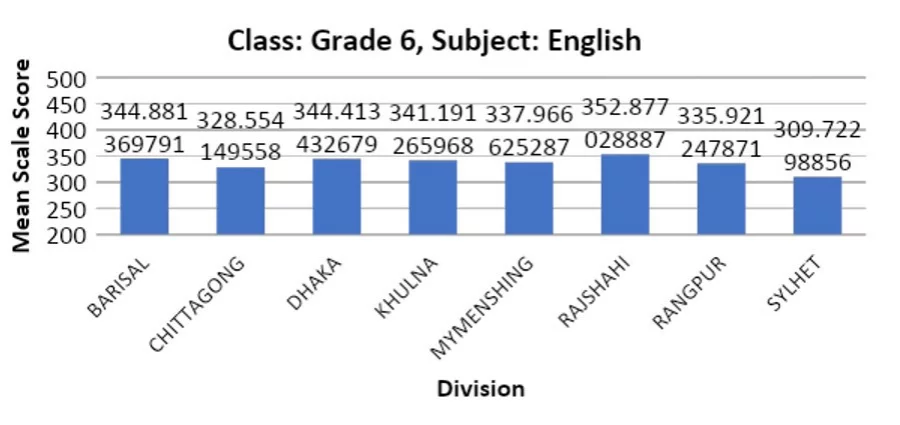
In the case of English, only 9.3 % of students achieved a good quality band score of 6 in grade six.
Meanwhile, 26.4 % and 40.4% of students got this band in eighth and tenth grade respectively.
In addition, 29.1% of sixth graders got the lowest band score of 2.
Rajshahi division is leading in terms of proficiency in English in sixth grade, and Sylhet is along with the poorest score.
A similar picture was found in the eighth grade but the situation for the tenth grade is different. In this class, Dhaka division is leading in terms of proficiency in English followed by Rajshahi while Mymensingh placed the poorest scores.
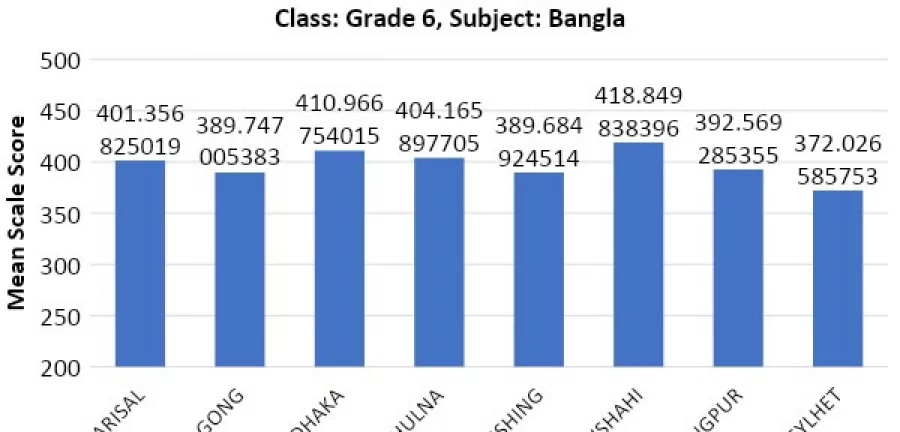
However, the report observed a comparatively comfortable picture in terms of skills in Bengali.
Some 25.8 % of students in the sixth grade scored a good quality band score of 6 in Bengali. Meanwhile, in the eighth and tenth grades, the rating scores are 47.7% and 64.3% respectively.
The percentage of students getting the lowest band score 2 is 6.6%, 1.5 % and 0.4% in sixth, eighth and tenth grades respectively.
Educationist Prof Serajul Islam Choudhury said teachers who do not have a minimum graduation degree in a particular subject cannot teach the subject perfectly and cannot ensure that students will achieve desired learning outcomes.
This case is true not only for English and Mathematics but is also for other subjects, he added.
However, he underscored the point that everything is changing fast and it will be very challenging to keep up with the pace of change if no comprehensive and effective steps are taken to provide quality education.
