




Indian Prime Minister Narendra Modi inaugurated a strategic tunnel on Monday in the northeastern region of disputed Kashmir, ensuring year-round access to a town previously isolated by heavy winter snowfall.
The $932 million initiative includes the newly completed 6.5-kilometre Z-Morh tunnel, with plans for a second, 14-kilometre tunnel expected to be completed by 2026.
This project aims to enhance connectivity between Kashmir and Ladakh, a region embroiled in longstanding territorial disputes involving India, Pakistan, and China.
The Z-Morh tunnel ensures all-season access to Sonamarg, a town marking the transition from the Kashmir Valley's forests to the rugged Zojila mountain pass leading to Ladakh. Historically, severe winter snowfall has cut off the area from neighboring regions for nearly half the year.
During the high-security visit, Modi addressed the public and highlighted the tunnel's significance for civilians and military personnel alike. Security measures included police deployment, checkpoints, sharpshooters, and drone surveillance.
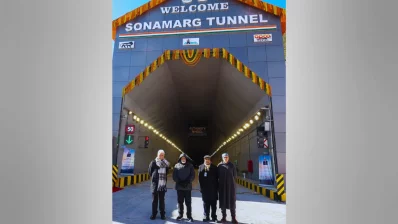
"With the opening of the tunnel here, connectivity will significantly improve," Modi said, speaking in freezing temperatures after cutting the ribbon on the $313 million project, which has taken a decade to complete.
India and China, the world’s two most populous nations, remain intense rivals, competing for strategic influence in South Asia. Their shared 3,500-kilometre border has long been a source of tension.
The two nations' troops clashed in 2020, resulting in the deaths of at least 20 Indian soldiers and four Chinese soldiers.
Forces from both sides continue to face off across contested high-altitude borderlands. However, in October, the two countries agreed on coordinated patrols in disputed areas. This preceded a rare formal meeting between Chinese President Xi Jinping and Modi—their first in five years.
In October, insurgents targeted the Z-Morh project, killing seven workers and injuring five others.
Authorities blamed militants opposing Indian governance in the region for the attack.
The project is expected to strengthen military logistics in Ladakh, a strategically sensitive area bordering China and Pakistan, while also improving civilian mobility between the Kashmir Valley and Ladakh.
The tunnel's inauguration comes amidst ongoing tensions in Kashmir, following the Indian government’s controversial 2019 decision to revoke the region's semi-autonomous status and divide it into two federally governed territories.
Kashmir remains a focal point of conflict between India and Pakistan, with both nations claiming the region in its entirety. The decades-long insurgency has led to significant loss of life among civilians, militants, and security forces.
Another tunnel on the same route, the 13-kilometre Zojila tunnel, is over halfway completed and is slated to open in 2026, according to the information ministry.
