


 It said the family members who “are in line with the rules” were issued the National Verification Cards (NVCs) upon entering Myanmar.
NVCs are part of the government’s ongoing effort to register Rohingyas, although it falls short of offering them citizenship. The card has been widely rejected by Rohingya community leaders, who say they treat life-long residents like new immigrants.
The family had been sent to stay “temporarily” with relatives in Maungdaw town after “finishing the repatriation process,” the statement added. But it did not mention plans for further returnees expected in the near future.
A Rohingya community leader confirmed the family’s return.
Photos posted alongside the statement showed a man, two women, a young girl and a boy receiving NVCs and getting health checks.
Myanmar officials could not be reached for more details.
It said the family members who “are in line with the rules” were issued the National Verification Cards (NVCs) upon entering Myanmar.
NVCs are part of the government’s ongoing effort to register Rohingyas, although it falls short of offering them citizenship. The card has been widely rejected by Rohingya community leaders, who say they treat life-long residents like new immigrants.
The family had been sent to stay “temporarily” with relatives in Maungdaw town after “finishing the repatriation process,” the statement added. But it did not mention plans for further returnees expected in the near future.
A Rohingya community leader confirmed the family’s return.
Photos posted alongside the statement showed a man, two women, a young girl and a boy receiving NVCs and getting health checks.
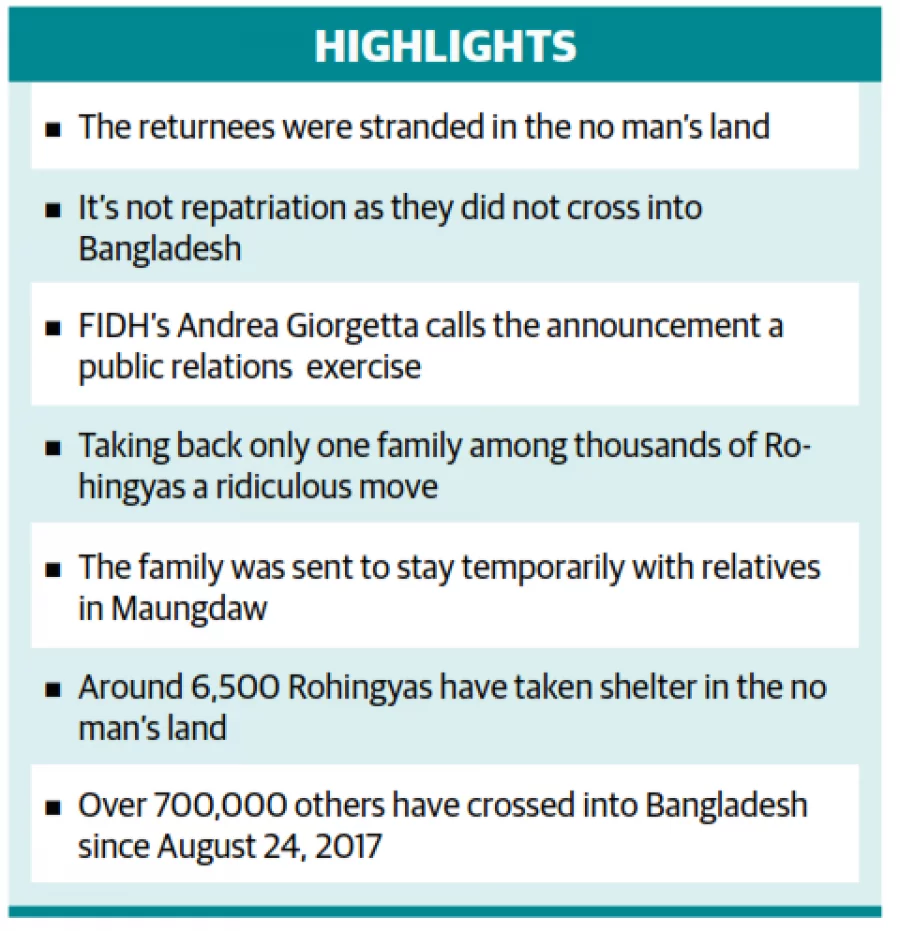
Myanmar officials could not be reached for more details.After Myanmar claimed it had “repatriated” the first family of Rohingya refugees among 700,000 who fled a brutal crackdown in the country’s Rakhine state, the Bangladesh government said the return of only one family cannot be regarded as repatriation in any way.
“Several thousand families have been stranded in the no man’s land between Bangladesh and Myanmar. Since the family did not enter Bangladesh, and used to live in the no man’s land, their return cannot be considered repatriation, Relief and Refugee Repatriation Commissioner Mohammad Abul Kalam said on Sunday.
“They were not under our jurisdiction; therefore, we cannot confirm whether there would be more people waiting to go back [to Myanmar], he said, adding that the two neighbours had not yet started the Rohingya repatriation process.
In a statement on Saturday, the Myanmar government claimed: “Five members of a Muslim family came to the Taungpyoletwea reception centre in Rakhine state in the morning.”
Aftar Alam and the other four of his family were scrutinized by immigration and health ministry officials and the social welfare, relief and resettlement ministry provided them with “materials such as rice, mosquito netting, blankets, T-shirt, longyis (Burmese sarong) and kitchen utensils,” the statement added. It said the family members who “are in line with the rules” were issued the National Verification Cards (NVCs) upon entering Myanmar.
NVCs are part of the government’s ongoing effort to register Rohingyas, although it falls short of offering them citizenship. The card has been widely rejected by Rohingya community leaders, who say they treat life-long residents like new immigrants.
The family had been sent to stay “temporarily” with relatives in Maungdaw town after “finishing the repatriation process,” the statement added. But it did not mention plans for further returnees expected in the near future.
A Rohingya community leader confirmed the family’s return.
Photos posted alongside the statement showed a man, two women, a young girl and a boy receiving NVCs and getting health checks.
Myanmar officials could not be reached for more details.
It said the family members who “are in line with the rules” were issued the National Verification Cards (NVCs) upon entering Myanmar.
NVCs are part of the government’s ongoing effort to register Rohingyas, although it falls short of offering them citizenship. The card has been widely rejected by Rohingya community leaders, who say they treat life-long residents like new immigrants.
The family had been sent to stay “temporarily” with relatives in Maungdaw town after “finishing the repatriation process,” the statement added. But it did not mention plans for further returnees expected in the near future.
A Rohingya community leader confirmed the family’s return.
Photos posted alongside the statement showed a man, two women, a young girl and a boy receiving NVCs and getting health checks.
Myanmar officials could not be reached for more details.
It said the family members who “are in line with the rules” were issued the National Verification Cards (NVCs) upon entering Myanmar.
NVCs are part of the government’s ongoing effort to register Rohingyas, although it falls short of offering them citizenship. The card has been widely rejected by Rohingya community leaders, who say they treat life-long residents like new immigrants.
The family had been sent to stay “temporarily” with relatives in Maungdaw town after “finishing the repatriation process,” the statement added. But it did not mention plans for further returnees expected in the near future.
A Rohingya community leader confirmed the family’s return.
Photos posted alongside the statement showed a man, two women, a young girl and a boy receiving NVCs and getting health checks.
Myanmar officials could not be reached for more details.