




 People walk through the damage, after an air raid in the besieged town of Douma, Eastern Ghouta, Damascus, Syria, February 23, 2018 | ReutersInsurgents in eastern Ghouta have vowed not to accept such a fate, ruling out an evacuation of fighters, their families and other civilians of the kind that ended rebellion in Aleppo and Homs after heavy bombardment in earlier years.
"We refuse categorically any initiative that includes getting the residents out of their homes and moving them elsewhere," Ghouta rebel factions wrote in a letter to the Security Council on Friday.
Eastern Ghouta has 400,000 people spread over a larger area than other enclaves the government has recaptured.
Late on Thursday, government aircraft dropped leaflets urging civilians to depart and hand themselves over to the Syrian army, marking corridors through which they could leave safely.
People walk through the damage, after an air raid in the besieged town of Douma, Eastern Ghouta, Damascus, Syria, February 23, 2018 | ReutersInsurgents in eastern Ghouta have vowed not to accept such a fate, ruling out an evacuation of fighters, their families and other civilians of the kind that ended rebellion in Aleppo and Homs after heavy bombardment in earlier years.
"We refuse categorically any initiative that includes getting the residents out of their homes and moving them elsewhere," Ghouta rebel factions wrote in a letter to the Security Council on Friday.
Eastern Ghouta has 400,000 people spread over a larger area than other enclaves the government has recaptured.
Late on Thursday, government aircraft dropped leaflets urging civilians to depart and hand themselves over to the Syrian army, marking corridors through which they could leave safely.A new wave of bombs struck Syria's eastern Ghouta district on Friday, witnesses said, ahead of a UN Security Council vote to demand a 30-day ceasefire to end one of the deadliest bombing campaigns of the seven-year-old civil war.
For a sixth straight day, warplanes flown by government forces and their allies pounded the densely populated enclave east of Damascus, the last rebel bastion near the capital.
The civilian casualties and devastation there are among the worst in Syria since the government captured rebel-held parts of Aleppo in intense fighting in 2016.
At least 462 people have been killed, including at least 99 children, and many hundreds injured, the Syrian Observatory for Human Rights monitoring group said.
Syrian state media reported one person was killed and 58 injured from rebel shelling of sites in Damascus, including a hospital.
In New York, the 10 elected members of the Security Council told reporters they were united in favour of the draft resolution for a cessation of hostilities in Syria and wanted it approved on Friday.
A vote scheduled for 11am EST (1600 GMT) was postponed until later in the day amid a flurry of last-minute negotiations on the text drafted by Sweden and Kuwait.
"We're still working on the language of some of the paragraphs, but we're almost there," Kuwait's UN Ambassador Mansour Ayyad Al-Otaibi said. "Hopefully we're so close to adopting this resolution today."
But all eyes were on Russia, and whether President Bashar al-Assad's veto-wielding ally would support the resolution, block it, or seek to water it down. Passage of the resolution could clear the way for aid deliveries and medical evacuations.
Russian Foreign Minister Sergei Lavrov said earlier on Friday that Moscow wanted guarantees that rebel fighters will not shoot at residential areas in Damascus.
German Chancellor Angela Merkel and French President Emmanuel Macron asked Russian President Vladimir Putin to support the Security Council resolution. Merkel, speaking in Brussels, said they wanted Putin to "do everything possible" to get it adopted on Friday.
Previous ceasefires have a poor record of ending fighting in Syria, and Moscow has a history of blocking Security Council measures that would harm Assad's interests.
Syria's government has often used the tactic of pushing rebels to surrender their strongholds after long sieges and military offensives.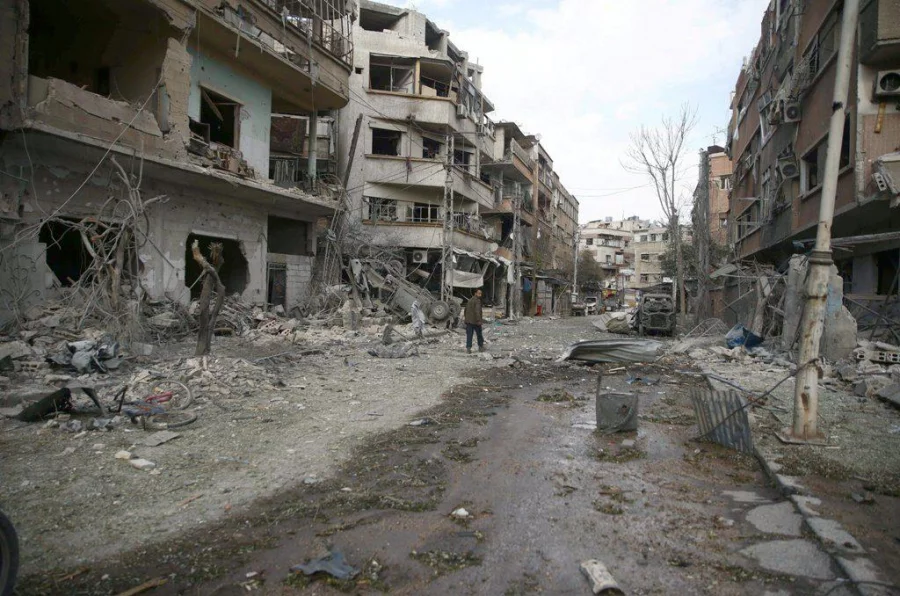 People walk through the damage, after an air raid in the besieged town of Douma, Eastern Ghouta, Damascus, Syria, February 23, 2018 | ReutersInsurgents in eastern Ghouta have vowed not to accept such a fate, ruling out an evacuation of fighters, their families and other civilians of the kind that ended rebellion in Aleppo and Homs after heavy bombardment in earlier years.
"We refuse categorically any initiative that includes getting the residents out of their homes and moving them elsewhere," Ghouta rebel factions wrote in a letter to the Security Council on Friday.
Eastern Ghouta has 400,000 people spread over a larger area than other enclaves the government has recaptured.
Late on Thursday, government aircraft dropped leaflets urging civilians to depart and hand themselves over to the Syrian army, marking corridors through which they could leave safely.
People walk through the damage, after an air raid in the besieged town of Douma, Eastern Ghouta, Damascus, Syria, February 23, 2018 | ReutersInsurgents in eastern Ghouta have vowed not to accept such a fate, ruling out an evacuation of fighters, their families and other civilians of the kind that ended rebellion in Aleppo and Homs after heavy bombardment in earlier years.
"We refuse categorically any initiative that includes getting the residents out of their homes and moving them elsewhere," Ghouta rebel factions wrote in a letter to the Security Council on Friday.
Eastern Ghouta has 400,000 people spread over a larger area than other enclaves the government has recaptured.
Late on Thursday, government aircraft dropped leaflets urging civilians to depart and hand themselves over to the Syrian army, marking corridors through which they could leave safely.
People walk through the damage, after an air raid in the besieged town of Douma, Eastern Ghouta, Damascus, Syria, February 23, 2018 | ReutersInsurgents in eastern Ghouta have vowed not to accept such a fate, ruling out an evacuation of fighters, their families and other civilians of the kind that ended rebellion in Aleppo and Homs after heavy bombardment in earlier years.
"We refuse categorically any initiative that includes getting the residents out of their homes and moving them elsewhere," Ghouta rebel factions wrote in a letter to the Security Council on Friday.
Eastern Ghouta has 400,000 people spread over a larger area than other enclaves the government has recaptured.
Late on Thursday, government aircraft dropped leaflets urging civilians to depart and hand themselves over to the Syrian army, marking corridors through which they could leave safely.