




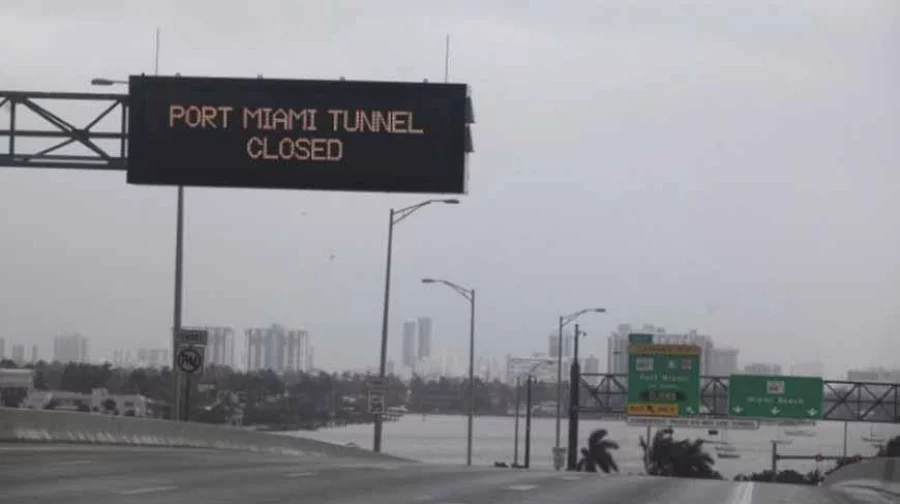
 A road sign in Miami says the road to Miami Port has been shut down due to bad weather Collected
Hurricane Matthew, after killing over 800 people in island country Haiti alone, lashed Florida on Friday with heavy rains and winds.
Matthew, the first major hurricane to threaten a direct hit on the United States in more than a decade, triggered mass evacuations along the coast from Florida through Georgia and into South Carolina and North Carolina.
At 1200GMT Friday, Matthew's eye, or centre, was 55 km east of Cape Canaveral, home to the country's main space launch site.
"The winds are ferocious right now," said Jeff Piotrowski, a 40-year-old storm chaser from Tulsa, Oklahoma, who was near Cape Canaveral early on Friday. "It's fierce."
The storm downed power lines and trees and destroyed billboards in Cape Canaveral, he said.
Nasa and the US Air Force, which operate the Cape Canaveral launch site, had taken steps to safeguard personnel and equipment. A team of 116 employees was bunkered down inside Kennedy Space Center's Launch Control Center to ride out the hurricane.
No significant damage or injuries were reported in West Palm Beach and other communities in south Florida where the storm had brought down trees and power lines earlier in the night, CNN and local media reported.
[iframe id="http://www.reuters.com/assets/iframe/yovideo?videoId=370052436"]
"People should not be looking at the damages they're seeing and saying this storm is not that bad," Fugate told NBC. Fugate also said people should be aware the hurricane carried more than just ferocious winds.
"The real danger still is storm surge, particularly in northern Florida and southern Georgia. These are very vulnerable areas. They've never seen this kind of damage potential since the late 1800s."
Speaking on NBC's "Today" programme, Fugate said few people were really prepared for the storm's effects and that while it was too late for some to move to safer ground, those who could still evacuate now should do so, unless they were in areas affected by hurricane-force winds.
"It's still a very dangerous situation."
About 300,000 Florida households were without power, local media reported. In West Palm Beach, street lights and houses went dark and Interstate 95 was empty as the storm rolled through the community of 100,000 people.
Matthew lessened in intensity on Thursday night and into Friday morning, the National Hurricane Center said. From being an extremely dangerous Category 4 storm, it became a Category 3 on the five-step Saffir-Simpson scale of hurricane intensity, but was still a major storm.
It could either plow inland or tear along the Atlantic coast through Friday night, the Miami-based centre said.
The National Hurricane Center warned of "potentially disastrous impacts" and the US National Weather Service said the storm could be the most powerful to strike northeast Florida in 118 years.
Thousands were displaced after the storm flattened homes, uprooted trees and inundated neighborhoods earlier in the week. Four people were killed in the Dominican Republic, which neighbors Haiti.
Damage and potential casualties in the Bahamas were still unclear as the storm passed near the capital, Nassau, on Thursday and then moved out over the western end of Grand Bahama Island.
The NHC's hurricane warning extended up the Atlantic coast from southern Florida through Georgia and into South Carolina. More than 12m people in the United States were under hurricane watches and warnings, according to the Weather Channel.
The last major hurricane, classified as a storm bearing sustained winds of more than 177km/h, to make landfall on US shores was Hurricane Wilma in 2005. A road sign in Miami says the road to Miami Port has been shut down due to bad weather Collected
A road sign in Miami says the road to Miami Port has been shut down due to bad weather Collected