




For much of Bangladesh’s journey in Test cricket, captaincy has often been defined by struggle rather than success. Leaders carried the burden of an inexperienced cricketing culture, inconsistent performances and the challenge of competing against stronger, more established nations. Victories were rare, series wins even rarer.
That is why the rise of Najmul Hossain Shanto as Test captain is beginning to feel like a defining shift in Bangladesh cricket history.
Following the historic 2-0 home series sweep over Pakistan, Shanto now has the strongest statistical case among Bangladesh captains who have led the side for a meaningful period in Test cricket. Among captains with at least five Tests in charge, no one has managed a higher win percentage than the current skipper.
In 18 Tests as captain, Shanto has led Bangladesh national cricket team to eight wins, giving him a remarkable 44.44 win percentage. By comparison, Mushfiqur Rahim won seven Tests in 34 matches as captain while Shakib Al Hasan registered four wins in 19 matches.
The numbers become even more impressive considering Bangladesh’s long-standing challenges in the format. Earlier captains often led teams lacking depth, experience and confidence. While some helped Bangladesh gain competitiveness, sustained winning consistency remained out of reach.
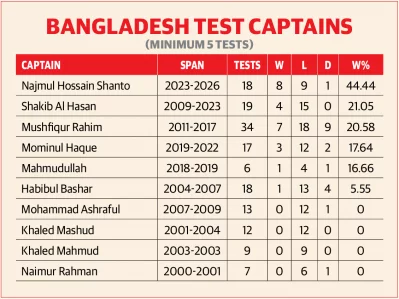
What makes Shanto’s leadership stand out further is the impact captaincy has had on his own batting. Historically, the responsibility of leading Bangladesh in Tests has often affected players negatively. Mominul Haque, one of the country’s most technically accomplished batters, saw his batting average decline significantly during his tenure as captain. Similar patterns were visible for Shakib and Mohammad Ashraful.
Shanto, however, has moved in the opposite direction.
Before becoming captain, he averaged below 30 in Test cricket. Since taking over leadership in 2023, his batting average has risen close to 39. He has scored five centuries in 18 Tests as captain, compared to four hundreds in 23 matches before becoming skipper.
Rather than burdening him, captaincy appears to have sharpened his sense of responsibility.
Beyond statistics, Shanto’s influence is becoming increasingly visible in Bangladesh’s overall approach to Test cricket. The Pakistan series offered perhaps the clearest example yet. Bangladesh played with composure, tactical discipline and belief across all five days of both matches.

Unlike many previous Bangladesh sides that often became defensive after gaining momentum, Shanto’s team consistently pushed for wickets and maintained attacking intent. His field placements have looked proactive, while his management of bowlers — particularly the rotation between spinners and pacers — has reflected growing tactical maturity.
His energy on the field has also become a defining trait. Whether encouraging bowlers, adjusting fields or celebrating breakthroughs, Shanto remains actively involved throughout sessions, helping maintain intensity in a format where concentration often determines results.
Of course, questions about longevity will remain. Mushfiqur led Bangladesh in far more Tests while Shakib captained across multiple difficult phases of transition. Shanto’s era is still relatively small in comparison.
Yet leadership is not judged only by duration. It is also measured by impact.
And under Shanto, Bangladesh are no longer merely trying to compete in Test cricket. They are beginning to expect victories.
That may ultimately become his greatest contribution as captain.
