According to USGS the earthquake’s epicentre was in north-central Myanmar near the town of Chauk and its magnitude was 6.8. In Dhaka, people were seen running out of buildings.
What to do
4 things not to do during an earthquake
Window treatmentThe first thing that one does in the event of a brewing storm or the distant sound of an explosion, ie, heading to the window to find out more, is the last thing one should be doing in the event of an earthquake. Standing anywhere near glass, or sharp edges could result in some pretty horrific injuries. So save the curiosity for later, and back away slowly. Ditto for chandeliers and other breakable fixtures.
Power hourFootage of the earthquake in Dhaka showed a lot of people congregating on the streets, staring up at the buildings they had just exited, trying to determine if it was still moving. What was also clearly visible in the video, were the power-lines swaying directly overhead. Had this been a stronger earthquake, this could have resulted in some serious injuries. While heading outside is a sensible choice, it's just as important to remember to get out of the way of power lines if one wants to minimise the risk of electrocution.
Rush hourAs terrifying as it is when the ground beneath your feet starts to shudder, it's worse being crushed underfoot while trying to get out of the building. If it's shaking inside the building, it's shaking outside as well, and if the tremors aren't violent, it's better to wait them out instead of starting a stampede.
Descent into chaosAnyone who happened to be at Bashundhara City on Wednesday would be able to testify to the mad rush to the elevators that ensued at the first sight of a tremor. We cannot stress enough just how dangerous this is. Setting aside the whole stampede factor we just mentioned, a big quake could snap the cables holding the elevator, causing a pretty nasty plummet and crash. And should there be a power outage, you could stand the risk of being trapped there for a very long time. It's better to take the stairs, slowly.
How to survive a mega quake
A recent GPS report has provided solid proof of the fact that we have known since forever: The Indian Subcontinent is sitting on a brewing and boiling Mega Quake ready for destruction anytime
No research until now can predict when this monster will be unleashed upon us. But when it does, Dhaka city, being one of the most densely populated capitals of the world, will be the hardest hit. For obvious reasons; the cramped up neighborhoods, commercial market places, weak infrastructure. The citizens of Dhaka, along with the other danger prone areas, must be prepared for this 9 Richter Scale earthquake on an individual level. Here’s all you need to know about how to survive a Mega Quake, and save your family in the process.
Before the EarthquakeThe first step is to organise your disaster emergency kit. Don’t be under the impression that natural disaster is going to give you a head start when you will pack your essentials and walk out.
Use a backpack carefully put in all the necessary basic supplies in it and place it somewhere quickly accessible. The necessary supplies include food, three gallons of water per person, medication, a flash light, a whistle to call for rescue, cash, blankets, paper and pen, batteries and a first aid kit. If you have a pet, take its necessary supplies as well.
Know how to turn off gas and electricity supply. Most importantly, create a mental map highlighting the spots in your house, your office or classroom where you are likely to be safer. Choose spots where there is no chance of heavy objects falling on you.
Next, teach the younger ones how to use emergency contact numbers; have family meetings and hold earthquake drills every now and then.
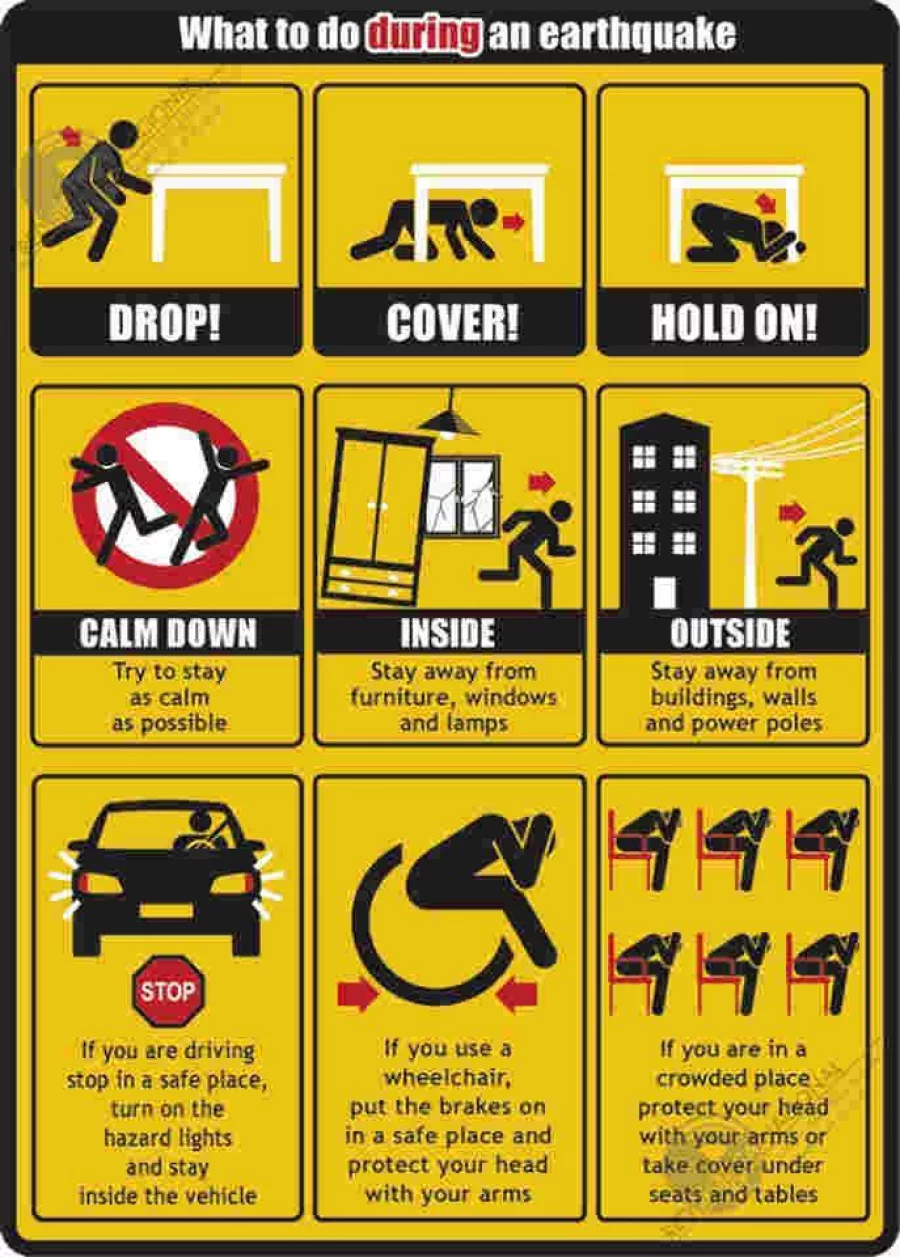
During an earthquakeThe shakes have started, and it’s now or never. Don’t panic. What you do during the quake depends on where you are at that moment.
If you’re indoors it’s best if you use the drop-cover-hold technique under some wooden furniture like beds or dining tables. Definitely stay away from windows. Taking shelter under a doorway isn’t as safe as you might think, so let’s not take chances. Do not get out of the building until you know it’s safe. It’s also very helpful if you can save your head with a pillow. If you are at home, don’t leave that emergency kit you packed previously.
If you are in a car and there is no traffic, slowly drive to a relatively empty area, where no buildings, bridges or electric poles fall on your car. If you are not inside any vehicles, just run to a park or any such clear locations and drop to the ground.
After the earthquakeFirst thing first, spot your family members and neighbours and stay united.
Don’t put down your shield after the shaking stops. You must be prepared for the aftershocks; just repeat the previous tactics.
If your building is one of those strong fighters that still stands among ruins, stay in and try fixing and repairing what has been broken. But don’t turn on gas supply or electricity supply until the companies assure that it’s safe.
Avoid being electrocuted by hanging wires. Electrocution and fire are potential hazards after the quake.
Try to contact emergency lines for life-threatening situations. Always keep your ears and eyes open for news updates.
If anyone can come to your rescue, it’s you. Don’t be dependent on someone else. Be alert, look sideways, look above you, look at what’s under you feet. First, attend to your wounds and then help others. Remember, it’s you family and neighbours and friends; be a responsible citizen and learn what you are up against. Be safe, people in the seismic-excited pla




