




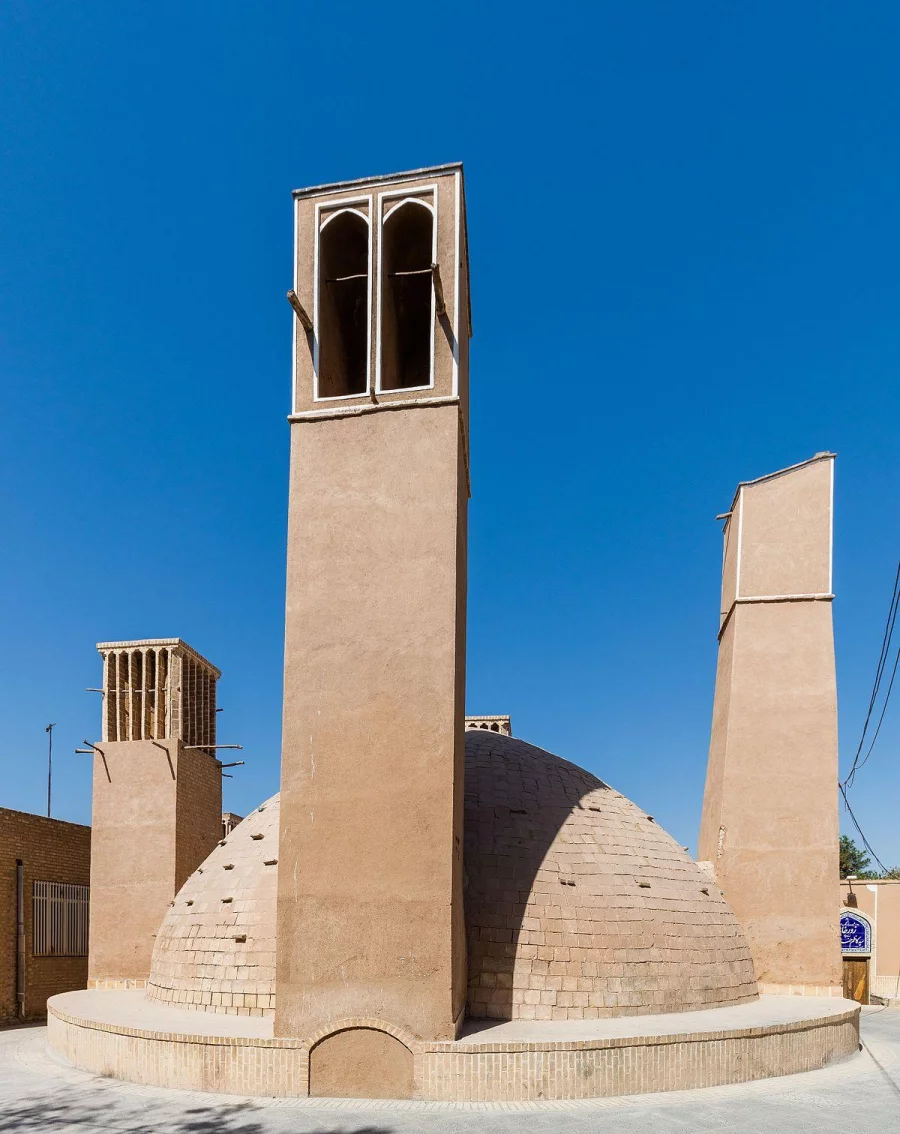
 Traditional Arabic wind tower WikicommonsWind towers, also known as wind catchers, are very common in the Persian Gulf and Egypt. Multiple towers are used to funnel wind inside a dome or a central building to carry away trapped heat. While a traditional wind tower can help cool temperatures to 24°C, Anita said additional technology using water will be installed in the towers to make the room temperatures even cooler to satisfy modern comfort levels.
“We are expecting to be the first passively cooled school in the Middle East,” said Ms Saul.
The Bangladesh-curriculum school has been in operation since 1980. The school’s recent accolades – most notably, winning the Zayed Future Energy Prize’s Global High Schools award in 2013 followed by subsequent prizes from the Environment Agency Abu Dhabi (EAAD) for its conservation efforts – have been a fitting tribute to the memory of Shaikh Zayed, UAE’s founding father, after whom the school is named.
The school saves energy from the 48 solar panels it installed on its roof as part of its sustainable schools initiative in 2013. Officials say the panels produce about 30% of the building’s electricity, mainly powering lights, computers and fans.
Muna Ali, outreach programme coordinator for the EAAD, said: “The Bangladesh school is one of the best schools in our sustainable schools initiative,” she said. “We want others to be like the Bangladesh school now. It is a real example for schools to transfer awareness and doing all the campaigns for real action towards sustainability.”
Traditional Arabic wind tower WikicommonsWind towers, also known as wind catchers, are very common in the Persian Gulf and Egypt. Multiple towers are used to funnel wind inside a dome or a central building to carry away trapped heat. While a traditional wind tower can help cool temperatures to 24°C, Anita said additional technology using water will be installed in the towers to make the room temperatures even cooler to satisfy modern comfort levels.
“We are expecting to be the first passively cooled school in the Middle East,” said Ms Saul.
The Bangladesh-curriculum school has been in operation since 1980. The school’s recent accolades – most notably, winning the Zayed Future Energy Prize’s Global High Schools award in 2013 followed by subsequent prizes from the Environment Agency Abu Dhabi (EAAD) for its conservation efforts – have been a fitting tribute to the memory of Shaikh Zayed, UAE’s founding father, after whom the school is named.
The school saves energy from the 48 solar panels it installed on its roof as part of its sustainable schools initiative in 2013. Officials say the panels produce about 30% of the building’s electricity, mainly powering lights, computers and fans.
Muna Ali, outreach programme coordinator for the EAAD, said: “The Bangladesh school is one of the best schools in our sustainable schools initiative,” she said. “We want others to be like the Bangladesh school now. It is a real example for schools to transfer awareness and doing all the campaigns for real action towards sustainability.”Following in the steps of previous ecological accomplishments, the Shaikh Kahlifa Bin Zayed Bangladesh Islamia School in Abu Dhabi has taken on a project to cool the school using 23 traditional Arab wind towers, reports thenational.ae.
The school, which has previously won the exclusive Shaikh Zayed Future Energy Prize and the only UAE school to do so, is well known for its environmentally friendly initiatives, including recently opening a greenhouse powered by a high-tech Japanese climate simulation system.
“They said it could simulate any climate, like even the climate of Alaska,” said Anita Saul, sustainable schools initiative coordinator at the school. “That is their ambition.”
The wind tower project is being developed with prize money the school has won over the years through its sustainability efforts and with financial and technical investment from the University of Leeds, in the UK. Officials say they expect construction on the 23 towers to resume in September. Traditional Arabic wind tower WikicommonsWind towers, also known as wind catchers, are very common in the Persian Gulf and Egypt. Multiple towers are used to funnel wind inside a dome or a central building to carry away trapped heat. While a traditional wind tower can help cool temperatures to 24°C, Anita said additional technology using water will be installed in the towers to make the room temperatures even cooler to satisfy modern comfort levels.
“We are expecting to be the first passively cooled school in the Middle East,” said Ms Saul.
The Bangladesh-curriculum school has been in operation since 1980. The school’s recent accolades – most notably, winning the Zayed Future Energy Prize’s Global High Schools award in 2013 followed by subsequent prizes from the Environment Agency Abu Dhabi (EAAD) for its conservation efforts – have been a fitting tribute to the memory of Shaikh Zayed, UAE’s founding father, after whom the school is named.
The school saves energy from the 48 solar panels it installed on its roof as part of its sustainable schools initiative in 2013. Officials say the panels produce about 30% of the building’s electricity, mainly powering lights, computers and fans.
Muna Ali, outreach programme coordinator for the EAAD, said: “The Bangladesh school is one of the best schools in our sustainable schools initiative,” she said. “We want others to be like the Bangladesh school now. It is a real example for schools to transfer awareness and doing all the campaigns for real action towards sustainability.”
Traditional Arabic wind tower WikicommonsWind towers, also known as wind catchers, are very common in the Persian Gulf and Egypt. Multiple towers are used to funnel wind inside a dome or a central building to carry away trapped heat. While a traditional wind tower can help cool temperatures to 24°C, Anita said additional technology using water will be installed in the towers to make the room temperatures even cooler to satisfy modern comfort levels.
“We are expecting to be the first passively cooled school in the Middle East,” said Ms Saul.
The Bangladesh-curriculum school has been in operation since 1980. The school’s recent accolades – most notably, winning the Zayed Future Energy Prize’s Global High Schools award in 2013 followed by subsequent prizes from the Environment Agency Abu Dhabi (EAAD) for its conservation efforts – have been a fitting tribute to the memory of Shaikh Zayed, UAE’s founding father, after whom the school is named.
The school saves energy from the 48 solar panels it installed on its roof as part of its sustainable schools initiative in 2013. Officials say the panels produce about 30% of the building’s electricity, mainly powering lights, computers and fans.
Muna Ali, outreach programme coordinator for the EAAD, said: “The Bangladesh school is one of the best schools in our sustainable schools initiative,” she said. “We want others to be like the Bangladesh school now. It is a real example for schools to transfer awareness and doing all the campaigns for real action towards sustainability.”
Traditional Arabic wind tower WikicommonsWind towers, also known as wind catchers, are very common in the Persian Gulf and Egypt. Multiple towers are used to funnel wind inside a dome or a central building to carry away trapped heat. While a traditional wind tower can help cool temperatures to 24°C, Anita said additional technology using water will be installed in the towers to make the room temperatures even cooler to satisfy modern comfort levels.
“We are expecting to be the first passively cooled school in the Middle East,” said Ms Saul.
The Bangladesh-curriculum school has been in operation since 1980. The school’s recent accolades – most notably, winning the Zayed Future Energy Prize’s Global High Schools award in 2013 followed by subsequent prizes from the Environment Agency Abu Dhabi (EAAD) for its conservation efforts – have been a fitting tribute to the memory of Shaikh Zayed, UAE’s founding father, after whom the school is named.
The school saves energy from the 48 solar panels it installed on its roof as part of its sustainable schools initiative in 2013. Officials say the panels produce about 30% of the building’s electricity, mainly powering lights, computers and fans.
Muna Ali, outreach programme coordinator for the EAAD, said: “The Bangladesh school is one of the best schools in our sustainable schools initiative,” she said. “We want others to be like the Bangladesh school now. It is a real example for schools to transfer awareness and doing all the campaigns for real action towards sustainability.”