




About Ashapurna Debi and the translation of ‘Bakul Katha’
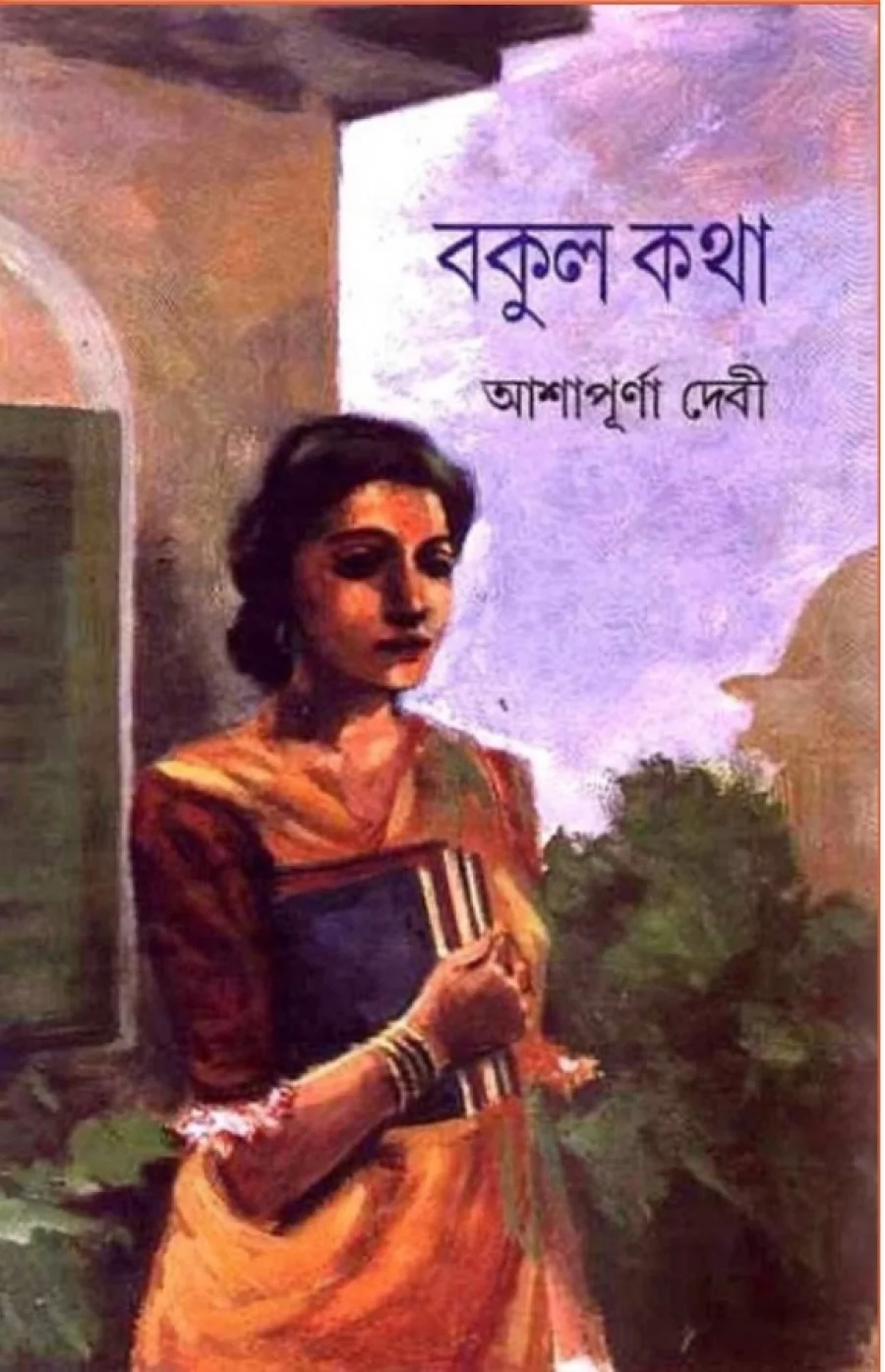
Writing my own poetry and prose along with translating classic works of poetry and prose has always been perceived by me as both sides of a single coin, where the nuances, the various shades, and layers of a poem or a story need to emerge from the depths of an inner consciousness. In 2018, when I came out of Bengal’s literary doyenne Ashapurna Debi’s house in Kanungo Park, Garia, Kolkata with the silent promise of bringing out her novel “Bakul Katha” in English translation for the global readers, propelled by a heart-to-heart conversation I had with her daughter-in-law Dr. Nupur Gupta, it was my emotional fervor which was accentuated further when I delved into the book and started transcreating the world of Bakul and her successors.
Ashapurna Debi (8 January 1909 – 13 July 1995), as everyone in Bengal and also beyond knows, was a widely honored, acclaimed, prominent Bengali novelist and poet, a Jnanpith Awardee (1976) and recipient of Padma Shri by the Government of India; D.Litt. by the Universities of Jabalpur, Rabindra Bharati, Burdwan, and Jadavpur. Vishwa Bharati University honoured her with Deshikottama in 1989. For her contribution as a novelist and short story writer, the Sahitya Akademi conferred its highest honour, the Sahitya Akademi Fellowship, in 1994. She has been a prolific novelist and short story writer all throughout her life and has written one thousand five hundred short stories and almost two hundred and fifty full-length novels and novellas in her lifetime. She has been considered as the doyenne of Bengali literature in the post Rabindranath and Saratchandra era.
The first challenge in translating any one of Ashapurna’s huge repertoire of novels came as I tried to choose a subject which would be contemporary, relevant, and resonating with today’s women. But when I chose Bakul Katha, which had only been translated into Marathi before, and never in English, I instantly felt it would inspire a bevy of today’s women and compel them to think about the bygone generation of patriarchal values, the strange intersection between hard-earned emancipation and the abuse of freedom, and the degeneration of values in which the protagonist Bakul finds herself.
Bakul Katha happens to be the last novel of Ashapurna’s literary masterpiece of a trilogy, preceded by Pratham Pratishuti, and Subarnalata, which won the Indian National Sahitya Academy award. Cumulatively, in these three novels, Ashapurna has portrayed the life stories of three generations of women, over the changing rural and urban milieu in Bengal of the twentieth century. Most importantly, in these three novels, she has touched on the contradictory expectations from women in contemporary Bengali society- at times oppressed, at times the apparently modern women with contemporary sensibilities, struggling to find their rightful places in the universe. At the same time, she explores the inner desires and aspirations of her women characters, unfettered by expectations of the men and families.
A sequel to the spirited, oppressed Subarnalata’s story, Bakul Katha, her daughter’s story is also a tale about women and the diverse manifestations of their emotions as they express their free wills as women. Bakul finds herself in a society where values are diluted due to the overexposure to western ethos. Is this the kind of society that her mother Subarnalata and her grandmother Satyabati envisioned for their progeny and fought for, being the torchbearers of the feminist movement in their own unique forms of protest? She questions herself.
Book Excerpt:
Shampa came to her aunt’s room, decked up in attractive clothes, fluttering like a butterfly.
“I’m going out, Pishi! There’s a fantastic movie running in Lighthouse Cinema, and I am so excited to watch it…Oh, it took so long for me to get dressed! That silly boy is waiting for me with the tickets since forever, he might be cursing me by now…I better get going. Please give the news to my mothe...did you get it, Pishi?”
Anamika Debi looked at her niece’s flamboyant, spirited gait. In fact, she was used to seeing Shampa like this every day. Why then, all of a sudden, did the pensive spirit of Asharh, the third month of the Bengali calendar come to overpower her today, lifting the veil of so many decades? Did Anamika Devi mistake Shampa for Bakul for a few fleeting moments, chasing that thickening shadow of the yesteryears? Did the truant body of her niece give way to another body wrapped in a more commonplace sari of thick weave, manufactured in some obscure “swadeshi mill”?
Yes, she clearly saw Bakul’s sari, the key string tied to its aanchal, its unceremonious edges in the traditional Bengali way. She clearly saw Bakul’s long tresses, tied up in a tight bun; she also saw her bare feet, her hands holding two books.
But why at all did she see glimpses of Bakul in Shampa? Bakul’s demeanour was starkly different, compared to Shampa’s indolent gestures. Bakul had always been hesitant, overtly civil, fearful. Bakul never knew what it meant to be adventurous, reckless. And yet, Bakul eclipsed the image of Shampa. Bakul stood with shoulders stooping, listening to the admonishing voices around her. “Beware, girl, never go to their house ever again. Look at you, what a tall mountain of a girl you’ve been, obsessed with novels and dramas…Don’t you have the slightest knowledge that you will be criticized for this?”
Bakul was not endowed with the feisty spirit of Shampa. Yet that day, she uttered an outrageous statement.
“Why would I be criticized all of a sudden for this? I have been visiting their house ever since I can remember!”
“Don’t dare to compare your present situation to whatever has happened till now. Don’t forget, your mother is no more. Besides, they have a grown-up, marriageable son in their family…” Bakul’s middle-aged father shrieked in his raspy voice.
Her father was used to uttering such random, irrational sentences every now and then.
“All right…but let me go today for one last time, I need to return these two books to them.” Bakul answered in her fearful, feeble voice.
“What books are these?”
“Nothing special.”
“What do you mean by ‘nothing special’? Drama or novels?”
Bakul stood, silent, transfixed.
“These books…the root of all evil! Good Lord, three generations of women with the same disease! I heard your grandmother had it, and your mother, I know, was the most affected with it…and now, her daughter, too…what a nuisance! Let me see what books you have!” He snatched the books from Bakul’s hands.
“I see, poetry of Rabindranath Tagore! Didn’t I say three generations of women with the same disease? All right, no need to step inside their house again, I will return the books myself! By the way, who do they belong to? Nirmal?” He shouted in a sarcastic, spiteful tone.
Bakul stood in a corner, perplexed by the derisive attack of her father. The stoned, fearful image of Bakul started to obliterate beneath the dark, spirited shadow, prompted by the cruel censuring of the words uttered by her father. The absence of Bakul created a momentary vacuum, and then the joyous, playful image of Shampa flashed, all of a sudden.
“Pishi, I am going. Give the news to Ma when she seems to be in a good mood.” Shampa said.
“You rather go and tell her yourself, dear…I don’t understand your mother’s mood these days, honestly.” Anamika Debi replied.
Shampa laughed. “Really? You don’t understand her mood? But that seems to be your domain of expertise, isn’t it? Please, Pishi, if I have to tell my mother now, forget about watching the movie! That poor boy will tear the tickets in sheer frustration and attempt suicide by jumping in the train tracks!”
Shampa set out from the house. Anamika kept looking at her as she left, stunned. “Strange, isn’t it, that she is the daughter of this house? How many generations passed before she was born?”
Shampa had always considered discussing with her aunt before going for any of her romantic adventures. She would come up to her aunt with the juicy tales of her multiple lovers when Anamika was the most hard-pressed for time.
“You know, Pishi, this fellow became so furious with me when I addressed him as ‘wretched man’! Can you imagine what he said after this?
He said: ‘It means in future, you will curse me and call me names like this?’ Just think! Now this idiot has also started to weave impossible dreams of our so-called ‘future’ together! I had just started to enjoy the intimacy of a romance, and he started to think of getting married! What a pity, these boys! But you know what I said in his reply? I said: You are wretched indeed! Why else wouldn’t you be able to find a ‘sweetheart’, worthier than me? Did I say anything wrong, Pishi?”
Shampa occupied her aunt’s attention in her writing den, and blabbered endlessly. Why couldn’t Anamika scold her, or tell her in the face, “Aren’t you ashamed to talk so much?” Instead, she indulged in her garrulousness. Perhaps, there was a self-interest in it. Whenever she would come close to her niece, it seemed like a caged bird was set free, peeping at the door leading towards light. Whenever she would come up to her aunt, she ignored the façade of Anamika Debi, caressing her whole being with intense love.
But why did she yearn for such pure love? There was nothing amiss in her own life -- it was already brimming with fame, reverence and love.
But then, the yearning to love without rhyme or reason brings a special delight, she thought. Whatever she had accomplished was for her outer skin, whom they called Anamika Debi.
Thus, she would bear with Shampa’s garrulousness, her reckless lifestyle, her shameless words. It seemed as if any other way of life was not meant for Shampa. The other family members had understood this equation between Shampa and her beloved aunt quite well. So, they blamed Anamika for her niece’s truant behaviour, directly or indirectly.
“Her boat is moored to a giant tree now! Why would she fear anyone, if her aunt supports her? It’s my destiny that my own daughter is not under my control…God knows that I didn’t get the opportunity to raise her. If I did, you would have seen how I would have treated her!” Shampa’s mother would say, throwing her words of complaint at the wordless walls.
Shampa was born many years after her elder brother. By the time Shampa arrived, Anamika’s sister-in-law had spent most of her motherly energies on raising her son. As a result, she could never manage her own daughter. But she blamed Anamika for her own failure.
Hence, Anamika asked Shampa: “You rather talk to your mother before going out anywhere.”
“Talk to my mother? Goodness gracious, then I am doomed for the whole day! The moment she will hear I am going out, she will start her interrogations… My maternal grandfather should have raised her to become a successful lawyer, I dare say! Imagine how much she would have benefitted her fellow countrymen, and how my life too would have been saved then!” Shampa replied with enlarged eyes.
Apparently, Anamika laughed at Shampa’s outrageous statements, but she knew the intense sighs that lay buried beneath her smiling exterior.
Shampa and the other boisterous young girls of her generation would never know that the generation of her grandfather never knew anything with the name of “women empowerment”. If by chance, anybody of that generation had cared to educate a girl, he would have been an outcast without a second thought. Plenty of intelligent women led a life of waste in the generation that went by.
Shampa was born in a truly fortunate world of free women, with a fistful of sky, with the world at their feet, with the luxury of their own lives at their disposal -- and such fortunate times had been built by their predecessors and their excruciating sacrifices.
How would Shampa’s generation realize the shapeless clay-like lives of the generation of her mothers and grandmothers, devoid of beauty and self-reliance? Anamika herself had seen that life of disparity. She knew how much freedom Shampa and the girls of her times were enjoying, like a natural birthright, without even having the gratitude to acknowledge it. They were the fortunate ones, privileged to inhale the uninhibited wind, never having to care about the ones choked to death in the absence of air.
The image of Bakul crept up in Anamika’s consciousness, across the distance of years, but she couldn’t find Bakul’s old notebook. She didn’t know where she could begin searching for it.
“Where would I find Bakul and her innermost world amid these inconsequential belongings?” She looked for it all over the place, and asked herself.
Bakul was compelled to lock up her love in an iron vault due to the harsh reprimands of her father, her elder brothers. She was unsure if it was a story worth telling the world. But hadn’t she promised long back to write Bakul’s story? Had she forgotten her promise? In the course of her writing journey, she had written thousands of stories of imaginary people and places, but Bakul’s story lay buried in obscurity.
But she didn’t have the time to think. There was so much of pending work already! The editor of “Banabaani” magazine sounded disappointed over the phone. “The next edition is due next week, Anamika Debi!”
The submission to “Banabaani” had to be followed by numerous others, and meanwhile, she had to attend the literature conference at North Bengal. After a week, she replied to her Sej di’s letter.
“I couldn’t find Bakul’s notebook anywhere. If it exists at all, I think it might be somewhere that you know. Search for it, will you?”
Lopamudra Banerjee is an author, poet, translator, editor with seven critically acclaimed books and five anthologies in fiction and poetry. She lives in Texas, USA where she teaches literature and writing courses at various universities. Her recent publications include her English translation of Ashapurna Devi’s award-winning novel ‘Bakul Katha’ and also ‘The Body of Memories: An Anthology of Memoirs and Personal Essays’ edited by her. Apart from writing, editing and teaching, she has co-produced and acted in the critically acclaimed poetry film ‘Kolkata Cocktail’ (2019).
