




Why has the title of the film been changed from Bangabandhu to Mujib: The Making of a Nation (2023)?
It has not changed. You see, Bangabandhu is known as Bangabandhu in Bangladesh. Everybody knows who Bangabandhu is. But in the rest of the world, he is known only as Mujibur Rahman. Because he was the founder of the nation. That's why we called it Mujib, because I discussed this with the Prime Minister Sheikh Hasina, and she said maybe it's better if you called him Mujib because, Mujib is also known, and he is known as Mujibur Rahman everywhere else in the world. That's why, that's why we called him Mujib. We could have said Bangabandhu, but then it would have required an explanation.
At a time when the history is fading fast and in a sense it's getting palimpasted, do you think this production will retain the images of Liberation War and sacrifice of Bangabandhu?
I'm quite certain it will be. Because that's the genesis of it, no? I mean, obviously it all started then. And, the person who is seeking it is his daughter, who is the present prime minister. So you see, it's a continuum. It's a continuation of what he started because he took the country out of the domination of West Pakistan as it were.
So, naturally it's a new nation. And as a new nation, everything is very optimistic. They're working very hard to bring the people up to much higher levels than most parts of South Asia.
When you talk about the prime minister’s involvement here, would you please share something about the detailing and the research process and how Prime Minister Hasina herself was involved during this production for the last four years?
Well, she didn't want to be involved like that. But I had long discussions with her, and so did the heads of departments, for instance my daughter, Pia, she also spent time with her, and so we got a great amount of insight from the present prime minister. Because there are two things there.
She was, first of all, witness to all of these things that happened then. Number one. She was very young, of course, but she was, she was witness to all of that. So she has a first hand account.
Then secondly, she has a much bigger objective view of the country as well because she happens to be the prime minister. So she has both the personal, political, and overall view much more than a lot of other people would have had.
Is it an adaptation of Bangabandu’s autobiography, because he used to maintain a diary?
It's [the diary] very nice. I mean, that was also studied. We studied all the literature that exists on Bangabandhu. All the literature that exists, both in Bengali, English, and even in Hindi and Urdu. We have all the material that we possibly could have about him. And his own experiences in jail and so on.
So we had all that material and our writers studied all this very carefully. And they traveled all over the place and they got all this material, and then we started working on the script. I mean, you can't make a film like this without proper research.
In what category would you put it? Is it a parallel film? What should be the genre of this film?
Those are non-definitions. They're not really definitions. It's simply called this, you know, a historical biography.
It's a biographical film about Sheikh Mujibur Rahman and his place in the history of Bangladesh and South Asia.
What are the most fascinating parts of the shooting and production, and how have you established the parts and scenes where there is no evidence, or there is no literature or direct research and information?
Our research team worked on all of this much before we started shooting the film. We interviewed a lot of people. All of that went into the making of the film. And we studied all the literature that exists about him. So there was no problem there, because we had excellent support from the academics and particularly the historians in Bangladesh. They were all Bangladesh historians. Particularly those who specialized in that period.
Would you please say something about the cast?
When I was casting, I had to see Bangladeshi films. But that was in Dhaka. So that's how I chose my cast. They are wonderful actors and they're such a brilliant set of actors.
You know, Arivind Shubh and the rest of them, all wonderful actors. Trisha is wonderful. She's very good. Faria is a great actress. They are very motivated and they are not doing this only for money.
But they were all chosen by me.
I didn't want anybody to play these parts who are not Bangladeshis. They had to be from Bangladesh. And also the film, the choice of the film, of the language, I had chosen that the film should be in Bengali because he was a Bengali nationalist, you know? Although it's a language that I don't understand too well, I had help on that score as well because I had an advisor on the language.
Because, you see, it also has to do with accents between Bangladeshi Bengali and West Bengal Bengali. There are lots of expressions that are native to one or the other. We had to be very careful on that score. As I said, even though I don't know the language, I had to have people who knew the language very well.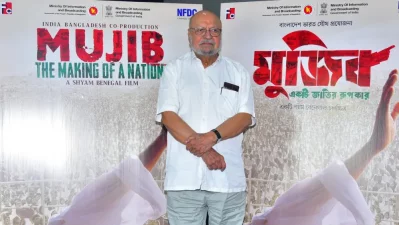
What’s your observation about the film industry of Bangladesh?
Wonderful! Yeah, in fact they are making almost as many films as we are making in India now, which is fantastic. I mean, it's very vibrant. And it's also viable now. That is the interesting part of it.
Does the quality match the number of productions as well?
Well, you see it has to do with sensibility. The individual sensibility of the filmmaker. You cannot make an overall judgment.
For instance, Satyajit Ray was a brilliant filmmaker. It didn't matter that his work was in Bengali or any other language, but the fact was that he got the Bengal ethos like no other filmmaker had got before him. So similarly, Bangladeshis are also producing filmmakers there who have that kind of quality about Bangladesh,
What would you say about the cinematic language here?
It also has to do with the individual filmmakers. You know, what kind of idiom that they will use, it's up to them. Because some people prefer a more theatrical style. Some people prefer a more realistic style. They write scripts in a particular way.
They make their short breakdowns in a particular way. They adopt a viewpoint in a particular way. All these things are individual choices. You don't make a generalization here. That's what gives a film its individuality. Otherwise it would all look like a daily newspaper, you know!
You will not know the individual, the sensitivity and the sensibility, and particularly the artistic sensibility of the filmmaker if you do not see how he has made the film, and the quality and the manner in which he tells the story.
How has he framed the narrative? How is he going to tell this particular story? All of these things, but they're part of cinematic language, you know? And then if it's a person who is cinema illiterate, and he makes a film, It's like a, it's like a child learning to spell.
Cinema is an art of that kind. It's not an art like architecture, where you say, picturesque architecture, different kinds of classical forms of architecture, and so on and so forth.
I heard you started filmmaking at the age of 12 with your father's camera set. Is that true?
Yeah, it is. Because, you see, my father had a movie camera, 16mm key-driven. And he used to make home movies on that. You know, he used to shoot little films about his own family. My father used to show these films to his guests, you know, when people came for dinner or something like that.
And all of us would say to our father, “please show our films.” So he would show the films that he had made about his various children, you know, in the millimeter, and that particular camera was available for me if I wanted to use it.
So I made a couple of small films and the first one that I made was called Chuttiyomain Maujmaja on how we spent holidays. With our cousins and so on, who used to come. You know, we used to live in a fairly large house.
Our cousins from different parts of India used to come and stay with us during summer holidays. And so we used to go swimming, we used to go hunting, different kinds of things, you know, like picking fruit, jungle fruit, and that sort of thing.
So I made a film about all of this. At the age of 12 I decided to make the film, because when people started to enjoy watching this little film I had made, at that time it struck me that this is what I'm going to be, a filmmaker.
What have you learned from this movie production?
I got to know a lot about the history of Bangladesh. A lot about the history of Bengal itself. A lot about the history of North-eastern states of India.
So you get to know a lot of all this, and you know the entire Delta area. Of Bengal. Which is fascinating, because you have the two of the rivers, Padma and Jamuna coming together, and from that side, Brahmaputra, and then you have the whole delta.
Care to share some interesting stories from the shooting?
The Sundarbans area is absolutely fascinating. I traveled there before we made the film. And it is just fabulous. I just enjoyed that enormously.
But a lot of people never used to go there. They used to say that it's malaria infested, the mosquitoes are horrible. One particular person, a boatman, who was taking me through all these deltaic, these riverine areas, he said here the mosquitoes grow as large as buffalos! Hilarious.
What is marvelous is that all you need to do is throw a net or hold the umbrella upside down in the water and the fish will just jump in and you need to do very little.
So do you like fish and Bangladeshi cuisine as well?
Oh yes, Ilish. Hilsa from the Padma river.
Bengali cooking is very interesting, even meat cooking. Very few people realize that the meat cooking, that is mutton, is cooked so well.
