



Before truly setting foot in a country, the image we hold of it often does not come from the land itself, but from books, television, and the countless fragments we see on screens.
Before arriving in Bangladesh, most of my impressions came from what others had written or filmed. In a travel book I once read, Bangladesh was described as “humid, crowded, and chaotic.” Some self-media videos portrayed it as a place defined by poverty and disorder. Those scattered descriptions slowly formed a vague picture in my mind -- a distant and unfamiliar country.
Only when I finally came here did I realize how incomplete such impressions could be.
I am a Chinese engineer engaged in infrastructure construction overseas. Under the broader framework of the Bangladesh-China-India-Myanmar Economic Corridor, cooperation between China and Bangladesh has grown steadily. It was within this larger context that I had the opportunity to step beyond my homeland and arrive in this land shaped by the rivers of the Ganges delta.
Bangladesh’s territory is roughly comparable in size to China’s Liaoning Province, yet it is home to more than 170 million people -- several times the population of Liaoning. From above, the country looks like a vast green web woven by rivers. This is a land of alluvial plains -- fertile, soft, and endlessly nourished by water. The rivers bring abundance. Fish are everywhere here.
Our project sites stretch across the southern and northern parts of Bangladesh. The railway we are building is one of the country’s largest railway connectivity projects. Local media once mentioned that after completion it could contribute about 1.5% to the national GDP. For a country, a railway is never just steel tracks and concrete sleepers. It is more like a flowing artery, connecting people, goods, and possibilities.
The first time I stood at the construction site, I saw another side of Bangladesh. Workers sweating under the blazing sun, muddy roads where machines and men moved steadily forward, and far beyond the site, green rice fields where water buffaloes stood quietly in the distance.
Many of the local workers did not have the chance to receive a complete education, yet they worked with remarkable dedication. Some tied steel bars, some prepared formwork, others guided machinery. Each person focused quietly on his task.
Getting along with Bangladeshi colleagues has never been difficult. Many of them are curious about the outside world. During breaks, someone would often come up to me and ask in simple English, “China big country?” Then they would wait eagerly for the answer, their eyes bright with curiosity.
In those eyes, I often see something sincere -- the desire for knowledge and the longing to understand the wider world.
Economic limitations mean that not everyone here has access to quality education. Yet most people are hardworking, kind, and sincere. They endure long hours of labour under the sun, and when the day ends, they often greet you with a simple and genuine smile.
Once, a young worker from the site invited me to his home for dinner. His house was a small brick building with a banana tree growing by the entrance. On the table were rice, fish curry, and a street snack called fuchka. That was the first time I tried it. When I bit into it, the flavour burst unexpectedly in my mouth.
Later I also tried dosa, a thin fermented rice pancake wrapped around spiced potatoes. Food has a quiet way of bringing people closer together. That evening, we talked for a long time, using a mixture of simple English, gestures, and laughter.
Walking back that night, I realized something important. The stereotypes I once held -- formed by television and the internet -- were slowly dissolving.
A country is never defined by just one narrative.
In recent years, Bangladesh has been changing. A new airport terminal is rising. The N8 highway is linking regions more efficiently. Bridges, railways, and infrastructure projects are gradually transforming the landscape. From around 2018 until today, many places have quietly evolved.
Development rarely happens overnight. But if you stay long enough, you begin to notice those small yet determined steps forward.
I often think that the real strength of a country lies in its ordinary people. Farmers cultivating their fields, workers building roads and railways, vendors selling food along busy streets -- each of them contributes a small but essential part to the country’s progress.
I sincerely hope that Bangladesh will continue moving toward a brighter future. Under the leadership of its new government, the country may create even greater achievements -- more roads and bridges, better opportunities for education, and broader horizons for the younger generation.
The friendship between China and Bangladesh, in many ways, resembles a railway line slowly extending across the land. We bring some of China’s experiences, and at the same time we learn from the resilience and warmth of this country. With the efforts of both governments, cooperation between our nations continues to deepen.
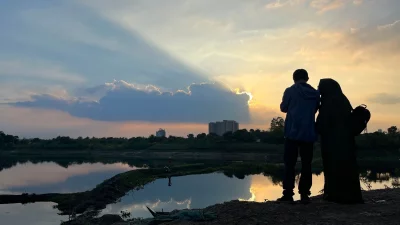
Sometimes after work, I stand beside the unfinished railway tracks and watch the sky gradually darken. Rivers glow under the setting sun. Smoke rises gently from distant villages. Children run along the dirt roads nearby.
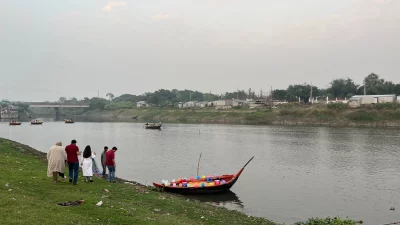
In moments like that, I often think that many years from now, when trains rush across these tracks, people may not remember who laid the first rail.
But I will know that, in some small way, I was part of the story.
Bangladesh is still young and full of possibilities. It has vast plains, powerful rivers, and a generation of young people filled with hope. If there is something truly moving about this land, it is its quiet determination to move forward.
And I hope that, through my work, I can contribute -- even in a very small way -- to the development of infrastructure here.
When night falls, lights appear one by one across the construction site, scattered like stars across the delta. The wind blows gently from the Ganges plain, carrying the scent of water and earth.
And in that moment, I realize that this once-distant country has slowly become a warm and luminous part of my own memory.
Wang Lei is Country Manager of China Railway First Group Co, ltd. Email: [email protected].
