




Judging by the social as well as mainstream media, one might think prices of essential food items in Dhaka have never been higher. One might also think there are good reasons for prices to be record high -- after all, in the last few months we have experienced a historic political change and the collapse of law and order, and two devastating floods. One might expect these to hamper production and thus push up prices. Furthermore, there are the pervasive concerns about the so-called syndicates.
However, as best as one can tell from the data, prices of most essential food items -- with the exception of red lentil (masoor dal) -- seem to be well in line with recent history.
There are important policy and political implications for this. The policymakers need to hold their nerves and not panic. And all pro-democracy voices should push back against potential disinformation.
Let’s go through the data and charts first. I have plotted monthly average prices since October 1996 (left panel) and February 2022 (right panel) for the following items: Coarse rice; red lentil; soyabean oil; salt; chilies; onion; and eggs. All prices are in Takas. The time series are from the Bangladesh Bureau of Statistics and end in June 2024. That is, to the extent that the BBS fabricated data for the old regime, the historic prices in recent years would be understated (that is, historically prices might have been higher).
The BBS hasn’t published any data since June. I have used Google as well as various online grocers for the latest prices. To the extent that online retailers charge more than what one might get from a kacha-bazaar in, say, Nakhalpara -- the data for October might be overstated (that is, the currently prevailing prices may be somewhat lower).
Further, to allow for biases, the October data is presented as a thick marker rather than a dot -- that is, I am not claiming the prices are exactly accurate, and for visual purposes, a thick marker helps one think of a range.
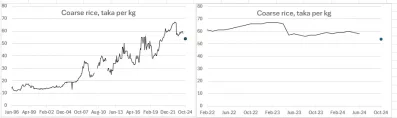
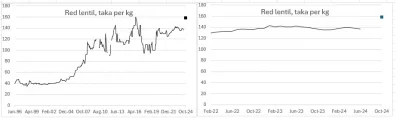
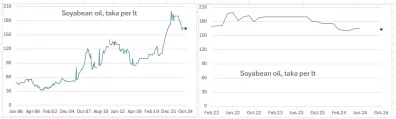
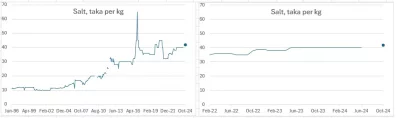
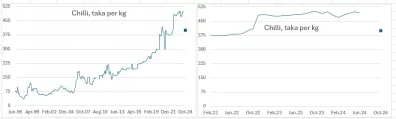
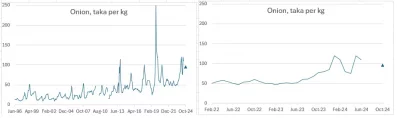
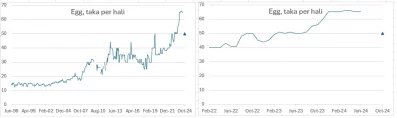
These charts would suggest that prices currently prevailing in Dhaka are not particularly out of line compared with recent history. For some items, prices are in fact lower than when Hasina was in power.
Of course, these charts also show that prices of these items are far higher than what was the case a few years ago. But that reflects macroeconomic mismanagement of the Hasina regime, not anything that has happened more recently.
Further, prices of these items might have risen in September before declining more recently -- remember the blockades and floods. Perhaps prices have fallen in more recent days because the government has reduced import tariffs on some items. Perhaps it’s just more production coming to the market. Whichever it is, prices currently aren’t out of line with what was the case under Hasina.
And finally, what about all the other items, like potato and tomato and fish and chicken -- well, of course there are many items one could plot charts for, but the above seemed like the minimum a poor working person in Dhaka might consume.
So, it is not at all clear that there is a reason for panicking about prices.
The interim administration is being judged on their ability to keep prices low, even though they don’t seem to be higher than what they inherited
What do I mean by panicking?
In early 2007, the conventional wisdom had it that so-called syndicates connected with the recently toppled BNP government had raised prices of essentials across the country. Egged on (excuse the pun), generals behind the 1/11 government went hunting for these syndicates across the country, creating a serious supply shock and thereby raising prices.
Even the Princeton-educated and World Bank experienced former central banker, formally in charge of that government, failed to convince the generals of their march of folly. That regime never recovered from the price shock.
They weren’t the first. The late Akbar Ali Khan used to talk about all military rulers having one thing in common -- rounding up the usual suspects from bazaars across the country.
There is clearly a perception that prices are unreasonably high. Judging by the media, the so-called syndicates are being blamed. And there is a real risk that the government would be pressured into taking actions to clean up the bazaars and raise prices.
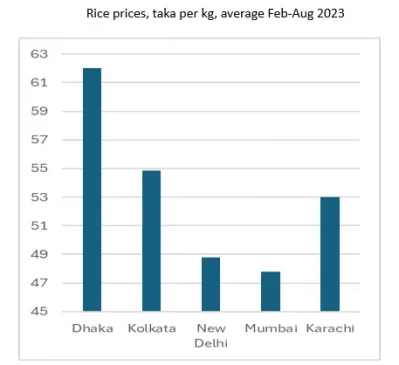
This is not to say under the previous regime, there weren’t shady practices. There might have been. A kilo of rice used to cost more in Dhaka than other subcontinental megacities, as shown by Chart 8. Perhaps it had something to do with higher cost of production, perhaps there were mark ups by too many intermediaries, perhaps there were indeed syndicates -- it is worth investigating the reasons.
And of course, it’s also very likely that many urban poor have suffered income loss.
But these are different problems than what one hears about high prices and syndicates.
Politics is the price of rice, and lentil-oil-salt. Keeping them low is the promise every politician makes ahead of every election. The interim administration is being judged on their ability to keep prices low, even though they don’t seem to be higher than what they inherited.
It is time all pro-democracy analysts and commentators take a deep breath and reset the narrative.
Jyoti Rahman reads and watches stuff and writes about them at www.jrahman.substack.com.
