





In January 2024 a parliamentary election was carried out in Bangladesh. In the run up to the election there was much controversy over the positions and actions of the two major political parties.
The Bangladesh National Party refused to participate in the election claiming that a valid election was impossible with the Awami League in power and controlling the police and the security agencies.
The AL accused the BNP of the use of violence during the months before the election. There was no cooperative behaviour and the Election Commission was unable to obtain the cooperation of either party.
The result was that the election was no real measure of who should govern the country. The AL held power and on the basis of the election, such as it was, has continued to govern the nation.
There were strong positions held by other countries or groups of nations. The EU and the US argued for cooperative actions to enable a free and fair election. India wanted the AL to return to power and made no secret of its preferences. The Chinese government was neutral but content with the AL government.
One of the most important theorems in mathematics is called “the central limit theorem.” Putting aside some of the technical conditions, it essentially says that if you take a large group of people or things (the statistical universe) you can find out with some accuracy a property of the group by taking a sample of 1,000 items and finding the proportion of the group that has the property in question.
The value obtained for the sample of 1,000 will be close to the value for the whole group. One has to choose the 1,000 carefully and one has to assume that the respondents tell the truth or that the researchers can measure the property correctly.
All of statistics is a variation on this theme. Make the sample larger and the answer is more accurate. If the sample is smaller than the answer is less accurate.
The US election of the president has a complicated system. However, most of the time the candidate who gets the most votes wins.
Before the election there are many opinion polls that attempt to estimate how many votes each candidate will receive. The sample size of these polls is typically around 1,000. In choosing who to ask the poll takers try to find persons that they think will vote. They try to obtain the real view of the person interviewed.
These polls are quite accurate. For example, in 2016 the election was won by Trump, but the polls were accurate in estimating the number of votes each candidate received. Clinton received more votes than Trump but the structure of the election system awarded the presidency to Trump.
Sample surveys are the most accurate way to estimate a number or property.
Based on our polling the AL would have won a majority of the seats in parliament
In the 2024 Bangladesh election one deals with a parliamentary election -- 300 separate elections. The key result is how many parliamentary seats each party would win.
We carried out a survey of 298 constituencies with a sample size that averaged 410 per constituency or 120,000 respondents in total.
In a few constituencies we did a larger sample size and at the end of the survey we returned to a few constituencies to see what change there was over the time it took us to do the survey.
Our statistical universe was the voter lists prepared by the Election Commission. The survey was done by face-to-face interviews.
Rather than ask the person for whom they will vote, we give him or her a ballot that has four party choices -- AL, BNP, JP, and Other.
The symbols were given for the three parties, as the time of the survey was before nominations. In any event while the BNP refused to participate in the election we could include the party in the sample survey.
The "voter" marked the ballot in private, folded it up, and placed it in a plastic, transparent, sealed container. In this way we tried to preserve the secrecy of the ballot box. It was impossible to figure out the choice of a voter.
The outcome of the final analysis of the sample survey was as follows:
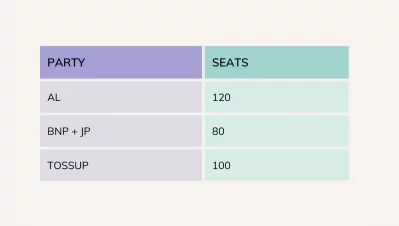
The tossup cases were where the probability of winning a constituency was in the range 45-55%. On the average these constituencies would result in 50 seats for each side.
According to our survey, then, the probability of the AL winning the election was almost 100%. The AL needed at least 31 seats from the 100 toss ups. The probability of this is almost one. Think of tossing a coin 100 times and the probability of getting 31 or more heads.
The conclusion is that based on our polling the AL would have won a majority of the seats in parliament. This is an accurate estimate of the political preferences of the voters in Bangladesh.
We submit a free and fair election where everyone on the voter list voted would have been won by the AL with a likely outcome of the AL winning 165-175 seats.
Forrest Cookson is an economist who has served as the first president of AmCham and has been a consultant for the Bangladesh Bureau of Statistics. Emdadul Haque is the CEO, Research and Development Centre.
