




As Sherlock Holmes famously quipped to his associate and devoted friend: “Watson, you see, but you do not observe.” It’s a rap on the knuckles that we all deserve from time to time, especially when it comes to looking at statistics.
Each day at 2:30pm, we eagerly await briefings from IEDCR regarding the Covid-19 pandemic that has prematurely ended many lives and suspended livelihoods.
To get an idea of the destructive spread of the disease, there are two figures that are of particular interest. These are:
(1) Number of people tested
(2) Number of people found to be infected among those tested
Combining these two figures yields an expression, test-positivity, which is simply a fancy proxy term for infection rate.
So, for example, if 100 persons are tested and 15 people are found to be infected, then test-positivity is 15%.
Since our economy was opened up in early May, test-positivity has hovered around 20%-22%. Does that mean that about one-fifth of the population is infected?
No, it does not.
As we have been told by IEDCR, testing is only carried out on people who show symptoms of the disease.
Although the number of tests are far from adequate, repeated sampling can often produce good indicative results. Since daily tests represent repeated sampling, it is may be said with some degree of confidence that among all those coughing, wheezing, sneezing, or suffering from fever, about 20% probably have the disease.
All of this is quite straightforward and well-known to those who follow the news regularly.
However, as Sherlock Holmes would have pointed out: “There is nothing more deceptive than an obvious fact.”
There are two major caveats to the implications suggested by the simple arithmetic presented so far.
First, as the number of tests slowly increases and testing-on-demand eventually becomes relatively common, what is the guarantee that testing would be restricted to only those exhibiting symptoms?
If asymptomatic persons are tested on a wide-scale, then the new data is no longer comparable to the data of the recent past pertaining to persons with symptoms. In other words, the inclusion of apparently healthy people would artificially bring down the test-positivity rate.
Note, this not an argument for excluding asymptomatic people from testing. Far from it. Instead, it highlights the importance of presenting test results on asymptomatic and symptomatic persons separately.
Second, also reported in the IEDCR daily briefings, is the happy figure of those who have recovered from the disease. Yet, unless the number of recovered cased is netted out, then test positivity can be significantly understated.
Let us return to the earlier example of testing 100 persons. In that hypothetical example, 15 persons tested positive, while 85 tested negative. Now, assume that included in the number 100 are 10 persons who were retested to ascertain if they had recovered.
Yet, these 10 persons who have recovered do not convey any new information about how the disease is spreading. So, lumping them in daily test reports biases the results.
Specifically, it understates the true test-positivity.
Going back once more to our hypothetical example, the 10 persons need to be netted out of the total sample. So, instead of suggesting that 100 people were tested, it would make more sense to say that 90 persons with symptoms were tested.
So, now, there would be 15 newly infected persons out of a sample of 90, which yields a higher and more representative test-positivity of 15/90 = 16.7%.
The larger the number of recovered persons, the larger would be the bias in reported test-positivity, ceteris paribus.
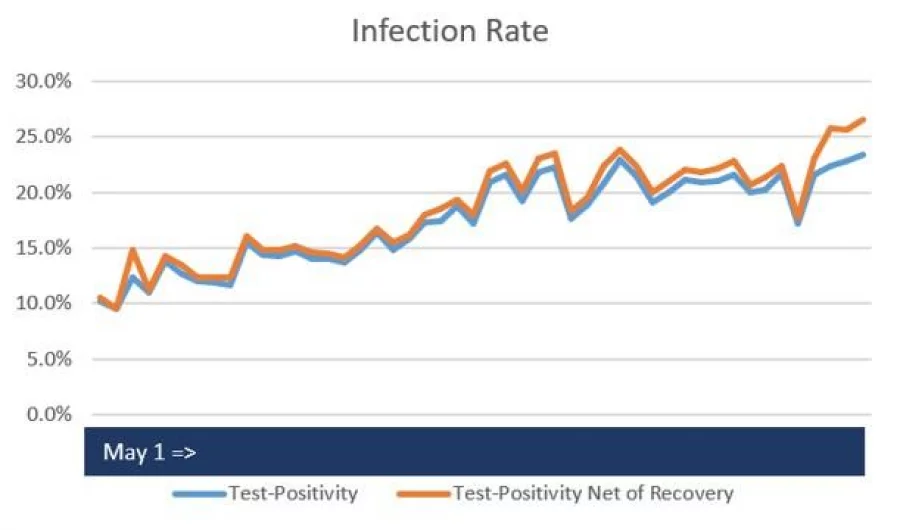
As the graph shows, adjusted for recoveries, test-positivity is considerably higher, especially in the last few days. For example, the reported test-positivity rate on June 18 was 23.4%. However, after netting out the number of recoveries, the rate jumps to 26.6%.
More distressingly, there doesn’t seem to have been any systematic recording of recovered cases. For example, up until June 14, the total number of recovered cases since the pandemic began was 18,370. Yet, the very next day, the recovered number of cases jumped by 15,297. IEDCR did provide an explanation, but it is indicative of poor data recording.
In emergency situations, mistakes can always happen. However, a lack of transparency in how data is being recorded and presented can misguide policy-makers who already have a daunting task on their hands.
Kaiser Kabir is CEO of Renata Limited.
