




Should we continue this lockdown? Well, if you are gullible enough to believe that we're in a lockdown at the moment, then you're also likely to accept that a chocolate chastity-belt is an effective lockdown.
The Sars-Cov-2 virus has little respect for political rhetoric, nor is it interested in respecting behaviours that emanate from an obsequious appreciation of social hierarchy. The virus sees nothing but the plain truth. In this case, it knows that we are not in a lockdown.
So, let's rephrase the question and ask if a lockdown makes a difference?
From the crash-course in epidemiology that many of us have received since January through numerous articles in academic journals, magazines, and newspapers, the following statement is incontrovertible:
When the infection rate is low, social-distancing through lockdowns slows down the transmission of Sars-Cov-2.
Indeed, even imperfect lockdowns seem to work when the infection-rate is low.
Unless you've been raised in the Hamptons, you'd know that social-distancing is difficult in Bangladesh. The large numbers of urban poor live in slums or crowded dormitories. It is impossible to socially-distance in such pitiful dwellings.
Yet, because the infection rate was low, even an imperfect lockdown brought down the test-positivity rate of symptomatic cases from a high of 17.7% to a low of 9.5%.
Then in May, it all went wrong.
The intellectually pretentious and hopelessly confused "Lives versus Livelihoods" debate clouded thinking and dealt a fatal blow to a manageable situation.
At that stage, all we required was a lockdown and program of feeding the needy. Even a back-of-the-envelope calculation showed that the cost of keeping the population well-fed for two months would have cost less than US$2 billion.
But we threw that advantage away because of the pressing needs of insatiable businessmen, political expediency, and fanciful thinking of vacuous professional intellectuals.
We opened up.
Now at an infection rate of well over 20% and rising, the answer to the lockdown question is no longer simple.
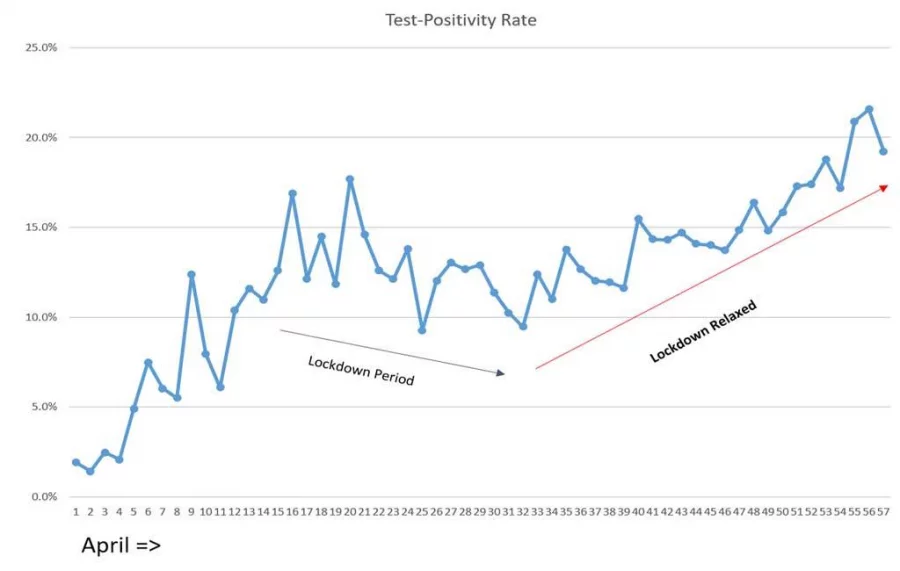
Would imperfect social-distancing work in this case, or are all bets off? This is a question that even the most accomplished epidemiologists would find challenging.
So, instead of pontificating on a question that may not yield satisfactory answers, we could try a combination of two strategies:
(1) Impose a strict 14-day lockdown and see if it makes a difference. If it works, then by all means extend the lockdown, while keeping the population well-fed through actual food or cashtransfers.
(2) Prepare the healthcare system for the worst case scenario.
In essence, the lockdown question deserves an empirical answer.
The second strategy deserves a few words. We all know that the healthcare infrastructure is inadequate to deal with the impending catastrophe.
We also know that it is asking too much of the government to ramp-up healthcare in the next few weeks. Instead, we expect the government to acknowledge its limitations and seek assistance from the wider community.
This means, healthcare has to become decentralized and community-based. Moreover, what should it look like?
Unlike in Europe or the US, our demographics are favourable. In fact, 87% of our population are aged below 50. When Covid-19 strikes, the vast majority of this population shall require only quarantine facilities and primary healthcare
The private sector is eminently qualified to provide make-shift quarantine facilities that also provide basic healthcare. The government should actively encourage such centres in every urban neighbourhood and each village.
Imagine: schools, community centres, warehouses, redundant buildings, etc, converted into healthcare centres, staffed mainly by junior doctors and newly trained nursing staff.
Covid-19 treatment for the 50+, or almost 23 million vulnerable people cannot be done through rudimentary healthcare centres. Such patients require sophisticated ICU facilities that can only be provided through established hospitals in both the public and private sector.
The idea of the rudimentary healthcare centres is to take pressure off existing hospitals. Indeed, taking care of the elderly is going to prove a massive challenge even for established hospitals.
Finally, a word about the government's bugbear -- testing. Testing and isolation is the established way of bypassing lockdowns. Testing reveals the true picture. Yet, we are not against bad news, we are against bad policies. Not allowing widespread testing is a bad policy.
We Bangladeshis are at our best when we reach out to others. The government should bring the best out of us.
Kaiser Kabir is CEO of Renata Limited.
