



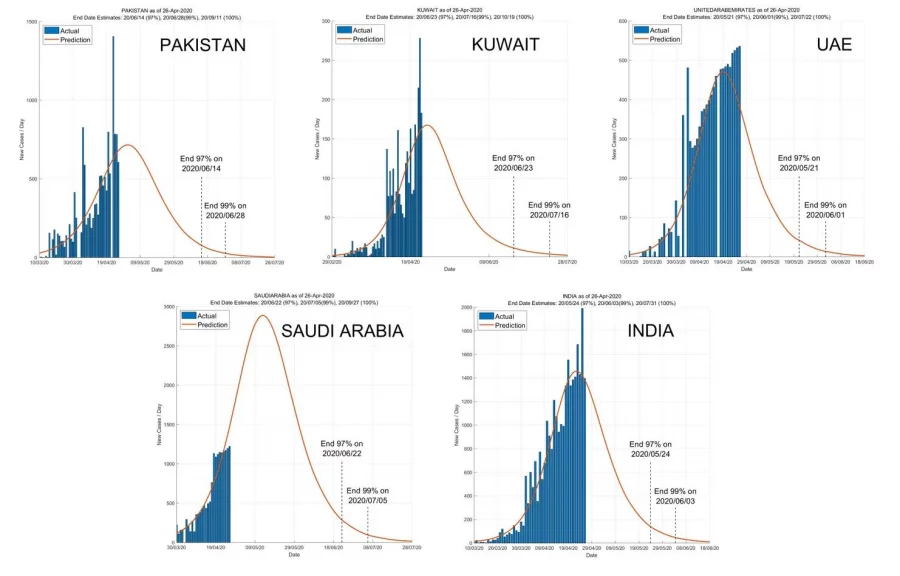
On April 27, several news outlets, including some of the leading newspapers in the country, quoted Singapore University of Technology and Design’s Data-Driven Innovation Lab claiming Covid-19 would end by 97% by May 19, and by 99% by May 30 in Bangladesh.
Ironically, this news spread across social media virally, the same way Covid-19 is spreading across the world. However, anyone with basic knowledge of epidemiology and data science can verify that this research is far from scientifically sound.
Having been a part of a group of experts who are trying model out Covid-19 spread, here are some important facts: The model used by Singapore is a toy model. However, if our policy-makers somehow take wrong idea from this, the outcome could be catastrophic. As everyone is waiting eagerly for good news during this pandemic, it is not wonder that such good news would go viral, but this brings the question of how ethical it is to share such a pre-publication research with no peer review. While the spread rate of Covid-19 slowed down in Bangladesh due to the lockdown, we are far from eradicating it.
Why such models are just toy models
Human interaction is the main vehicle of spreading Covid-19. As a result, for every country so far, we have seen two states: Before lockdown (when everyone is moving freely and the virus is spreading at an alarming rate), during lockdown (when people are not moving much and the spread rate is slower as a result).
The biggest issue with the Singaporean model is that it has no way to account for the change and the difference between these two states, as it is trying to fit a single equation for both cases. Naturally, as it is trying to explain both situations with a single equation, it can appear that the virus has slowed down, but the reality is that we have just entered State b from State a. Now without proper measures taken, if we open up the country pre-maturely, we will just get back to the previous state a -- and this model cannot account for that.
Separately, in the long run, the only way for a country to fully get rid of Covid-19 is either getting to a state when a majority of the population achieves immunity. That can be achieved when 1) the population gets the virus (eg chicken pox) 2) when we can find a vaccine and vaccinate everyone (eg polio).
The main concern has been that if we take out the lockdown too soon, there could be a catastrophic second wave.
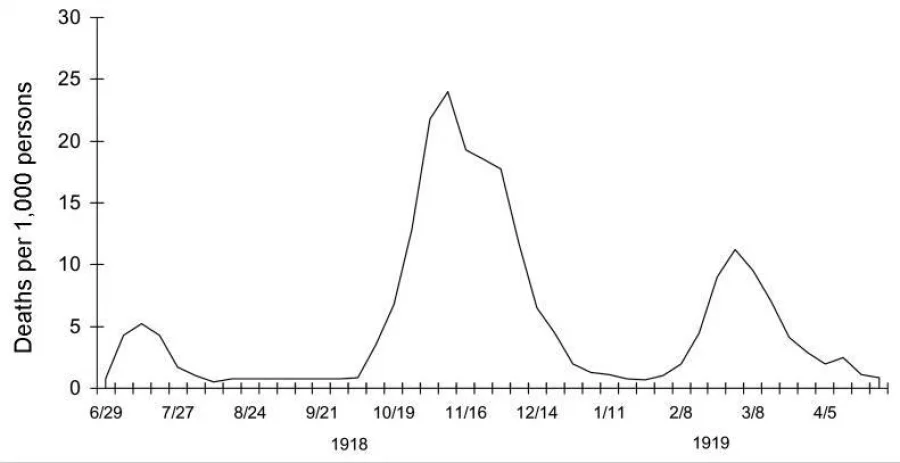
For example, in this graph, we can see that during the 1918 pandemic, more people died during the second wave of the pandemic -- in fact, five times more people died during the second pandemic. Using the toy model of Singapore, it is impossible to model the second wave. As a result, by using such mathematical models, it is not surprising that we would end up with some unscientific results.
Are such research works unethical?
On the website of the Singaporean research (https://ddi.sutd.edu.sg/when-will-covid-19-end), it is mentioned clearly that the model was created “strictly only for educational and research purposes” and that this will not be able to predict the scenario of each countries perfectly. They urge the reader to judge the results and to take this with caution. They also mentioned that over-optimism based on these numbers is outright dangerous.
All that said, during these crazy times, when everyone is confused and when the majority of the consumers of the news have no scientific background to judge, it is straight unethical to publish such results.
In addition, digging slightly deeper, it is clear that this research uses the SIR model, which is an extremely simple pandemic prediction model from 1927. This model fails to take into account the differences in population and their behaviour around the country.
Not only that -- just looking at their published graphs it is clear they tried to fit the results to a single curve without taking into account any of the aforementioned epidemiological considerations. Such research work is not only dangerous, but also unethical at this time.
The reality in Bangladesh: Tests are lacking
Finally, in Bangladesh the number of tests per 100,000 people is one of the lowest around the world. We have so far tested only 38.4 per 100,000 of our population, whereas the number is 2,000 to 3,000 in developed countries. Even disregarding the developed countries, our testing is lacking compared to countries such as India or even Pakistan.  The key metric to understand any infectious disease is the so called R0 number, which signifies how many people get the disease from a single infected person. This is the basic reproduction rate, R0 of the disease.
Through research, we find that in Bangladesh, we started with an R0 higher than 3 and the government has been able to bring it down to 1.1 with their interventions starting in late March. However, before we can start keeping this number strictly below 1, we cannot see that we will end the Covid-19 crisis.
Especially, if we open up the whole country without making sure of proper social distancing measures, we will most likely see a second wave. While we can always hope, this is not the time for our policy-makers to be self-satisfied, and hope is not the right strategy when we have a pandemic at hand.
To sum up, if we cannot follow the footsteps of South Korea or Vietnam and do hundreds of thousands of tests daily, we cannot really prove that we truly are not seeing a surge in our Covid-19 cases. If we fail to take these measures, we might see a devastating second wave after May.
Tarik Adnan Moon is a data scientist and social entrepreneur, and Harvard graduate. Nur Muhammad Shafiullah is an AI researcher and MIT graduate. Adib Hasan and Sanzeed Anwar are researchers and students at MIT.
