




I was recently riffing on an idea often championed by NVIDIA’s Jensen Huang: That the AI revolution represents the production of intelligence. This insight sparked a question: Could we understand all human development as a series of revolutions, each defined by the production of something transformative?
Looking at history through this new lens, I saw a series of turning points in human history, revolutions, if you will, each driven by our ability to produce something that shaped the course of our future.
From the first tools that shaped our environment to the fire that extended our reach, from agriculture that sustained civilizations to industry that mechanized production and data that connected the globe, each revolution fundamentally reshaped how we lived, worked, and connected. Products, whether hammers, plows, or algorithms, were always at the heart of these revolutions that transformed societies and continue to shape our world today.
But where does this story lead us? As we reflect on the revolutions that have shaped humanity, what do they tell us about where we are today and where we might go next?
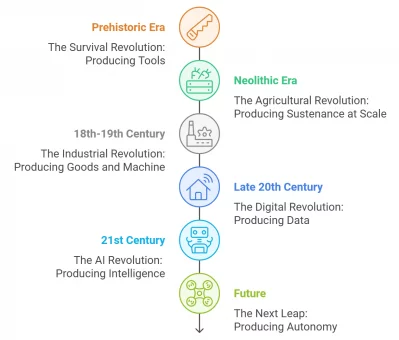
Tools: The survival revolution
Our first revolution was the production of tools. With tools in hand, humanity gained the means to hunt, build, and defend, breaking free from dependence on the whims of nature. For the first time, we started actively shaping our surroundings to meet our needs.
This leap was more than just about survival; tools also brought innovation. They became the foundation for problem-solving and adaptability, enabling us to expand into new territories and pave the way for future revolutions. This was humanity’s first step toward mastering its environment, a trait that continues to define us today.
The agricultural revolution: Sustenance at scale
The next revolution happened thousands of years later when we discovered how to cultivate crops and domesticate animals. More than just providing us with a steady food supply, we ushered in the production of sustenance at scale.
For the first time, communities could grow more than they needed for immediate survival, creating a surplus. This surplus fueled population growth, enabled trade networks, transformed small settlements into thriving cities, and gave birth to civilizations. Agriculture did not just sustain us; it helped us lay the foundations for governance, art, and innovation.
The industrial revolution: Producing goods
The third revolution was the industrial revolution. The 18th century made producing goods at scale, powered by machines, possible, changing how humanity worked and lived. The steam engine drove factories, assembly lines turned previously handcrafted items into mass-produced goods, and railroads connected nations, enabling the movement of products and people like never before.
With the production of goods came the rise of modern economies. Machines replaced manual labour in urbanized societies, driving demand for new workers and creating new industries. This shift accelerated technological development and laid the groundwork for globalization as nations became increasingly interconnected. This revolution did not just improve efficiency; it changed society. The concepts of mass production, consumerism, and global markets, born from this era, continue to shape our lives today.
Each revolution fundamentally reshaped how we lived, worked, and connected
The digital revolution: Producing data
The fourth revolution happened just yesterday. The late 20th century gave us the digital revolution, which was driven by the production of data. Computers and the internet changed how humanity created, stored, and shared information, enabling the generation of data on an unprecedented scale.
The production of data gave rise to entirely new industries, e-commerce, social media, and cloud computing, reshaping economies and daily life. This revolution didn’t just change how we communicated; it changed how we live, learn, and interact with the world. Data became the foundation for innovation and progress, bringing a new age of digital transformation and global interconnectivity. Knowledge became democratized.
The AI revolution: Producing intelligence
And here we are today.
While past revolutions were defined by what humanity learned to produce, whether they be tools, sustenance, goods, or data, today’s revolution has a different flavour. We are not just producing another commodity; we are producing intelligence itself. Machines no longer simply process data; they analyze, learn, and make decisions.
As someone who has watched these systems evolve firsthand, from the rigid logic of rule-based algorithms to the fluid adaptability of neural networks, I find it breathtaking to witness the production of intelligence in action. Machines are moving ever closer to what we once believed was uniquely human: the ability to think, reason, and even create.
The production of intelligence marks a profound shift in human progress. Unlike earlier revolutions centered on physical goods or connectivity, this focuses on replicating the human mind. It challenges our definitions of creativity, decision-making, and what it truly means to be intelligent. By producing intelligence, we’re not just transforming technology; we’re changing how we understand ourselves and our place in the world.
The next revolution: Producing autonomy
What is the next revolution? If intelligence was the great product of this revolution, the next logical step is the production of autonomy: machines that don’t just think but act. This will be a tremendous shift, where technology evolves from assisting humans to operating on its own, making decisions, and taking actions without oversight.
Imagine autonomous agents managing workflows or optimizing supply chains with no human intervention. Picture robots constructing habitats on Mars or deep beneath the ocean, completing tasks far beyond human safety or capability. Imagine a swarm of autonomous drones responding to a wildfire, coordinating their efforts to contain the blaze and protect human lives with a speed and precision no human team could match. In disaster zones, these machines could navigate rubble, locate survivors, and deliver aid with an efficiency that surpasses human capability.
The greatest revolution is not in what we produce but in who we choose to become
Like every revolution before it, autonomy will reshape civilization. It’s not just about having smarter tools; it’s about challenging our understanding of agency, dominion, and control in a world shared with autonomous systems. Autonomy marks the start of a new chapter, one where we share decision-making with our machines.
Speculating on future revolutions
But the story doesn't end here. What uncharted territory lies beyond autonomy? What new production revolution will redefine our world next? I find myself drawn to the future of possibilities, where the next revolution might surpass even our wildest imagination.
One possibility is the production of consciousness. Could machines one day achieve awareness, emotions, or even moral reasoning? Such a leap would blur the line between human and machine, raising questions about identity, agency, and coexistence. What would it mean to share the world with creations that think and feel as we do?
Another could be the production of societal systems where AI governs, educates, and heals. Imagine systems that adapt in real-time to address individual needs, working to create fairer and more accessible solutions than humans have been able to achieve on their own. Could such systems, driven by intelligence rather than human biases, succeed where we have often failed, building societies more just and equitable than any we’ve known?
These potential revolutions aren’t just technological; they challenge us to rethink what it means to innovate responsibly and purposefully. They challenge us to rethink the core of humanity in a world where the horizons of creation and identity continue to expand.
As I reflect on these possibilities, one question remains: Will we actively shape these revolutions to come or passively react to the changes they will bring? Ultimately, the greatest revolution is not in what we produce but in who we choose to become.
Dr Zunaid Kazi is an AI exponent and entrepreneur with 30 years of experience. He is the Founder and CEO of Knowtomation, a company specializing in AI solutions.
