




A young president of the United States -- he was yet to reach the half century mark of his life -- was gunned down on a street in Dallas, Texas, on November 22, 1963. John Fitzgerald Kennedy had been president for a thousand days and was looking forward to winning a second term in office the following year. In Texas, he tried to resolve the differences in the Democratic Party camp, for 1964 was beginning to look like a tough period in politics. And at a personal level, Kennedy hoped that his Republican rival would not be the liberal New York governor Nelson Rockefeller but the arch conservative Arizona senator Barry Goldwater. It would be hard to beat Rockefeller, but it would be relatively easy to demolish Goldwater.
Those bullets fired from the Texas School Book Depository, if the subsequent assumptions are any guide, put paid to Kennedy’s ambitions for a second term. It brought Camelot to a screeching end, that team of what had been termed as the best and the brightest in the sixth decade of the 20th century in America. With men like Arthur Schlesinger Jr, John Kenneth Galbraith, McGeorge Bundy, Kenny O’Donnell, Pierre Salinger and so many others, President Kennedy had around him a team of intellectuals that conveyed a new sense of purpose to Americans. For the world, Kennedy’s arrival in the White House was a harbinger of spring, a break from the bleak weather which had dominated western politics since the end of the Second World War.
All these six decades after the assassination in Dallas, how does one assess the Kennedy presidency? His inauguration in January 1961 was heralded as a New Frontier, one in which America would become a force for public good around the world. Kennedy promised to pay any price, bear any burden, support any friend and oppose any foe in order to assure the survival and success of liberty around the world. But that was a goal which was sabotaged by the Cold War policies of his administration. In his brief period in office, he carried on the work of undermining the Cuban government of Fidel Castro, an act first initiated by the Eisenhower administration, with some of the means employed being aimed at the murder of the Cuban leader. And then there was Vietnam.
Historians as well as political observers have, post-Kennedy, remarked on the possibility of the young president, had he lived, staying away from escalating the conflict in Vietnam. It was escalation his successor Lyndon Johnson was to carry forward with relish. But given the fact that the Kennedy administration dispatched US advisors to South Vietnam to assist the Saigon government, such assumptions do not hold much water. It must be remembered that at one point the White House became disenchanted with the regime headed by President Ngo Dinh Diem, who of course had his brother Ngo Dinh Nhu and his sister-in-law to advise him, wrongly, on policy against the communist Vietcong. The assassinations of Diem and Nhu, two corrupt men, only 21 days before Kennedy’s own murder were a broad hint that had the US president lived, Vietnam would become an albatross around his neck.
Kennedy’s liberalism insofar as internal American politics was concerned remains a prominent feature of his administration. His attempts to do away with segregation, as evident through the confrontation with the racist Alabama governor George Wallace over the admission of a black student in a university, were hints of where he meant to take America on his watch. His speeches, especially those before students at US university campuses, were indicative of the dreams he had begun to fashion for his country. And for the world, his aspirations of transforming the world into a peaceful place were well reflected in his address in Berlin -- and this was nearly two years after the wall had been put up -- where he identified with Germans with his “ich bin ein Berliner” comments.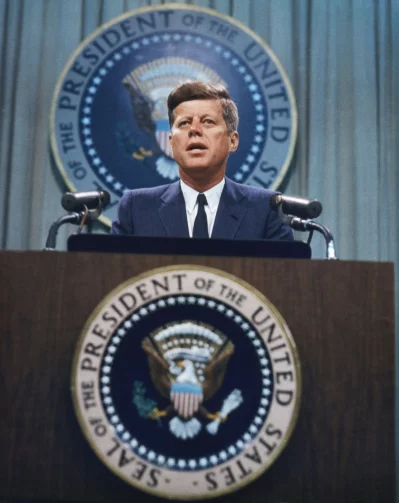
For all the charm he exuded in his country and around the world, how did Kennedy fare in foreign policy? He had Dean Rusk as secretary of state but it was obvious from day one of his presidency that he meant to be the maker and operator of foreign policy. He believed in diplomacy being complemented by military strength if the US meant to be a dominant geopolitical power around the world. It was a policy which ran into problems when Kennedy masterminded the invasion of Cuba within months of his inauguration. The Bay of Pigs invasion by Cuban exiles supported by Washington was a disaster, for Castro’s forces, waiting on the beaches for the exiles, easily and swiftly cut them down. President Kennedy and his administration were left licking their wounds.
Kennedy’s first meeting with Soviet leader Nikita Khrushchev in Vienna went badly, for Khrushchev clearly engaged in a brutal, rustic test of the young American president’s ability to withstand his verbal assaults. The confrontation left Kennedy in a state of shock, giving him the feeling that in his very first confrontation with the leader of the world’s other superpower he had failed to project the America of his aspirations. Vienna tested Kennedy on the global stage. But it also fortified him for the future. When the Cuban missile crisis exploded in October 1962, Kennedy was fully prepared to face Khrushchev eyeball to eyeball. The world teetered on the brink of nuclear war, but Kennedy prevailed. The Soviets blinked and took their missiles back, though after negotiating with the Americans on a withdrawal of their own missiles from Turkey.
There was a dreamer in John Kennedy. The dream came alive in the early days of his administration when he promised to have a man sent to the moon and return to Earth within the decade of the 1960s. The moon program was certainly an integral component of Kennedy’s New Frontier, though he did not live long enough to see American astronauts walk on the moon and return home. When the Apollo-11 astronauts came home from the Sea of Tranquility in 1969, it was his old rival in politics, President Richard Nixon, who welcomed them on behalf of the world. But Kennedy lived long enough to see Alan Shepard and John Glenn go on orbital journeys around Earth, seeing in them America’s future odyssey into outer space.
The brighter side of the Kennedy character aside, there was that streak of nepotism which was manifested in the early days of Camelot. He appointed brother Robert Francis Kennedy the country’s attorney general, telling him before they announced it to the press, “Don’t smile too much or they’ll think we are happy.” For his old Senate seat in Massachusetts, he wanted the young Edward Moore Kennedy to obtain the nomination and take his place in the Senate. He appointed brother-in-law Sargent Shriver director of the newly created Peace Corps.
Kennedy’s reputation where dealing with women is concerned is part of the record. Since his death, reports have emerged, in a long stream, of his liaisons with a number of women, among whom was Marilyn Monroe. He was a compulsive womanizer who did not fail to have young women taking his fancy brought to the White House in the absence of wife Jacqueline. It was a trait that is also said to have been an affliction with his father, reports of whose rape of a well-known Hollywood actress in the 1940s have never been refuted.
President Kennedy was a fast reader, covering a thousand words a minute. His intellectual abilities were revealed early on through his books Why England Slept and Profiles in Courage, the latter his observations of individuals he thought exemplified bravery in politics and life. It is a different matter, though, that Indian Prime Minister Jawaharlal Nehru, on a visit to the United States in 1961, was unimpressed with the range of Kennedy’s intellectual abilities, preferring to focus on his conversation with the beautiful Jackie Kennedy.
In John F Kennedy were the beginnings of a remarkable American political dynasty that 60 years on is a mere shadow of its former self. Brother Robert Kennedy was elected senator from New York in 1964 and then was assassinated as he campaigned for the Democratic Party presidential nomination in 1968. Brother Edward Kennedy ran into his own misfortunes but in the end earned bipartisan respect as the lion of the Senate before dying at a ripe age.
Jacqueline Kennedy married Aristotle Onassis in 1968. It was a marriage that would not last. Edward Kennedy divorced his first wife Jane and married a second time. Victoria Kennedy, Mrs Edward Kennedy II, is today US ambassador to Austria. President Kennedy’s son John Jr lost his life when the light plane he was piloting, with his wife and sister-in-law, crashed in the sea.
Daughter Caroline Kennedy, six years old at the time of her father’s assassination, served as US ambassador to Japan in the Obama administration and is today ambassador to Australia. Joe Kennedy III, grandson of Robert Kennedy, is US special envoy to Northern Ireland in the Biden administration. Meanwhile, Robert Kennedy Jr, son of the murdered senator, vainly seeks the presidency next year as an independent candidate.
To this day, the assassination of John F Kennedy remains a mystery unresolved. The Warren Commission appointed by President Lyndon Johnson was unable to convince people that its report on the murder was credible. Lee Harvey Oswald is often cited as the man who pulled the trigger, but the details that would have been elicited from him ran up against a roadblock when Jack Ruby shot him within days of the Kennedy murder.
President Kennedy’s funeral on November 25, 1963, a cold, bleak day, brought together a large number of leaders and statesmen to Washington. Charles de Gaulle, Eamon de Valera, Prince Philip Duke of Edinburgh, Haile Selassie, King Baudouin, Anastas Mikoyan, Ludwig Erhard, Willy Brandt, Vijaya Lakshmi Pandit, Lester Pearson, Zulfikar Ali Bhutto and a host of others marched in the funeral procession to Arlington.
The young Jacqueline Kennedy lit the Eternal Flame on Kennedy’s grave. It has burned for the past sixty years. And beside Kennedy rest Jacqueline Kennedy, who died in 1994, and their baby who died in infancy only months before his father’s assassination.
Syed Badrul Ahsan is Consultant Editor, Dhaka Tribune.
