




Is London the Moscow of the 1980s? This is how it is perceived in Russia, referring to the years of final decline of the Soviet Union before breaking apart in 1992.
Film-maker Adam Curtis has released TraumaZone, a BBC documentary on Russia between 1985 to 1999. It traces the dying years of the Soviet Union, followed by the implementation by PM Yegor Gaider of extreme capitalist policies (a shock therapy) from 1992 onwards.
This led directly to robber-baron oligarchs' looting industries. Russian society and economy simply fell apart. Health and life expectancy plummeted. Scientists were reduced to begging on the streets.
Curtis notes that "out of this anger, violence, despair and corruption, Putin emerged." He compares that Russian experience to the extreme capitalism of the late Liz Truss (in political terms).
Moscow on the Thames
In both countries, the big idea stemmed from economist Friedrich Hayek (author of The Road to Serfdom). Before one is tempted to put this down to a couple of weird politicians, remind yourself that Russian and Brit lionized Margaret Thatcher, the PM who essentially launched neo-liberal economics in 1979 on an unsuspecting Europe. Thatcher too devoured the writings of Hayek.
While Truss and Kwarteng were outliers, they did not invent this theoretical framework and political economy. They merely wrote “Britannia Unchained,” which in retrospect seems to refer to Fantasy Island. They thought their shock therapy would transform a low productivity UK economy.
A generation of neo-Thatcherite politicians from Blair to Boris Johnson have not fixed anything at all. Something does have to be done. But not this.
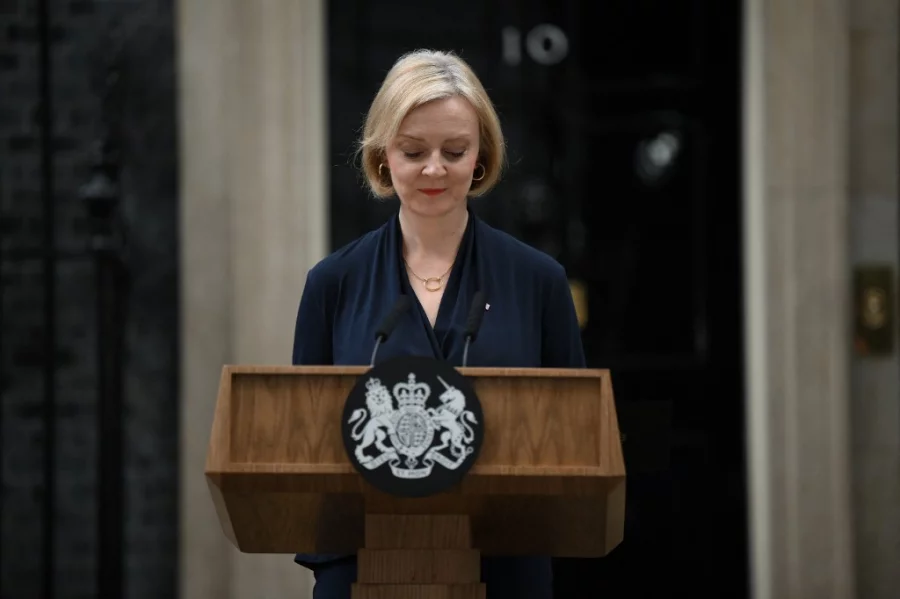 Britain's Prime Minister Liz Truss delivers a speech to announce her resignation outside of 10 Downing Street in central London on October 20, 2022 AFP
Instead, the Truss “dash for growth” almost collapsed the (leveraged derivative laced) pension funds and thus government bonds. After a decade and a half of QE “money printing” (the main thing propping up the Western financial system since 2008), the UK is now a highly vulnerable hyper-financialized economy.
That is not how it will be spun. The defanged New Labour Party has purged all left-wingers. It positions itself as the sensible party. The banks will be safe under its stewardship. The narrative will be that the Tory Party was hijacked by extremists who ruined “the freedoms of Brexit” but normal service will now resume now that the weirdos have been despatched to the wilderness.
Note this is how they rationalized Trump in the US. A blip. An accident. Temporary not permanent. An individual not System Error.
Societies and states mired in stagnation, harking back to past glories, cannot admit that the rot is deep. That it is systemic.
Then and now
In the end, Truss took one a half minutes to announce her resignation, after one and half months in office. The English elite is embarrassed to the core. It feels betrayed and humiliated. Note how quickly it has moved to clean things up. The British establishment is famed for its magnificent staging of royal funerals as we recently witnessed. It does political funerals almost as well.
Unfortunately, there will be no meaningful debate on how to rescue and rebuild a shipwrecked Britain. The forces for independence in Scotland and those advocating a united Ireland can only feel their time has come.
Heavyweight media such as the Financial Times no longer rule out a fracturing of Brexit Britain over the next decade. No one really believes the political system is capable of steering the Kingdom into sunny lands.
 Britain's newly appointed Prime Minister Rishi Sunak waves as he poses outside the door to 10 Downing Street in central London, on October 25, 2022, after delivering his first speech as prime minister AFP
The eighties and nineties were different times. Thatcher deindustrialized Britain, encouraging the multi-nationals to decamp to China . She was smart enough to modify her own extreme road map and effectively turned over a sleepy financial system over to the Americans in the Big Bang. London became the hedge fund capital of Europe. The new global elites (especially Russians) eagerly sent their loot to England and invested in property, companies and even football clubs.
Tony Blair rebranded the show as Cool Britannia, but apart from minor social tinkering continued on the neo=liberal Tory path with gusto. And it looked like a roaring success until the Great Financial Crisis of 2008.
The London riots of 2011 should have provided a clue that under the bonnet things were in a bad shape. But money printing led to a new boom and the London Olympics of 2012 seemed to say that Britannia was still cool.
Around then, Hard Right libertarians and Brexiteers instead saw the need for drastic surgery, hence the project Britannia Unchained. They misread the symptoms and prescribed the wrong operation. The country continues on an unsustainable, unequal path, gorging on low interest rates. Now rates are on the up and the hangover begins.
Which way now?
Beyond the benighted island, we are in the middle of a broader economic conflict acting in parallel to the war in eastern Europe. An Austrian former foreign minister (and energy expert) writes that: "A financialized West has gone to war with a Eurasian Energy World."
This is causing European powerhouses, especially Germany, to buckle. There is ill-disguised panic among both business and ordinary people. There were significant French protests this week. This is only the start. One in seven adults in Britain are skipping meals or going hungry. because of the cash crunch. Strikes are spreading. Some analysts are already saying that the UK is behaving more like an emerging market these days.
Has the English political elite gone all late era Soviet? Recall the early eighties when several leaders came and went. Brezhnev, Andropov, Chernenko. Then Gorbachev and complete collapse. Incidentally, the China of today is a result of their painstaking analysis of Russian mistakes in the 1980s.
Four British prime ministers in quick succession. Cameron, May, Johnson, Truss. This year there will be three in office. Far more pressing is the reconfiguration of a financialized economy into something fit for purpose in the 2030s to 2050.
The economic and political centre of gravity in Eurasia is shifting to the East. Issues are being discussed in Beijing today.
Wise heads understood that, which is why many promoters of Brexit originally envisioned ditching the EU and replacing it several times over with Chinese (and further East Asian) investment and market access.
Angela Merkel also looked east, visiting China ten times as chancellor. No more. All those bridges are burning today.
Brexit gone wrong
Regardless (or perhaps in anticipation) of Brexit, the new big idea was to leave a sclerotic Europe and embrace the globalized world, becoming the destination of massive East Asian investment.
Well, instead British foreign policy, hijacked by Trump (and continuing under Biden) has ensured that China is an enemy (Taiwan and Hong Kong). India is aggrieved after being insulted over immigration by the recent home minister -- ironically of sub-continental origin. The US has declined to pen a trade deal. Russia is now a mortal enemy. No more Londongrad.
This is simply tragic given the stellar strategic sense of the British elite since the 1500s.
Besides this, neo-liberal economics itself has hit the buffers and is set for full scale retreat. It faces an existential crisis, masked by QE for 14 years, but now accelerated by the political and economic response to Russia's invasion of Ukraine.
States are making a comeback. Tech wars are killing globalization. Even capital controls might make a comeback one day.
After its pilot project in Pinochet's fascist Chile, neo-liberalism in the Global North was launched in London. This week it died there. Amid comedic chaos.
The parrot is dead. Long live the parrot.
Farid Erkizia Bakht is a political analyst.
