




Desert Minerals (ASX: DM1) (OTCPK: DMTLF) shares are up 128% on their announcement of an ionic clay rare earth finding. DM1 shares might be worth this sort of change on this find too - the company was only worth $7 million of those bijou Australian dollars before this. But we do also have a larger point to consider here. Which is whether some to all of these ionic clay rare earth finds are worth quite what is assumed. Even, are we going to see the value of hard rock deposits fall too? The essential background to understand here is that rare earths are not, in fact, rare - nor are they earths. There’s a shortage of current miners, sure enough. But the market is pretty small too - a couple of hundred thousand tonnes a year globally. What matters, contrary to the thinking of many, is therefore not any sense of an absolute shortage. It’s who has the best mining opportunity, not that every opportunity has value.
The announcement: “Analysis from recent aircore drilling on the Company’s Dingo Pass license has demonstrated that clay hosted rare earth element (REE) mineralisation extends from the Tower resource (KTA:ASX 21 November 2022) for at least 9km into Desert Metals’ license.” And, well, OK, that’s very nice. But by our count that’s the 13th find of ionic clays hosting rare earths on the Australian stock exchange this year alone. OD6, Victory and so on.
The former belief - up to perhaps two years back - was that these ionic clays existed only in South China and the Burma border. That’s why they dominated the market for dysprosium and terbium, the two heavy magnet rare earths. What we’re now finding out - given that everyone’s gone nuts about rare earths and has now gone looking - is that such ionic clays are commonplace among granites that have weathered in subtropical climes. The deposits, that is, simply are not rare. Things that are not rare do not have a rarity value.
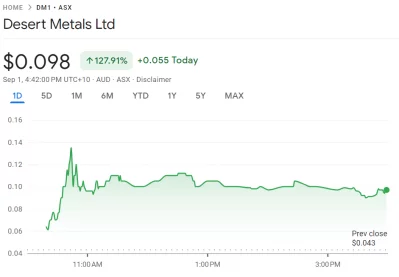
Desert Metals share price from Google Finance
If there’s no rarity value to a rare earths deposit - and our estimation is that the amount found, in rock and clay, is more than enough for likely global usage - then that does change the economics of the business. Sure, there will still be returns made from mining for rare earths. But it will be normal profits - just the usual return upon capital employed. Those with the really juicy deposits will still make excess profits from that rarity. But, well, to be honest with you, given the frequency with which people are discovering these easy to mine, easy to process ionic clays we’re really very unsure that anyone’s going to have a deposit much better than anyone else’s.
